







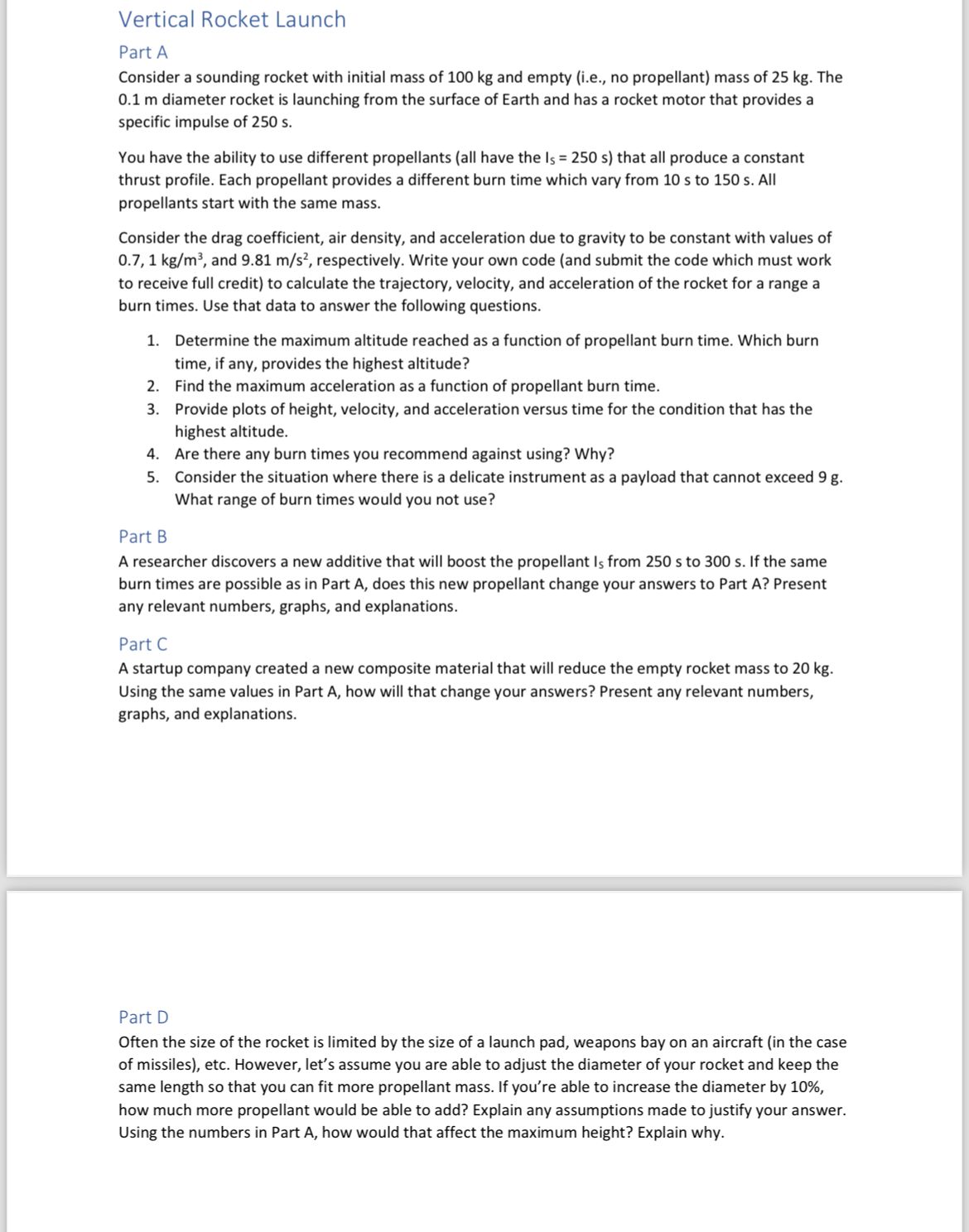
Question: SOLVEVertical Rocket Launch Part A Consider a sounding rocket with initial mass of 1 0 0 kg and empty ( i . e . ,
SOLVEVertical Rocket Launch
Part A
Consider a sounding rocket with initial mass of kg and empty ie no propellant mass of kg The
m diameter rocket is launching from the surface of Earth and has a rocket motor that provides a
specific impulse of s
You have the ability to use different propellants all have the that all produce a constant
thrust profile. Each propellant provides a different burn time which vary from s to s All
propellants start with the same mass.
Consider the drag coefficient, air density, and acceleration due to gravity to be constant with values of
and respectively. Write your own code and submit the code which must work
to receive full credit to calculate the trajectory, velocity, and acceleration of the rocket for a range a
burn times. Use that data to answer the following questions.
Determine the maximum altitude reached as a function of propellant burn time. Which burn
time, if any, provides the highest altitude?
Find the maximum acceleration as a function of propellant burn time.
Provide plots of height, velocity, and acceleration versus time for the condition that has the
highest altitude.
Are there any burn times you recommend against using? Why?
Consider the situation where there is a delicate instrument as a payload that cannot exceed g
What range of burn times would you not use?
Part B
A researcher discovers a new additive that will boost the propellant from s to s If the same
burn times are possible as in Part A does this new propellant change your answers to Part A Present
any relevant numbers, graphs, and explanations.
Part C
A startup company created a new composite material that will reduce the empty rocket mass to kg
Using the same values in Part A how will that change your answers? Present any relevant numbers,
graphs, and explanations.
Part D
Often the size of the rocket is limited by the size of a launch pad, weapons bay on an aircraft in the case
of missiles etc. However, let's assume you are able to adjust the diameter of your rocket and keep the
same length so that you can fit more propellant mass. If you're able to increase the diameter by
how much more propellant would be able to add? Explain any assumptions made to justify your answer.
Using the numbers in Part A how would that affect the maximum height? Explain why.
Step by Step Solution
There are 3 Steps involved in it
1 Expert Approved Answer
Step: 1 Unlock

Question Has Been Solved by an Expert!
Get step-by-step solutions from verified subject matter experts
Step: 2 Unlock
Step: 3 Unlock
 Study Help