







Question: solving (b) and (c) using matlab So i want the code of this answer 150 2.43. One of the important properties of convolution, in both
solving (b) and (c) using matlab So i want the code of this answer
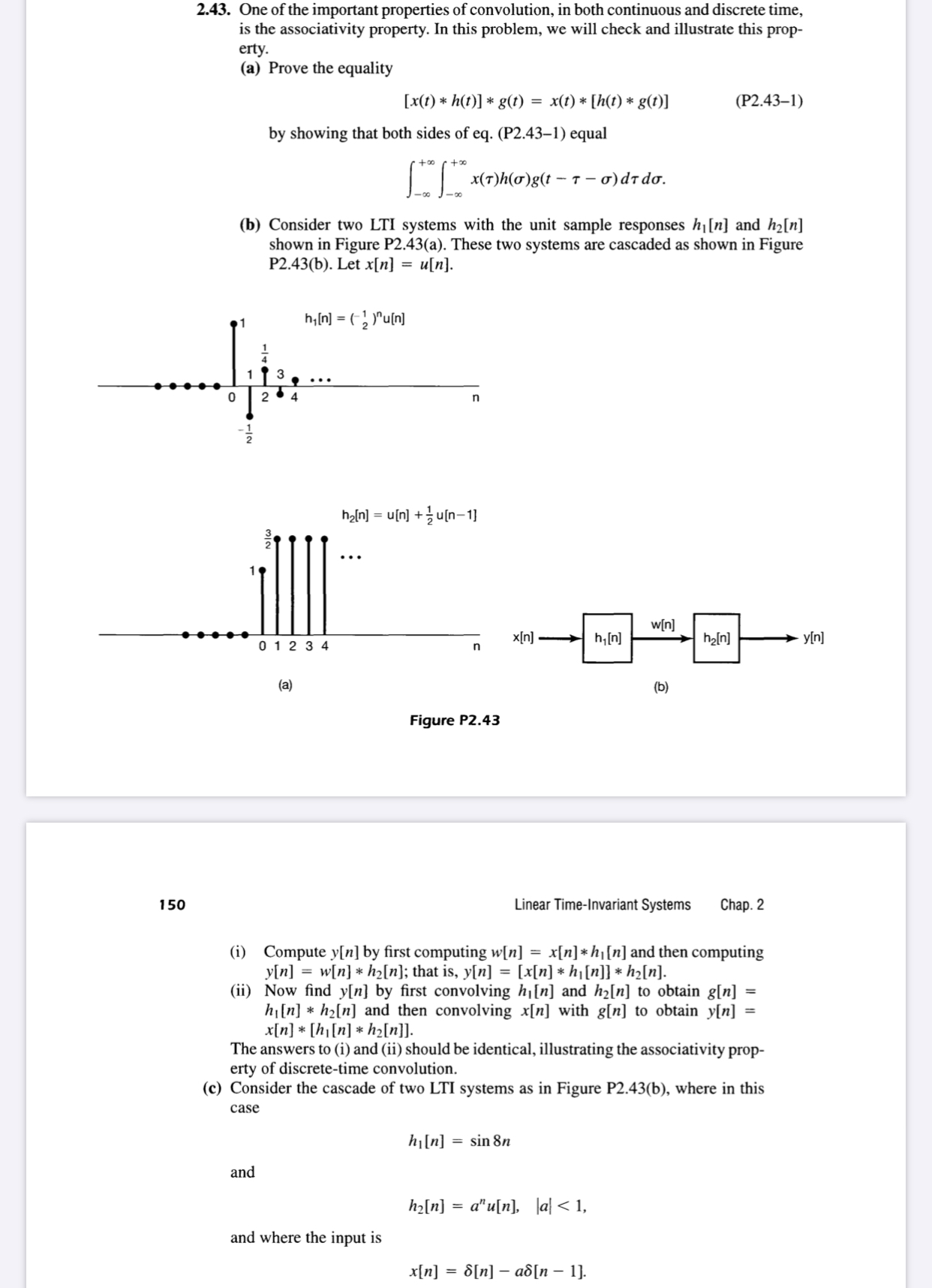
150 2.43. One of the important properties of convolution, in both continuous and discrete time, is the associativity property. In this problem, we will check and illustrate this prop- erty. (a) Prove the equality 0 1 51- by showing that both sides of eq. (P2.43-1) equal (b) Consider two LTI systems with the unit sample responses h [n] and h[n] shown in Figure P2.43(a). These two systems are cascaded as shown in Figure P2.43(b). Let x[n] = u[n]. and 2 3 4 01234 (a) [x(t) * h(t)] * g(t) = x(t) * [h(t) * g(t)] h [n] = (-)^u[n] : +00 + | | x()ho)g(t + )d+da. -00 h[n] =u[n] +u[n-1] and where the input is Figure P2.43 n h[n] h [n] = sin 8n x[n] n = = x[n] h [n] (i) Compute y[n] by first computing w[n] = x[n] *h [n] and then computing y[n] = w[n] * h[n]; that is, y[n] = [x[n] * h[n]] * h[n]. (ii) Now find y[n] by first convolving h [n] and h[n] to obtain g[n] h [n] *h[n] and then convolving x[n] with_g[n] to obtain y[n] = x[n] * [h [n] * h[n]]. The answers to (i) and (ii) should be identical, illustrating the associativity prop- erty of discrete-time convolution. (c) Consider the cascade of two LTI systems as in Figure P2.43(b), where in this case w[n] Linear Time-Invariant Systems au[n], |a|
Step by Step Solution
There are 3 Steps involved in it

Get step-by-step solutions from verified subject matter experts
 Study Help