





Question: Solving the Problem for Shipment and Network Suppose we have a product (possibly masks, possibly shields, possibly containers of hand sanitiser) that we wish to
Solving the Problem for Shipment and Network

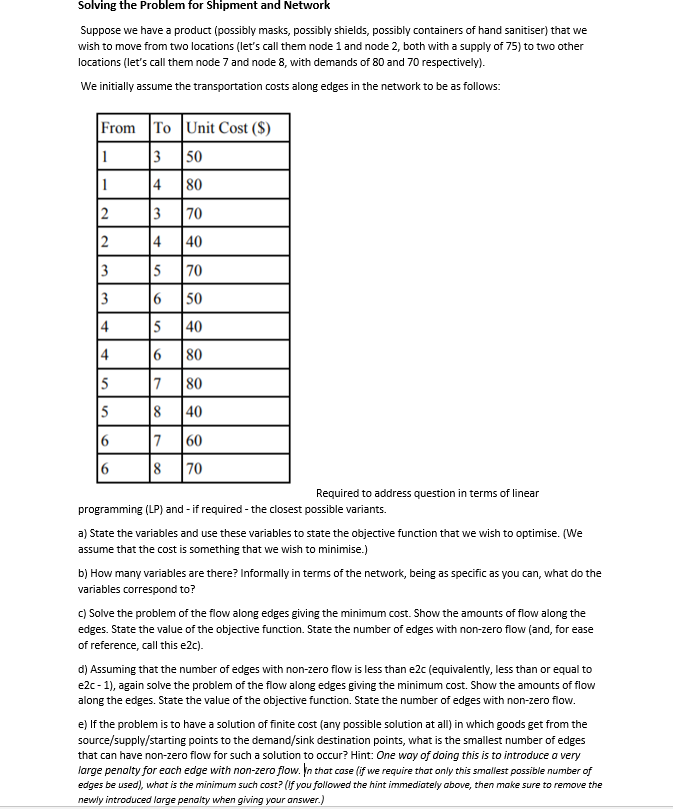
Solving the Problem for Shipment and Network Suppose we have a product (possibly masks, possibly shields, possibly containers of hand sanitiser) that we wish to move from two locations (let's call them node 1 and node 2, both with a supply of 75) to two other locations (let's call them node 7 and node 8, with demands of 80 and 70 respectively). We initially assume the transportation costs along edges in the network to be as follows: From To Unit Cost ($) 1 13 1 4 80 50 3 70 2 2 4 40 70 3 3 15 16 50 4 15 6 40 80 4 5 7 80 15 8 40 6 7 60 6 8 70 Required to address question in terms of linear programming (LP) and - if required - the closest possible variants. a) State the variables and use these variables to state the objective function that we wish to optimise. (We assume that the cost is something that we wish to minimise.) b) How many variables are there? Informally in terms of the network, being as specific as you can, what do the variables correspond to? c) Solve the problem of the flow along edges giving the minimum cost. Show the amounts of flow along the edges. State the value of the objective function. State the number of edges with non-zero flow (and, for ease of reference, call this e2c). d) Assuming that the number of edges with non-zero flow is less than e2c (equivalently, less than or equal to e2c-1), again solve the problem of the flow along edges giving the minimum cost. Show the amounts of flow along the edges. State the value of the objective function. State the number of edges with non-zero flow. e) If the problem is to have a solution of finite cost any possible solution at all) in which goods get from the source/supply/starting points to the demand/sink destination points, what is the smallest number of edges that can have non-zero flow for such a solution to occur? Hint: One way of doing this is to introduce a very large penalty for each edge with non-zero flow. In that cose (if we require that only this smallest possible number of edges be used), who is the minimum such cost? (if you followed the hint immediately above, then make sure to remove the newly introduced large penalty when giving your answer.)

Step by Step Solution

There are 3 Steps involved in it

1 Expert Approved Answer
Step: 1 Unlock blur-text-image

Question Has Been Solved by an Expert!

Get step-by-step solutions from verified subject matter experts

Step: 2 Unlock
Step: 3 Unlock

Students Have Also Explored These Related General Management Questions!