







Question: sorry, its only clear on the image. An engineer is designing a heat exchanger that consists of a tank containing a liquid that is to
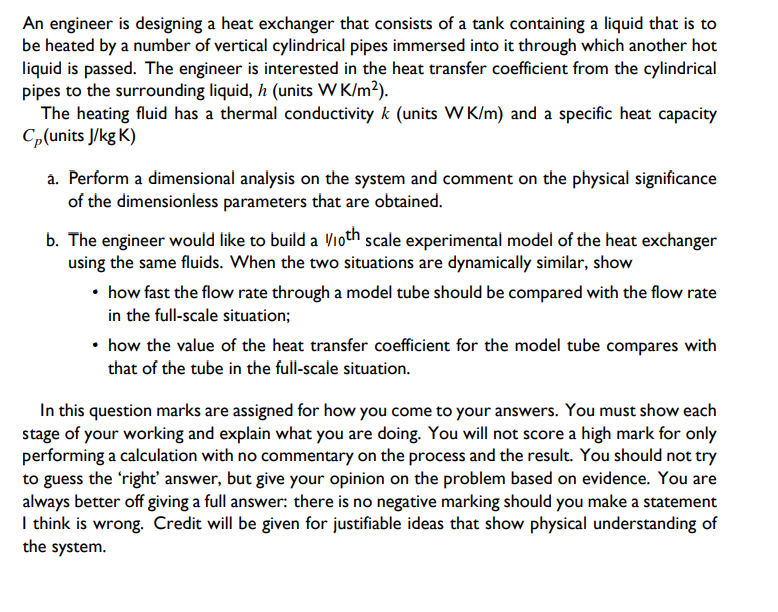
sorry, its only clear on the image. An engineer is designing a heat exchanger that consists of a tank containing a liquid that is to be heated by a number of vertical cylindrical pipes immersed into it through which another hot liquid is passed. The engineer is interested in the heat transfer coefficient from the cylindrical pipes to the surrounding liquid, h units mathrmWKmathrmm
The heating fluid has a thermal conductivity k units mathrmWKmathrmm and a specific heat capacity Cpunits Jkg K
a Perform a dimensional analysis on the system and comment on the physical significance of the dimensionless parameters that are obtained.
b The engineer would like to build a text th scale experimental model of the heat exchanger using the same fluids. When the two situations are dynamically similar, show
how fast the flow rate through a model tube should be compared with the flow rate in the fullscale situation;
how the value of the heat transfer coefficient for the model tube compares with that of the tube in the fullscale situation.
In this question marks are assigned for how you come to your answers. You must show each stage of your working and explain what you are doing. You will not score a high mark for only performing a calculation with no commentary on the process and the result. You should not try to guess the 'right' answer, but give your opinion on the problem based on evidence. You are always better off giving a full answer: there is no negative marking should you make a statement I think is wrong. Credit will be given for justifiable ideas that show physical understanding of the system.
Step by Step Solution
There are 3 Steps involved in it
1 Expert Approved Answer
Step: 1 Unlock

Question Has Been Solved by an Expert!
Get step-by-step solutions from verified subject matter experts
Step: 2 Unlock
Step: 3 Unlock
 Study Help