







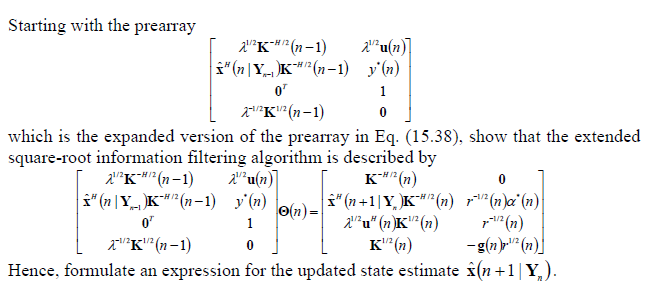
Question: Starting with the prearray [ [ lambda ^ ( ( 1 ) / ( 2 ) ) K ^ ( - ( H )
Starting with the prearray
lambda KHnlambda unhatxHnYnKHnynTlambda Kn
which is the expanded version of the prearray in Eq show that the extended
squareroot information filtering algorithm is described by
lambda KHnlambda unhatxHnYnKHnynTlambda KnTheta nKHnhatxHnYnKHnrnalpha nlambda uHnKnrnKngnrn
Hence, formulate an expression for the updated state estimate hatxnYn
Step by Step Solution
There are 3 Steps involved in it
1 Expert Approved Answer
Step: 1 Unlock

Question Has Been Solved by an Expert!
Get step-by-step solutions from verified subject matter experts
Step: 2 Unlock
Step: 3 Unlock
 Study Help