Question: Stoli vodka case study A stakeholder analysis and an assessment of the issue (if there is one) using the issue management process. Introduction of other
Stoli vodka case study
-
A stakeholder analysis and an assessment of the issue (if there is one) using the issue management process.
-
Introduction of other themes and concepts discussed in class (some relevant themes may be in chapters not yet covered in class) that relate to the case.
-
Application of these themes and concepts to the case. More specifically, how does the case shed light on these class topics?
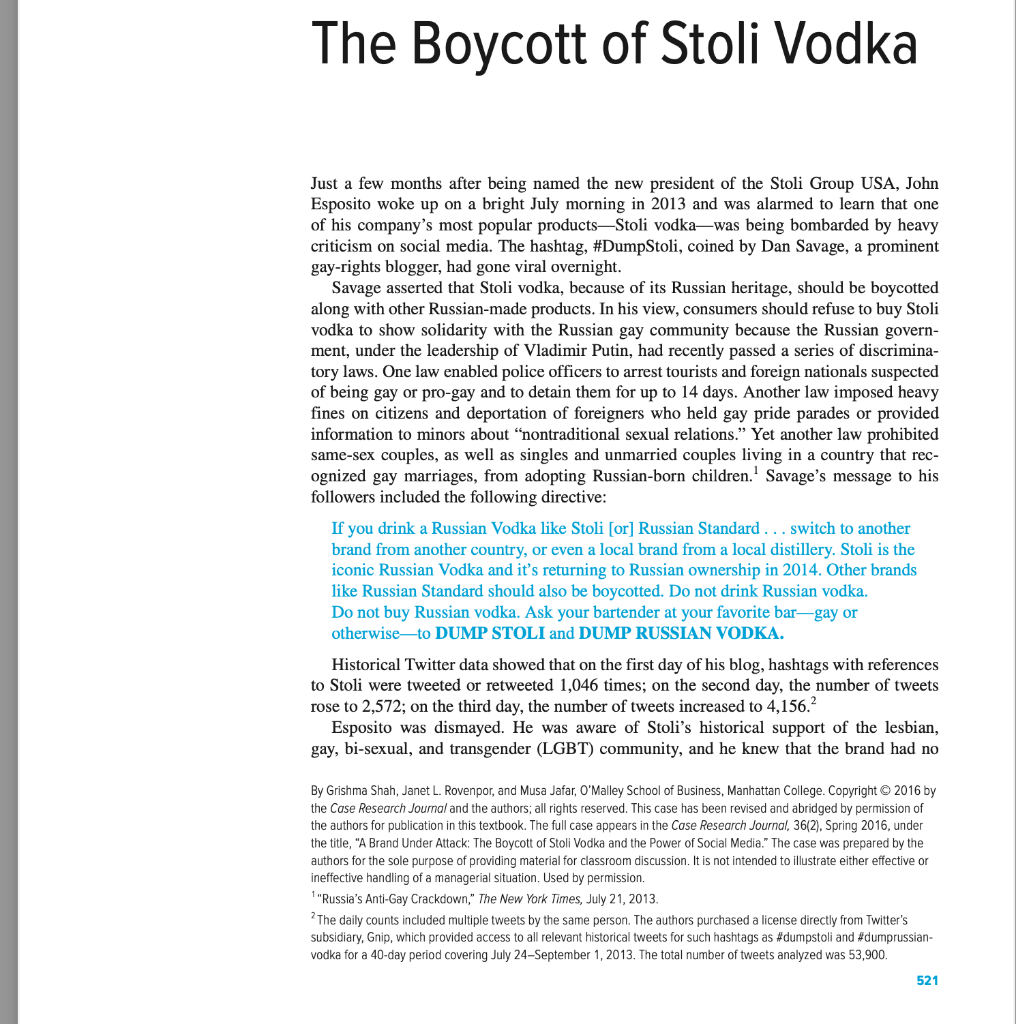
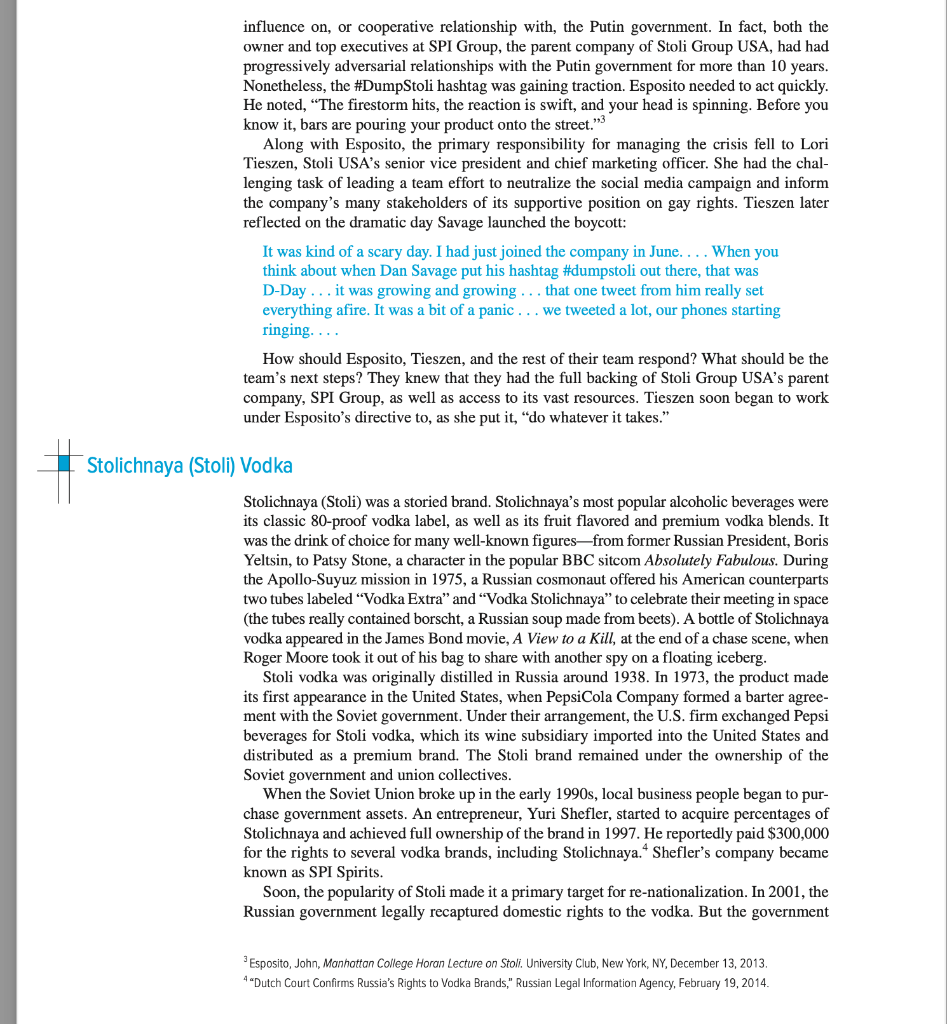
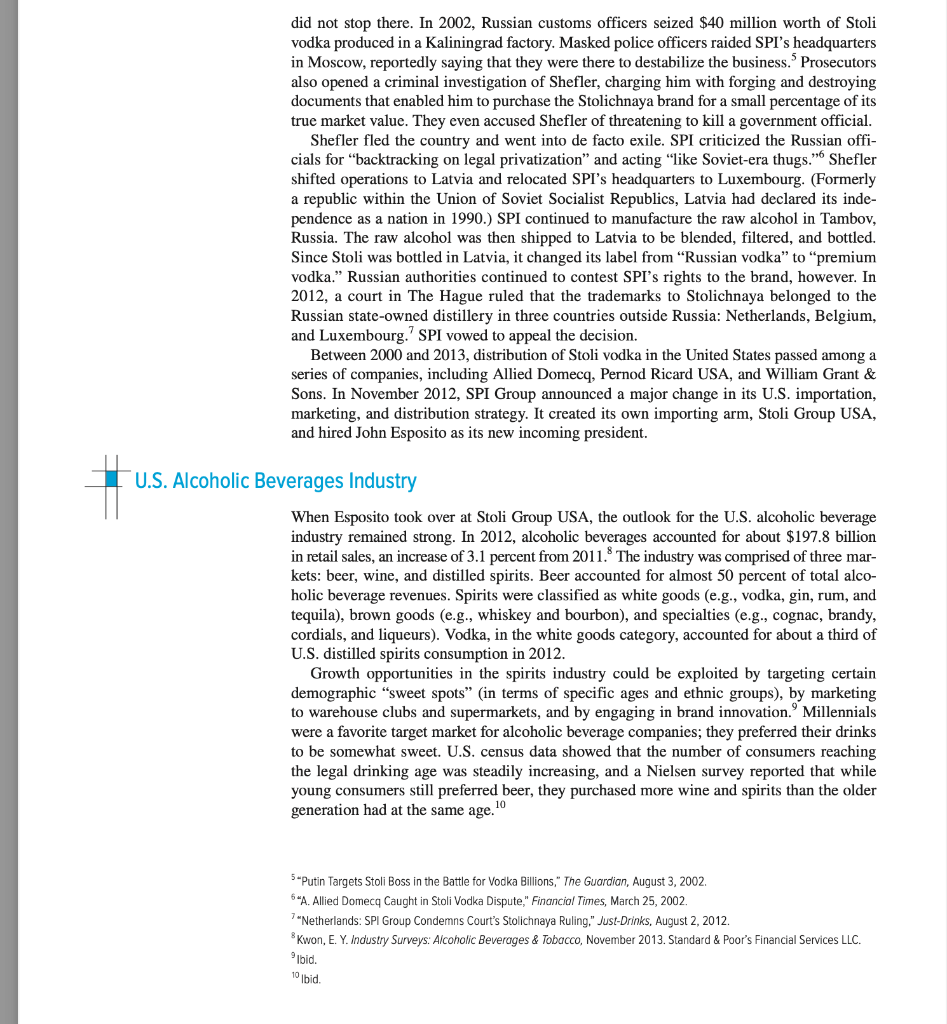
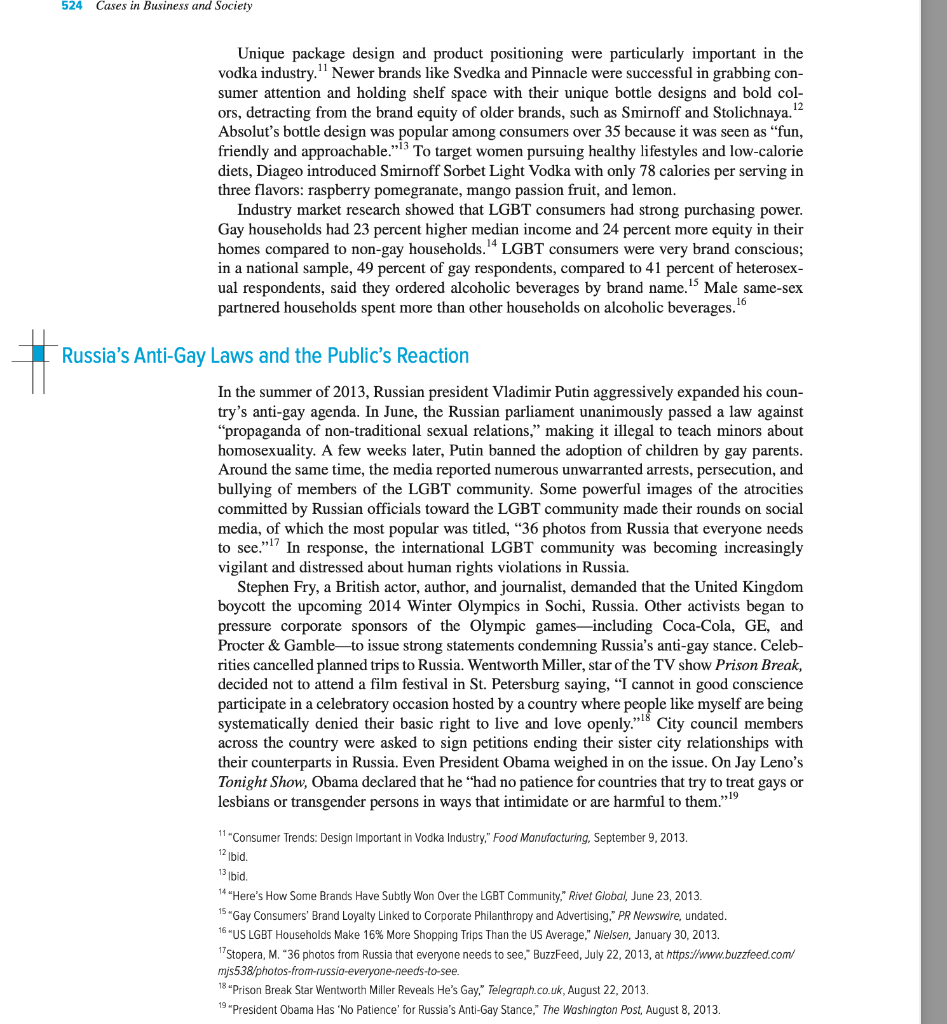
The Boycott of Stoli Vodka Just a few months after being named the new president of the Stoli Group USA, John Esposito woke up on a bright July morning in 2013 and was alarmed to learn that one of his company's most popular productsStoli vodkawas being bombarded by heavy criticism on social media. The hashtag, #DumpStoli, coined by Dan Savage, a prominent gay-rights blogger, had gone viral overnight. Savage asserted that Stoli vodka, because of its Russian heritage, should be boycotted along with other Russian-made products. In his view, consumers should refuse to buy Stoli vodka to show solidarity with the Russian gay community because the Russian govern- ment, under the leadership of Vladimir Putin, had recently passed a series of discrimina- tory laws. One law enabled police officers to arrest tourists and foreign nationals suspected of being gay or pro-gay and to detain them for up to 14 days. Another law imposed heavy fines on citizens and deportation of foreigners who held gay pride parades or provided information to minors about "nontraditional sexual relations." Yet another law prohibited same-sex couples, as well as singles and unmarried couples living in a country that rec- ognized gay marriages, from adopting Russian-born children.' Savage's message to his followers included the following directive: If you drink a Russian Vodka like Stoli [or] Russian Standard ... switch to another brand from another country, or even a local brand from a local distillery. Stoli is the iconic Russian Vodka and it's returning to Russian ownership in 2014. Other brands like Russian Standard should also be boycotted. Do not drink Russian vodka. Do not buy Russian vodka. Ask your bartender at your favorite bar-gay or otherwiseto DUMP STOLI and DUMP RUSSIAN VODKA. Historical Twitter data showed that on the first day of his blog, hashtags with references to Stoli were tweeted or retweeted 1,046 times; on the second day, the number of tweets rose to 2,572; on the third day, the number of tweets increased to 4,156.? Esposito was dismayed. He was aware of Stoli's historical support of the lesbian, gay, bi-sexual, and transgender (LGBT) community, and he knew that the brand had no By Grishma Shah, Janet L. Rovenpor, and Musa Jafar, O'Malley School of Business, Manhattan College. Copyright 2016 by the Case Research Journal and the authors, all rights reserved. This case has been revised and abridged by permission of the authors for publication in this textbook. The full case appears in the Case Research Journal, 36(2), Spring 2016, under the title, "A Brand Under Attack: The Boycott of Stoli Vodka and the Power of Social Media." The case was prepared by the authors for the sole purpose of providing material for classroom discussion. It is not intended to illustrate either effective or ineffective handling of a managerial situation. Used by permission. "Russia's Anti-Gay Crackdown," The New York Times, July 21, 2013. 2 The daily counts included multiple tweets by the same person. The authors purchased a license directly from Twitter's subsidiary, Gnip, which provided access to all relevant historical tweets for such hashtags as #dumpstoli and #dumprussian- vodka for a 40-day period covering July 24-September 1, 2013. The total number of tweets analyzed was 53,900. 521 influence on, or cooperative relationship with, the Putin government. In fact, both the owner and top executives at SPI Group, the parent company of Stoli Group USA, had had progressively adversarial relationships with the Putin government for more than 10 years. Nonetheless, the #DumpStoli hashtag was gaining traction. Esposito needed to act quickly. He noted, The firestorm hits, the reaction is swift, and your head is spinning. Before you know it, bars are pouring your product onto the street."3" Along with Esposito, the primary responsibility for managing the crisis fell to Lori Tieszen, Stoli USA's senior vice president and chief marketing officer. She had the chal- lenging task of leading a team effort to neutralize the social media campaign and inform the company's many stakeholders of its supportive position on gay rights. Tieszen later reflected on the dramatic day Savage launched the boycott: It was kind of a scary day. I had just joined the company in June.... When you think about when Dan Savage put his hashtag #dumpstoli out there, that was D-Day ... it was growing and growing ... that one tweet from him really set everything afire. It was a bit of a panic ... we tweeted a lot, our phones starting ringing.... How should Esposito, Tieszen, and the rest of their team respond? What should be the team's next steps? They knew that they had the full backing of Stoli Group USA's parent company, SPI Group, as well as access to its vast resources. Tieszen soon began to work under Esposito's directive to, as she put it, do whatever it takes." Stolichnaya (Stoli) Vodka Stolichnaya (Stoli) was a storied brand. Stolichnaya's most popular alcoholic beverages were its classic 80-proof vodka label, as well as its fruit flavored and premium vodka blends. It was the drink of choice for many well-known figuresfrom former Russian President, Boris Yeltsin, to Patsy Stone, a character in the popular BBC sitcom Absolutely Fabulous. During the Apollo-Suyuz mission in 1975, a Russian cosmonaut offered his American counterparts two tubes labeled "Vodka Extra" and "Vodka Stolichnaya" to celebrate their meeting in space (the tubes really contained borscht, a Russian soup made from beets). A bottle of Stolichnaya vodka appeared in the James Bond movie, A View to a Kill, at the end of a chase scene, when Roger Moore took it out of his bag to share with another spy on a floating iceberg. Stoli vodka was originally distilled in Russia around 1938. In 1973, the product made its first appearance in the United States, when Pepsi Cola Company formed a barter agree- ment with the Soviet government. Under their arrangement, the U.S. firm exchanged Pepsi beverages for Stoli vodka, which its wine subsidiary imported into the United States and distributed as a premium brand. The Stoli brand remained under the ownership of the Soviet government and union collectives. When the Soviet Union broke up in the early 1990s, local business people began to pur- chase government assets. An entrepreneur, Yuri Shefler, started to acquire percentages of Stolichnaya and achieved full ownership of the brand in 1997. He reportedly paid $300,000 for the rights to several vodka brands, including Stolichnaya. Shefler's company became known as SPI Spirits. Soon, the popularity of Stoli made it a primary target for re-nationalization. In 2001, the Russian government legally recaptured domestic rights to the vodka. But the government * Esposito, John, Manhattan College Horan Lecture on Stoli. University Club, New York, NY, December 13, 2013, 4 "Dutch Court Confirms Russia's Rights to Vodka Brands," Russian Legal Information Agency, February 19, 2014. did not stop there. In 2002, Russian customs officers seized $40 million worth of Stoli vodka produced in a Kaliningrad factory. Masked police officers raided SPI's headquarters in Moscow, reportedly saying that they were there to destabilize the business. Prosecutors also opened a criminal investigation of Shefler, charging him with forging and destroying documents that enabled him to purchase the Stolichnaya brand for a small percentage of its true market value. They even accused Shefler of threatening to kill a government official. Shefler fled the country and went into de facto exile. SPI criticized the Russian offi- cials for "backtracking on legal privatization and acting "like Soviet-era thugs." Shefler shifted operations to Latvia and relocated SPI's headquarters to Luxembourg. (Formerly a republic within the Union of Soviet Socialist Republics, Latvia had declared its inde- pendence as a nation in 1990.) SPI continued to manufacture the raw alcohol in Tambov, Russia. The raw alcohol was then shipped to Latvia to be blended, filtered, and bottled. Since Stoli was bottled in Latvia, it changed its label from "Russian vodka" to "premium vodka." Russian authorities continued to contest SPI's rights to the brand, however. In 2012, a court in The Hague ruled that the trademarks to Stolichnaya belonged to the Russian state-owned distillery in three countries outside Russia: Netherlands, Belgium, and Luxembourg.? SPI vowed to appeal the decision. Between 2000 and 2013, distribution of Stoli vodka in the United States passed among a series of companies, including Allied Domecq, Pernod Ricard USA, and William Grant & Sons. In November 2012, SPI Group announced a major change in its U.S. importation, marketing, and distribution strategy. It created its own importing arm, Stoli Group USA, and hired John Esposito as its new incoming president. U.S. Alcoholic Beverages Industry When Esposito took over at Stoli Group USA, the outlook for the U.S. alcoholic beverage industry remained strong. In 2012, alcoholic beverages accounted for about $197.8 billion in retail sales, an increase of 3.1 percent from 2011. The industry was comprised of three mar- kets: beer, wine, and distilled spirits. Beer accounted for almost 50 percent of total alco- holic beverage revenues. Spirits were classified as white goods (e.g., vodka, gin, rum, and tequila), brown goods (e.g., whiskey and bourbon), and specialties (e.g., cognac, brandy, cordials, and liqueurs). Vodka, in the white goods category, accounted for about a third of U.S. distilled spirits consumption in 2012. Growth opportunities in the spirits industry could be exploited by targeting certain demographic "sweet spots" (in terms of specific ages and ethnic groups), by marketing to warehouse clubs and supermarkets, and by engaging in brand innovation.' Millennials were a favorite target market for alcoholic beverage companies; they preferred their drinks to be somewhat sweet. U.S. census data showed that the number of consumers reaching the legal drinking age was steadily increasing, and a Nielsen survey reported that while young consumers still preferred beer, they purchased more wine and spirits than the older generation had at the same age.10 5-Putin Targets Stoli Boss in the Battle for Vodka Billions," The Guardian, August 3, 2002. 6 "A. Allied Domecq Caught in Stoli Vodka Dispute," Financial Times, March 25, 2002. 7"Netherlands: SPI Group Condemns Court's Stolichnaya Ruling." Just-Drinks, August 2, 2012 Kwon, E. Y. Industry Surveys: Alcoholic Beverages & Tobacco, November 2013. Standard Poor's Financial Services LLC. ibid. 10 lbid. 524 Cases in Business and Society Unique package design and product positioning were particularly important in the vodka industry." Newer brands like Svedka and Pinnacle were successful in grabbing con- sumer attention and holding shelf space with their unique bottle designs and bold col- ors, detracting from the brand equity of older brands, such as Smirnoff and Stolichnaya." Absolut's bottle design was popular among consumers over 35 because was seen as "fun, friendly and approachable."13 To target women pursuing healthy lifestyles and low-calorie diets, Diageo introduced Smirnoff Sorbet Light Vodka with only 78 calories per serving in three flavors: raspberry pomegranate, mango passion fruit, and lemon. Industry market research showed that LGBT consumers had strong purchasing power. Gay households had 23 percent higher median income and 24 percent more equity in their homes compared to non-gay households."* LGBT consumers were very brand conscious; in a national sample, 49 percent of gay respondents, compared to 41 percent of heterosex- ual respondents, said they ordered alcoholic beverages by brand name. Male same-sex partnered households spent more than other households on alcoholic beverages. 16 Russia's Anti-Gay Laws and the Public's Reaction In the summer of 2013, Russian president Vladimir Putin aggressively expanded his coun- try's anti-gay agenda. In June, the Russian parliament unanimously passed a law against "propaganda of non-traditional sexual relations," making it illegal to teach minors about homosexuality. A few weeks later, Putin banned the adoption of children by gay parents. Around the same time, the media reported numerous unwarranted arrests, persecution, and bullying of members of the LGBT community. Some powerful images of the atrocities committed by Russian officials toward the LGBT community made their rounds on social media, of which the most popular was titled, 36 photos from Russia that everyone needs to see."!? In response, the international LGBT community was becoming increasingly vigilant and distressed about human rights violations in Russia. Stephen Fry, a British actor, author, and journalist, demanded that the United Kingdom boycott the upcoming 2014 Winter Olympics in Sochi, Russia. Other activists began to pressure corporate sponsors of the Olympic gamesincluding Coca-Cola, GE, and Procter & Gambleto issue strong statements condemning Russia's anti-gay stance. Celeb- rities cancelled planned trips to Russia. Wentworth Miller, star of the TV show Prison Break, decided not to attend a film festival in St. Petersburg saying, I cannot in good conscience participate in a celebratory occasion hosted by a country where people like myself are being systematically denied their basic right to live and love openly":18 City council members across the country were asked to sign petitions ending their sister city relationships with their counterparts in Russia. Even President Obama weighed in on the issue. On Jay Leno's Tonight Show, Obama declared that he had no patience for countries that try to treat gays or lesbians or transgender persons in ways that intimidate or are harmful to them."19 11 "Consumer Trends: Design Important in Vodka Industry," Food Manufacturing, September 9, 2013. 12 lbid. 13 ibid. 14 "Here's How Some Brands Have Subtly Won Over the LGBT Community," Rivet Global, June 23, 2013. 15 "Gay Consumers' Brand Loyalty Linked to Corporate Philanthropy and Advertising." PR Newswire, undated. 18 US LGBT Households Make 16% More Shopping Trips Than the US Average," Nielsen, January 30, 2013. 17 Stopera, M. "36 photos from Russia that everyone needs to see." BuzzFeed, July 22, 2013, at https://www.buzzfeed.com/ mjs538/photos-from-russio-everyone needs-to-see. 18 "Prison Break Star Wentworth Miller Reveals He's Gay," Telegraph.co.uk, August 22, 2013, 19"President Obama Has 'No Patience' for Russia's Anti-Gay Stance." The Washington Post, August 8, 2013 526 Cases in Business and Society Many employees working in Stoli's Riga production facility, along with members of the small LGBT community in Latvia, expressed their deep concern over the boycott. They feared that gays might face the anger of their neighbors. If the boycott works, Latvians will lose their jobs, who are they going to blame? Putin? No, they are going to blame gays.26 While discrimination against gays was banned in Latvia (since it was a member of the European Union), de facto discrimination was rampant, and the LGBT community often faced verbal and physical abuse. Mr. Zalitis, an advocate for gay rights in Latvia, wrote an open letter requesting that the Americans behind the vodka boycott reconsider, but Queer Nation, a New York City based LGBT group, refused. 27 ACT UP, an HIV-awareness and activist group, supported the boycott. It sent protestors to disrupt Stoli Vodka's "Most Original Stoli Guy" event at the Splash Bar in the Chelsea section of New York City. The event involved a competition between 13 contestants from around the country who were vying to become Stoli's national LGBT ambassador. The activists entered the bar and positioned themselves in front of an audience of 150 partic- ipants (including Stoli executives), shouting and holding signs that read, Russia Kills Gays," "Boycott Russia," and "Dump Stoli. They were removed from the club. Activists from ACT UP and Queer Nation also disrupted the competition's finale held at the Mar- quee NY on September 19. Stoli Group USA was not deterred. The company stayed the course and continued its marketing campaign and other scheduled events. The SP and Stoli Group USA Response In mid-June, executives at SPI and Stoli Group USA received forewarning that a threat to its brand might be brewing. Stoli's public relations firm, the Magrino Agency, detected a meme on Facebook asking people to boycott Stolichnaya, especially in gay bars. A few days later, the firms' LGBT media partner, Gay Cities, began to see negative comments about the "Stoli Guy" on Twitter. The owner of a Seattle bar sent an e-mail to Stoli sales- people asking them why they were promoting the brand when Russia had just "outlawed homosexuality."28 Stoli took a "wait and see" approach and vowed to take quick action should the situation escalate. Executives began to work on a statement, which would be released if they got a call from a mainstream media outlet or a well-respected LGBT site. The catalyst for immediate action was Dan Savage's blog and hashtag. Val Mendeleev, CEO of the SPI Group (Stoli USA's parent organization), published an open letter to the LGBT community just one day after Savage posted the hashtag. In it, he acknowledged that Stoli vodka included some Russian ingredients (wheat, rye, and raw alcohol) but was distilled, blended, and bottled at its facility in Riga, Latvia. Mendeleev also highlighted the strained relationships with the Putin government, saying, The Russian government has no ownership interest or control over the Stoli brand that is privately owned by SPI Group, headquartered in Luxembourg in the heart of Western Europe." Moreover, Mendeleev noted, Stoli had been a longtime supporter of the LGBT com- munity. As he pointed out in his letter, In the US, the brand's commitment to the LGBT community has been ongoing for years. Among the best examples, I can cite the series produced by Stoli in 2006 called 'Be Real: Stories from Queer America,' which featured 26 lbid. 27K. Zalitis, "Letter to Latvian LGBT Activists," August 1, 2013, at http://queernationny.org/post/57204296175/ letter-to-latvian-lgbt-activists. 28 Stoli USA e-mail dated June 18, 2013 29 Stoli Responds to LGBT Boycott of Russian Products" Advocate, July 25, 2013 Case 9 The Boycott of Stoli Vodka 527 short documentaries on real life stories depicting the challenges and accomplishments of the LGBT community in the United States." In addition to his open letter, Mendeleev travelled to the United States, appeared on radio shows, and granted interviews to the press. He described himself as an "ex-Russian" who had left the country 20 years earlier. He reiterated that SPI Group was not allowed to sell its brand inside Russia and that it had been reducing its workforce and operations in that country. In a New York Times article, he stated, "Stolichnaya ... is no more a proxy for the Russian state than Google, whose co-founder Sergey Brin was born in Moscow."31 Stoli Group USA president Esposito said, "Hurting Stoli in the U.S. is actually probably going to make the Russian government happy, given that they've been fighting us for the last 13 years. They're probably going to be sitting there chuckling."*2 Back at Stoli Group USA, Esposito reached out with an e-mail to the firm's business partners (distributors, bartenders, and retailers). In it, he wrote: As you are probably aware the attitudes and actions of the Russian Government against the LGBT had understandably ignited a passionate response from all of us who believe in human rights for all.... In an attempt to call attention to the situa- tion in Russia, which we fully agree is outrageous, boycotting Stoli, is being singled out as a way to express outrage. While I understand this reaction, I want to set the record straight and ask that each of you share with your organizations Stoli's posi- tion and reinforce our longstanding support of the LGBT community. Despite Stoli's early efforts to appease its critics, Savage and others in the LGBT com- munity continued to push the boycott in the United States. The hashtag gained followers. On their end, Stoli's marketing and public relations employees, led by Tieszen, were busy monitoring all news media channels. They received and evaluated analytics daily to shed light on both the level of activity and the sentiment of the reporters who were reflecting and com- menting on the Dump Stoli message. One of the marketing department's conclusions was that activity on Twitter was more intense than on Facebook. A tracking of the daily tweets across time showed that social media activity was most intense during the first 15 days of the crisis. John Esposito joined Tieszen in community outreach activities. As Tieszen recalled: He did not want to just send out press releases. ... John personally talked to key accounts. He actually tried to get Dan Savage on the phone (who would not talk to him). We attended meetings and we attended some town hall meetings ... we got to the open forum and we got to the check-in and they knew who we were. It was like we were on a most-wanted list. And they said, 'Well, you can attend but you can't speak.' We attended, we listened. Esposito added: Our initial reaction was to come to the defense of our brand. People were attacking our brand, hurting our family. The team in our global home office was focused on the WORDS. Our initial response was to get the facts straight ... but in the end, this was the wrong response. It was time for Esposito and Tieszen to intensify their activities. They were faced with the difficult task of challenging what they believed was an unwarranted boycott in the age of social media. What more should they do? 20 "Val Mendeleev,Stoli CEO, Speaks Out on Gay Community's Vodka Boycott," Huffington Post, July 31, 2013. 31"Facing Fury," op. cit









 Study Help