







Question: Student are required to write an ARTICLE REVIEW based on the article given. 1 of 2 System 0201 44129 007/s10916-020015956 TIEND LEVEL QUALITY IMPROVEMENT Check
Student are required to write an ARTICLE REVIEW based on the article given.
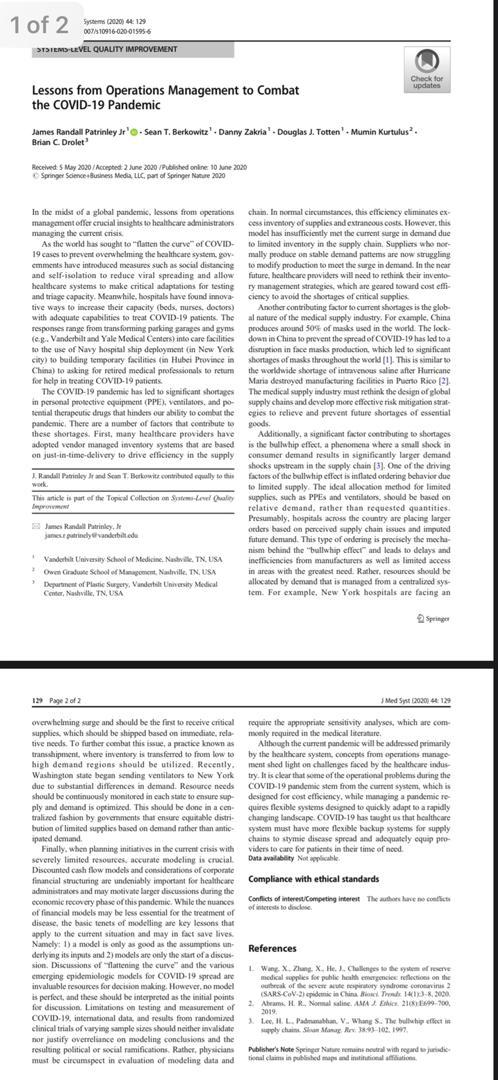
1 of 2 System 0201 44129 007/s10916-020015956 TIEND LEVEL QUALITY IMPROVEMENT Check for updates Lessons from Operations Management to Combat the COVID-19 Pandemic James Randall Patrinley Jr'. Sean T. Berkowitz'. Danny Zakria'. Douglas). Totten. Mumin Kurtulus. - . . Brian C. Drolet Received May 2020 /Accepted 2 June 2020 /Published online: 10 un 2020 Springer Science Business Media LLC. part of Springer Nature 2020 In the midst of a global pandemic lessons from operations Cham. In normal circumstances, this efficiency eliminates ex management offer crucial insights to healthcare administrators coss inventory of supplies and extraneous costs. However, this managing the current crisis model has insufficiently met the current surge in demand due As the world has sought to "flation the curve of COVID to limited inventory in the supply chain Supplicts who ner 19 cases to prevent overwhelming the healthcare system, gov mally produce un stable demand pattems are now struggling cmments have introduced measures such as social distancing to modify production to meet the surge in demand. In the near and self-isolation to reduce viral spreading and allow future, healthcare providers will need to rethink their invento healthcare systems to make critical adaptations for testing ry management strategies, which are geared toward cost effi and triage capacity. Meanwhile, hospitals have found innova ciency to avoid the shortages of critical supplies tive ways to increase their capacity (beds, nurses, doctors) Another contributing factor to current shortages is the glob with adequate capabilities to treat COVID-19 patients. The al nature of the medical supply industry. For example. China responses range from transforming parking garages and gynis produces around 50% of macks used in the world. The lock (eg. Vanderbilt and Yale Medical Centers into care facilities down in China to prevent the spread of COVID-19 has led to a to the use of Navy hospital ship deployment in New York disruption in face masks production, which led to significant city) to building temporary facilities in Hubei Province in shortages of masks throughout the world (I). This is similar to China) to asking for retired medical professionals to return the worldwide shortage of intravenous saline after Hurricane for help in treating COVID-19 patients Maria destroyed manufacturing facilities in Puerto Rico (2) The COVID-19 pandemic has led to significant shortages The medical supply industry mest rethink the design of global in personal protective equipment (PPE), ventilators and po supply chains and develop more effective risk mitigation strat tential therapeutic drugs that hinders our ability to combat the egies to relieve and prevent future shortages of essential pandemic. There are a number of factors that contribute to goods. these shortages. First, many healthcare providers have Additionally, a significant factor contributing to shortages adopted vendor managed inventory systems that are based is the bullwhip effect a phenomena where a small shock in on just-in-time delivery to drive efficiency in the supply consumer demand results in significantly larger demand shocks upstream in the supply chain (3). One of the driving Randall Painley and Sean Berkowited equally to factors of the bullwhip effect is inflated ordering behavior due to limited supply. The ideal allocation method for limited This article is part of the Topical Collection on Statem-Love Quotes supplies, such as PPES and ventilators, should be based on relative demand, rather than requested quantities Presumably, hospitals across the country are placing larger James Randall Putriny, orders based on perceived supply chain issues and imputed myndbillede future denund. This type of ordering is precisely the mecha nism behind the bullwhip effect and leads to delays and Vanderbilt University School of Medicine Nuse TN, USA inefficiencies from manufacturers as well as limited access Owm Graduate School of Management Nastrille, TN, USA in areas with the greatest need. Rather, resources should be Department of Plastic Surgery, Vundet Unity Medical allocated by demand that is managed from a centralized sys- Center, Nashville, TN, USA tem. For example, New York hospitals are facing an Springer 129 Page 2 of 2 Med Sys202004129 overwhelming surge and should be the first to receive critical require the appropriate sensitivity analyses, which are com supplies, which should be shipped based on immediate, rela monly required in the medical literature tive needs. To further combat this issue, a practice known as Although the current pandemic will be addressed primarily transhipment, where inventory is transferred to from low to by the healthcare systent, concepts from operation manage high demand regions should be utilized. Recently. ment shed light on challenges faced by the healthcare indus Washington state began sending ventilators to New York try. It is clear that some of the operational problems during the due to substantial differences in demand. Resource needs COVID-19 pandemic stem from the current system, which is should be continuously monitored in cach state to ensure sup designed for cost efficiency, while managing a pandemic to ply and demand is optimized. This should be done in a con quires flexible systems designed to quickly adapt to a rapidly tralized fashion by governments that ensure equitable distri changing landscape. COVID-19 has taught us that hculthcare bution of limited supplies based on demand rather than anti system must have more flexible backup systems for supply pated demand chains to styme disease spread and adequately equip pro Finally, when planning initiatives in the current crisis with viders to care for patients in their time of need severely limited resources, accurate modeling is crucial Data availability Not applicable Discounted cash flow models and considerations of corporate financial structuring are undeniably important for healthcare Compliance with ethical standards administrators and many motivate larger descussions during the economic recovery phase of this pandemie. While the ancos conflicts of interest Competing interest The authors have comics of interest to diocese of financial models may be less essential for the treatment of disease, the basic tenets of modelling are key lessons that apply to the current situation and may in fact save lives Namely: 1) a model is only as good as the assumptions References derlying its inputs and 2) models are only the start of a discus sion. Discussions of attening the curve" and the various W X. Zhang, X. He, J. Challenges to the system of reserve emerging epidemiologie models for COVID-19 spread are medical applies for public health emergencies reflections on the invaluable resources for decision making. However, no model bak of every wome.com is perfect, and these should be interpreted as the initial points SARS-CoVape in China The 2000 2. Alam. HR Normalie AMA Ethic. 21699-700 for discussion. Limitations on testing and measurement or 2019 COVID-19 international data, and results from randomized L. L. Padaha. V. Whang S. The bullwhip effect is clinical trials of varying sample sizes should neither invalidate ply chain. San Mag A380-102.1997 nor justify overreliance on modeling conclusions and the resulting political or social ramifications. Rather, physicians Publisher's Note Spring Nature email with regard de must be circumspect in evaluation of modeling data and thaalaimain patathai paal antional talin
Step by Step Solution
There are 3 Steps involved in it
1 Expert Approved Answer
Step: 1 Unlock

Question Has Been Solved by an Expert!
Get step-by-step solutions from verified subject matter experts
Step: 2 Unlock
Step: 3 Unlock
 Study Help