Question: SUBJECT: TRAINING AND DEVELOPMENT a. You are a store manager at Decathlon, and the management has ordered you to conduct a needs assessment to identify
SUBJECT: TRAINING AND DEVELOPMENT
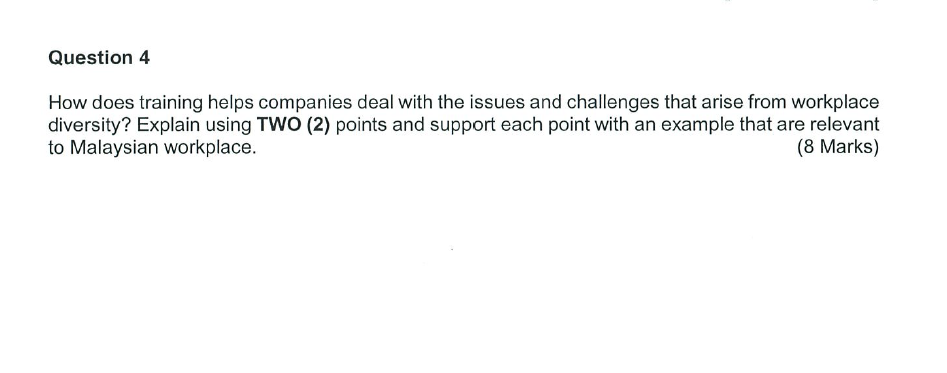
a. You are a store manager at Decathlon, and the management has ordered you to conduct a needs assessment to identify the types of safety knowledge, skills, and attitude that employees must have but still lacking. Explain in detail how you would carry out the following assessments at your store. Support your explanation with relevant examples. i. Task analysis (6 Marks) ii. Person analysis (6 Marks) b. Decathlon is looking for a training approach on safety that (1) can be completed by employees during their work hours without taking them off of the retail floor, (2) appeals to a diverse, multigenerational workforce, and (3) is flexible enough so that it can be customized to address the unique safety challenges that Decathlon stores have. In view of the above, propose TWO (2) training methods that the company can use to train its employee while fulfilling the three requirements above. You must justify why the proposed methods would be most suitable for Decathlon. ( 10 Marks) Pat Rowe, Vice President of University Hospital, recently attended a conference session that discussed the problems of integrating computer technology into the work practices of health care professionals. The session leader argued that implementation often fails because the staff does not receive proper training in the use of the new equipment and software. This seemed plausible to Pat. In the last year, the hospital's senior management team had decided to purchase thousands of dollars of equipment that was supposed to "redesign the delivery of patient care." However, the word was getting around that staff were disgruntled with the new equipment and were not using it. Upon returning to the hospital, Pat called the director of training and development, Wei Lee, to discuss the insights gained at the conference. Pat said to Wei, "I think I know why staff isn't using the computer equipment. They didn't receive adequate training." Wei replied, "I seem to recall that the manufacturer did provide training, but I'm not entirely sure what was included. Do you want me to look into it?" "Yes, that's a good idea. But I still think we need to train the employees. Why don't you get the manufacturer in here to do some more training?" Wei immediately called the computer equipment manufacturer and learned that ten months ago, as part of the implementation process, two design engineers had conducted numerous lectures with unit staff on how to work with the new equipment and software. These sessions were poorly attended and were conducted using a lecture and overhead format. Wei decided that the poor attendance was probably responsible for the problems, and so she asked the manufacturer to rerun the training session. This time, staff would be offered free coffee and doughnuts to encourage attendance. Staff were sent a memo from the training department encouraging them to attend one of the sessions. Unit managers, who were not invited to attend the training, were asked to mention the sessions in staff meetings and highlight the free coffee and doughnuts. Unfortunately, attendance was only marginally better. The new training sessions were again conducted by design engineers, but this time they used a laptop computer hooked up to an overhead projector. This allowed them to walk through the various screens and options of the program with staff in a real-time simulation. At the end of the session, staff were given a manual describing the computer hardware and software. It was suggested to staff that they read the manual on their own time and consult it when they had problems. Walking out of the session, one staff member was heard saying, "Computers scare the heck out of me. I can't possibly learn this stuff. And to top it all off, I don't think anybody really cares if I do use this new system." a. From the perspective of training design, identify and explain TWO (2) weaknesses that can be found in the training carried out by the hospital for its staff. (6 Marks) b. Learning objectives are essential in any training design and development. A good learning objective provide trainees with a clear purpose of what knowledge, skills and attitude that should be acquired and how these will be applicable and evaluated in their job. In this context, write TWO (2) learning objectives that Wei Lee will provide to both the trainer and the staff attending above. (4 Marks) c. Based on learning and transfer of learning principles that have been discussed in class, recommend, and discuss TWO (2) actions that the hospital management can take to improve the training design and ensure that the training achieved its purpose in helping health care professionals integrate computer technology into their work practices. (10 Marks) [Total: 20 Marks] Question 3 Veritas Holding, a large communication company with employee strength of 2,000 nationwide uses the nine-box grid for its succession planning and review. After several rounds of analysis and discussions, the company finally identified several candidates that have the potential to be promoted to managerial level in the next five years. Nevertheless, the management wishes to know a few things before proceeding further: a. Should the company make it known to the managers who they have identified as star performers and thus will be in line for the next round of promotion to C-suite level or should the result be kept a secret? Explain ONE(1) reason for and against such disclosure. (4 Marks) b. Veritas has also discovered several solid and dependable employees that can be promoted but they are lacking certain skills and are not outstanding performers. Suggest TWO(2) development programs that the company can use to advance the career of these employees. (6 Marks) How does training helps companies deal with the issues and challenges that arise from workplace diversity? Explain using TWO (2) points and support each point with an example that are relevant to Malaysian workplace. (8 Marks)









 Study Help