







Question: Successful Software Engineers (SSE) is a small-sized software development house that has been contracted to develop a novel social modelling software (SocMol). SSE has
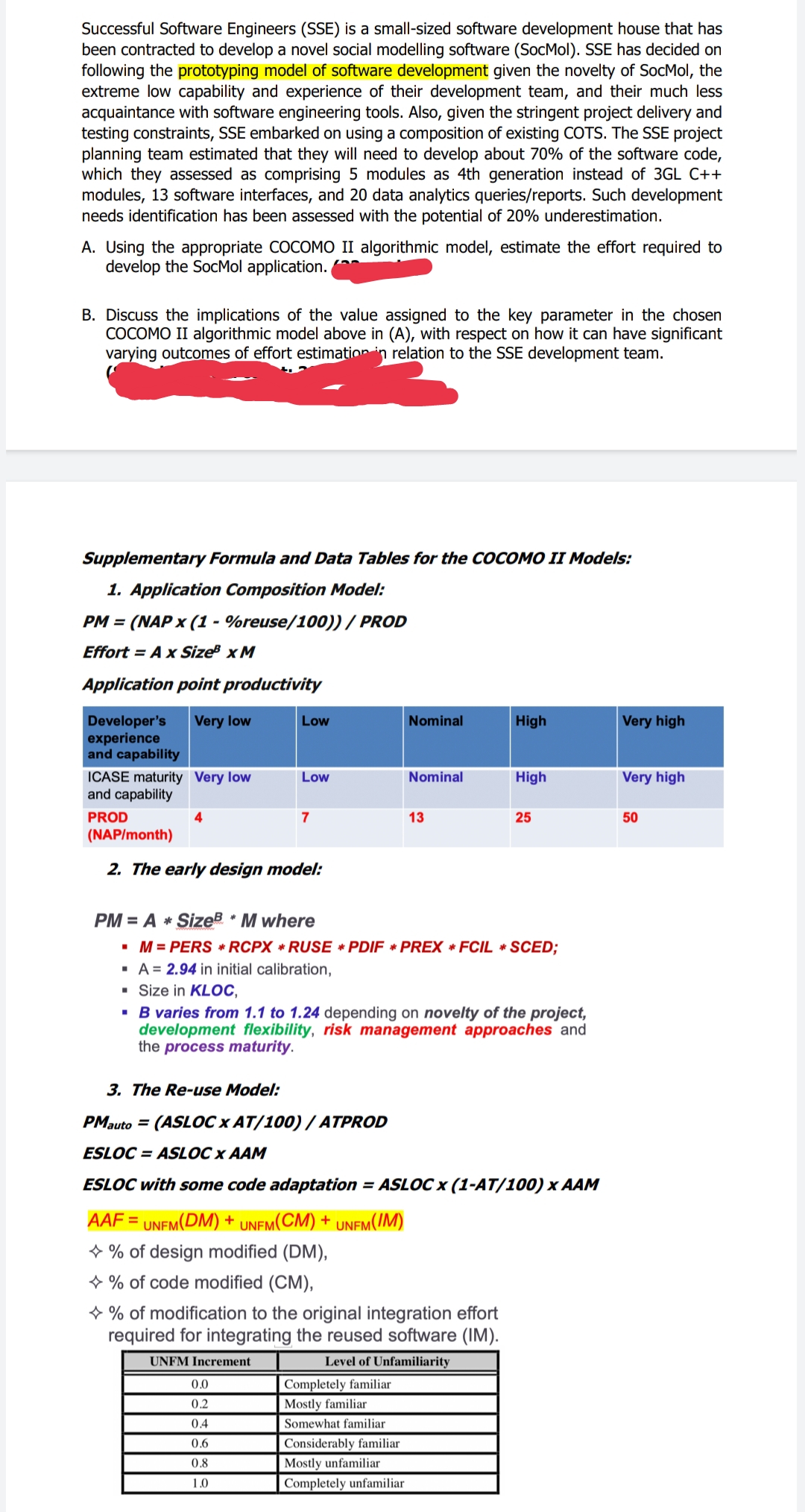
Successful Software Engineers (SSE) is a small-sized software development house that has been contracted to develop a novel social modelling software (SocMol). SSE has decided on following the prototyping model of software development given the novelty of SocMol, the extreme low capability and experience of their development team, and their much less acquaintance with software engineering tools. Also, given the stringent project delivery and testing constraints, SSE embarked on using a composition of existing COTS. The SSE project planning team estimated that they will need to develop about 70% of the software code, which they assessed as comprising 5 modules as 4th generation instead of 3GL C++ modules, 13 software interfaces, and 20 data analytics queries/reports. Such development needs identification has been assessed with the potential of 20% underestimation. A. Using the appropriate COCOMO II algorithmic model, estimate the effort required to develop the SocMol application. B. Discuss the implications of the value assigned to the key parameter in the chosen COCOMO II algorithmic model above in (A), with respect on how it can have significant varying outcomes of effort estimation in relation to the SSE development team. Supplementary Formula and Data Tables for the COCOMO II Models: 1. Application Composition Model: PM = (NAP X (1-%reuse/100)) / PROD Effort = A x Size x Application point productivity Developer's Very low experience Low and capability ICASE maturity Very low and capability PROD (NAP/month) 2. The early design model: Low 7 0.0 0.2 0.4 0.6 0.8 1.0 Nominal Nominal 13 Completely familiar Mostly familiar Somewhat familiar Considerably familiar PM = A * Size * M where M = PERS RCPX RUSE *PDIF * PREX * FCILSCED; A = 2.94 in initial calibration, Size in KLOC, % of modification to the original integration effort required for integrating the reused software (IM). UNFM Increment Level of Unfamiliarity Mostly unfamiliar Completely unfamiliar High B varies from 1.1 to 1.24 depending on novelty of the project, development flexibility, risk management approaches and the process maturity. High 3. The Re-use Model: PM auto = (ASLOC X AT/100)/ATPROD ESLOC=ASLOC x AAM ESLOC with some code adaptation = ASLOC x (1-AT/100) x AAM AAF = UNFM(DM) + UNFM(CM) + UNFM(IM) % of design modified (DM), % of code modified (CM), 25 Very high Very high 50
Step by Step Solution
There are 3 Steps involved in it

Get step-by-step solutions from verified subject matter experts
 Study Help