Question: Summarize each section in a way that someone not involved in law will roughly understand and point out. Also which of these provisions are the
Summarize each section in a way that someone not involved in law will roughly understand and point out. Also which of these provisions are the most important in the Employee Agreement and why?
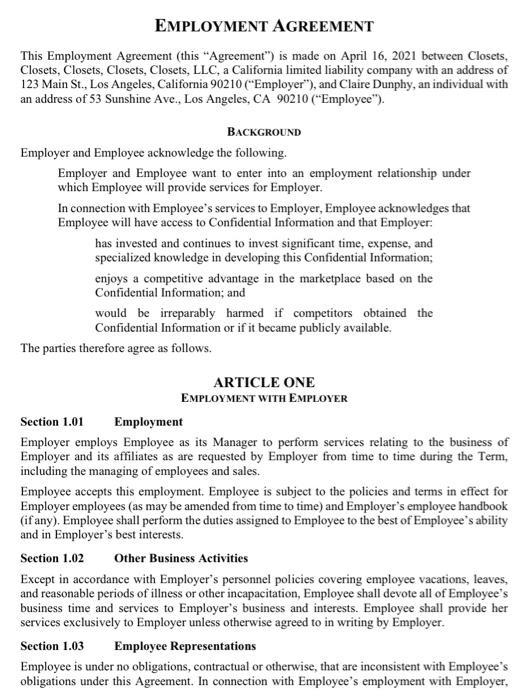
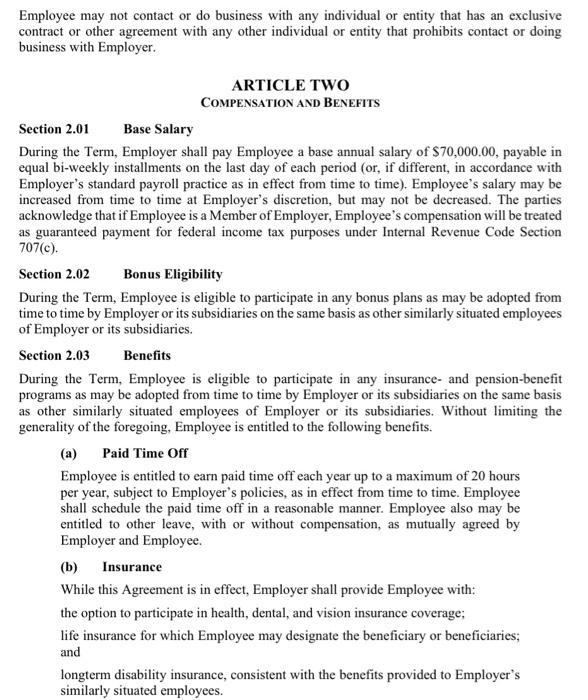
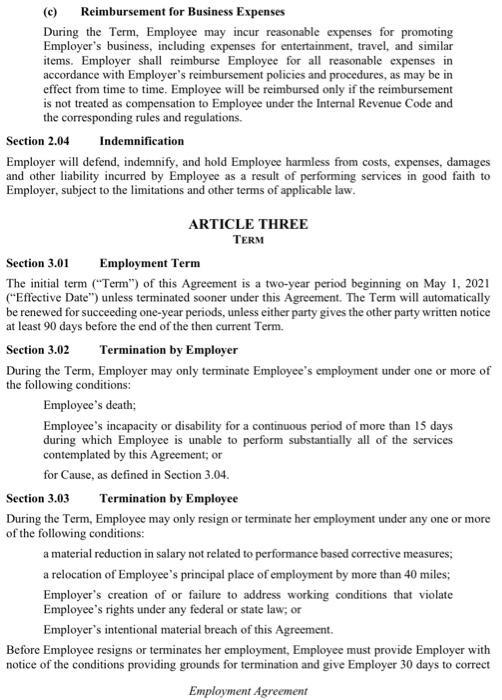
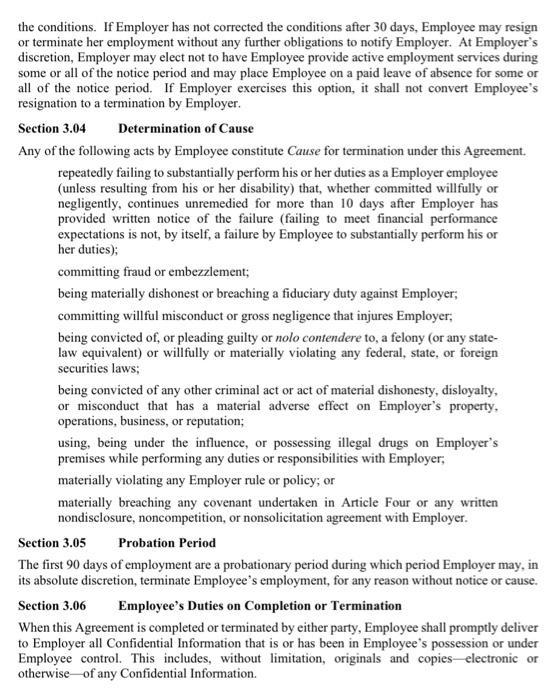
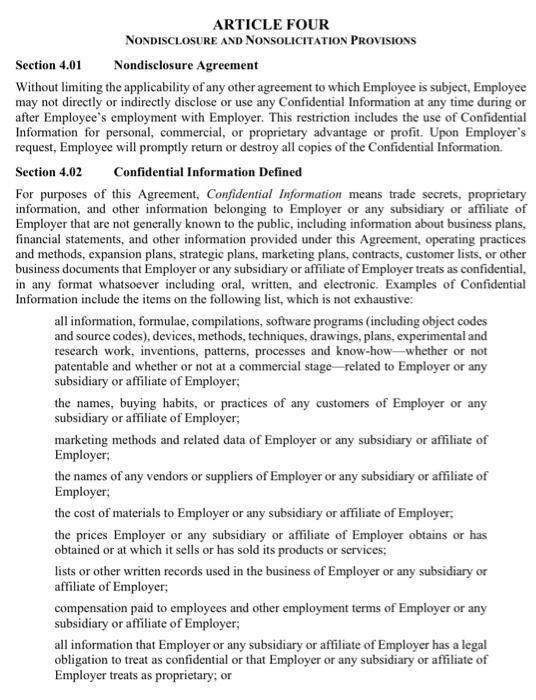
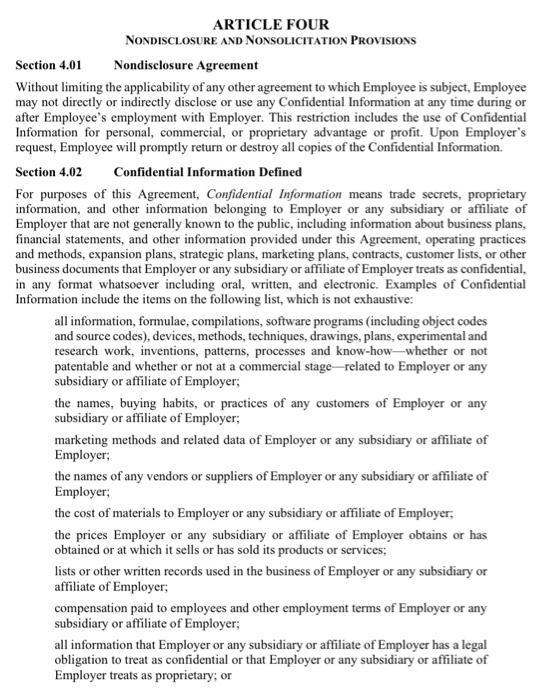
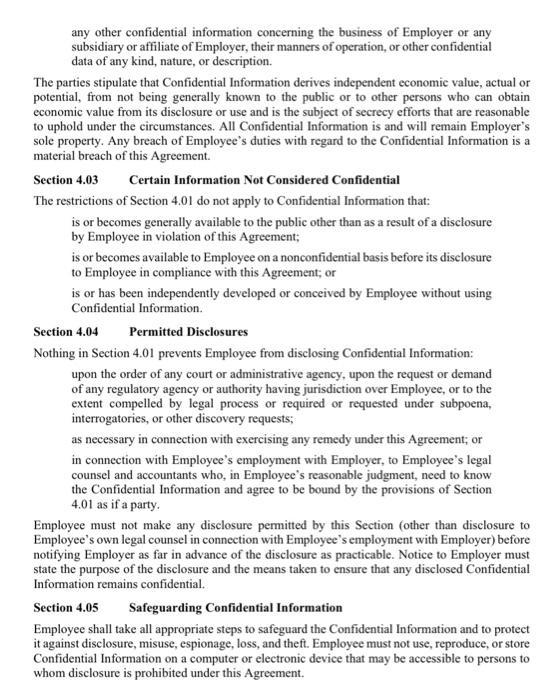
EMPLOYMENT AGREEMENT This Employment Agreement (this Agreement") is made on April 16, 2021 between Closets, Closets, Closets, Closets, Closets, LLC, a California limited liability company with an address of 123 Main St., Los Angeles, California 90210 ("Employer"), and Claire Dunphy, an individual with an address of 53 Sunshine Ave., Los Angeles, CA 90210 ("Employee"). BACKGROUND Employer and Employee acknowledge the following. Employer and Employee want to enter into an employment relationship under which Employee will provide services for Employer. In connection with Employee's services to Employer, Employee acknowledges that Employee will have access to Confidential Information and that Employer: has invested and continues to invest significant time, expense, and specialized knowledge in developing this Confidential Information; enjoys a competitive advantage in the marketplace based on the Confidential Information; and would be irreparably harmed if competitors obtained the Confidential Information or if it became publicly available. The parties therefore agree as follows. ARTICLE ONE EMPLOYMENT WITH EMPLOYER Section 1.01 Employment Employer employs Employee as its Manager to perform services relating to the business of Employer and its affiliates as are requested by Employer from time to time during the Term, including the managing of employees and sales. Employee accepts this employment. Employee is subject to the policies and terms in effect for Employer employees as may be amended from time to time) and Employer's employee handbook (if any). Employee shall perform the duties assigned to Employee to the best of Employee's ability and in Employer's best interests. Section 1.02 Other Business Activities Except in accordance with Employer's personnel policies covering employee vacations, leaves, and reasonable periods of illness or other incapacitation, Employee shall devote all of Employee's business time and services to Employer's business and interests. Employee shall provide her services exclusively to Employer unless otherwise agreed to in writing by Employer. Section 1.03 Employee Representations Employee is under no obligations, contractual or otherwise, that are inconsistent with Employee's obligations under this Agreement. In connection with Employee's employment with Employer, Employee may not contact or do business with any individual or entity that has an exclusive contract or other agreement with any other individual or entity that prohibits contact or doing business with Employer. ARTICLE TWO COMPENSATION AND BENEFITS Section 2.01 Base Salary During the Term, Employer shall pay Employee a base annual salary of $70,000.00, payable in equal bi-weekly installments on the last day of each period (or, if different, in accordance with Employer's standard payroll practice as in effect from time to time). Employee's salary may be increased from time to time at Employer's discretion, but may not be decreased. The parties acknowledge that if Employee is a Member of Employer, Employee's compensation will be treated as guaranteed payment for federal income tax purposes under Internal Revenue Code Section 707(c). Section 2.02 Bonus Eligibility During the Term, Employee is eligible to participate in any bonus plans as may be adopted from time to time by Employer or its subsidiaries on the same basis as other similarly situated employees of Employer or its subsidiaries. Section 2.03 Benefits During the Term, Employee is eligible to participate in any insurance- and pension-benefit programs as may be adopted from time to time by Employer or its subsidiaries on the same basis as other similarly situated employees of Employer or its subsidiaries. Without limiting the generality of the foregoing, Employee is entitled to the following benefits. (a) Paid Time Off Employee is entitled to earn paid time off each year up to a maximum of 20 hours per year, subject to Employer's policies, as in effect from time to time. Employee shall schedule the paid time off in a reasonable manner. Employee also may be entitled to other leave, with or without compensation, as mutually agreed by Employer and Employee. Insurance While this Agreement is in effect, Employer shall provide Employee with: the option to participate in health, dental, and vision insurance coverage; life insurance for which Employee may designate the beneficiary or beneficiaries; and longterm disability insurance, consistent with the benefits provided to Employer's similarly situated employees. (e) Reimbursement for Business Expenses During the Term. Employee may incur reasonable expenses for promoting Employer's business, including expenses for entertainment, travel, and similar items. Employer shall reimburse Employee for all reasonable expenses in accordance with Employer's reimbursement policies and procedures, as may be in effect from time to time. Employee will be reimbursed only if the reimbursement is not treated as compensation to Employee under the Internal Revenue Code and the corresponding rules and regulations. Section 2.04 Indemnification Employer will defend, indemnify, and hold Employee harmless from costs, expenses, damages and other liability incurred by Employee as a result of performing services in good faith to Employer, subject to the limitations and other terms of applicable law. ARTICLE THREE TERM Section 3.01 Employment Term The initial term ("Term") of this Agreement is a two-year period beginning on May 1, 2021 ("Effective Date) unless terminated sooner under this Agreement. The Term will automatically be renewed for succeeding one-year periods, unless either party gives the other party written notice at least 90 days before the end of the then current Term. Section 3.02 Termination by Employer During the Term, Employer may only terminate Employee's employment under one or more of the following conditions: Employee's death Employee's incapacity or disability for a continuous period of more than 15 days during which Employee is unable to perform substantially all of the services contemplated by this Agreement; or for Cause, as defined in Section 3.04. Section 3.03 Termination by Employee During the Term, Employee may only resign or terminate her employment under any one or more of the following conditions: a material reduction in salary not related to performance based corrective measures; a relocation of Employee's principal place of employment by more than 40 miles; Employer's creation of or failure to address working conditions that violate Employee's rights under any federal or state law; or Employer's intentional material breach of this Agreement. Before Employee resigns or terminates her employment, Employee must provide Employer with notice of the conditions providing grounds for termination and give Employer 30 days to correct Employment Agreement the conditions. If Employer has not corrected the conditions after 30 days, Employee may resign or terminate her employment without any further obligations to notify Employer. At Employer's discretion, Employer may elect not to have Employee provide active employment services during some or all of the notice period and may place Employee on a paid leave of absence for some or all of the notice period. If Employer exercises this option, it shall not convert Employee's resignation to a termination by Employer. Section 3.04 Determination of Cause Any of the following acts by Employee constitute Cause for termination under this Agreement. repeatedly failing to substantially perform his or her duties as a Employer employee (unless resulting from his or her disability) that, whether committed willfully or negligently, continues unremedied for more than 10 days after Employer has provided written notice of the failure (failing to meet financial performance expectations is not, by itself, a failure by Employee to substantially perform his or her duties); committing fraud or embezzlement; being materially dishonest or breaching a fiduciary duty against Employer; committing willful misconduct or gross negligence that injures Employer, being convicted of, or pleading guilty or nolo contendere to, a felony (or any state- law equivalent) or willfully or materially violating any federal, state, or foreign securities laws; being convicted of any other criminal act or act of material dishonesty, disloyalty, or misconduct that has a material adverse effect on Employer's property, operations, business, or reputation; using, being under the influence, or possessing illegal drugs on Employer's premises while performing any duties or responsibilities with Employer, materially violating any Employer rule or policy; or materially breaching any covenant undertaken in Article Four or any written nondisclosure, noncompetition, or nonsolicitation agreement with Employer. Section 3.05 Probation Period The first 90 days of employment are a probationary period during which period Employer may, in its absolute discretion, terminate Employee's employment, for any reason without notice or cause. Section 3.06 Employee's Duties on Completion or Termination When this Agreement is completed or terminated by either party, Employee shall promptly deliver to Employer all Confidential Information that is or has been in Employee's possession or under Employee control. This includes, without limitation, originals and copies-electronic or otherwise of any Confidential Information ARTICLE FOUR NONDISCLOSURE AND NONSOLICITATION PROVISIONS Section 4.01 Nondisclosure Agreement Without limiting the applicability of any other agreement to which Employee is subject, Employee may not directly or indirectly disclose or use any Confidential Information at any time during or after Employee's employment with Employer. This restriction includes the use of Confidential Information for personal, commercial, or proprietary advantage or profit. Upon Employer's request, Employee will promptly return or destroy all copies of the Confidential Information. Section 4.02 Confidential Information Defined For purposes of this Agreement, Confidential Information means trade secrets, proprietary information, and other information belonging to Employer or any subsidiary or affiliate of Employer that are not generally known to the public, including information about business plans, financial statements, and other information provided under this Agreement, operating practices and methods, expansion plans, strategic plans, marketing plans, contracts, customer lists, or other business documents that Employer or any subsidiary or affiliate of Employer treats as confidential, in any format whatsoever including oral, written, and electronic. Examples of Confidential Information include the items on the following list, which is not exhaustive: all information, formulae, compilations, software programs (including object codes and source codes), devices, methods, techniques, drawings, plans, experimental and research work, inventions, patterns, processes and know-how-whether or not patentable and whether or not at a commercial stage-related to Employer or any subsidiary or affiliate of Employer; the names, buying habits, or practices of any customers of Employer or any subsidiary or affiliate of Employer; marketing methods and related data of Employer or any subsidiary or affiliate of Employer; the names of any vendors or suppliers of Employer or any subsidiary or affiliate of Employer; the cost of materials to Employer or any subsidiary or affiliate of Employer, the prices Employer or any subsidiary or affiliate of Employer obtains or has obtained or at which it sells or has sold its products or services; lists or other written records used in the business of Employer or any subsidiary or affiliate of Employer; compensation paid to employees and other employment terms of Employer or any subsidiary or affiliate of Employer; all information that Employer or any subsidiary or affiliate of Employer has a legal obligation to treat as confidential or that Employer or any subsidiary or affiliate of Employer treats as proprietary: or ARTICLE FOUR NONDISCLOSURE AND NONSOLICITATION PROVISIONS Section 4.01 Nondisclosure Agreement Without limiting the applicability of any other agreement to which Employee is subject, Employee may not directly or indirectly disclose or use any Confidential Information at any time during or after Employee's employment with Employer. This restriction includes the use of Confidential Information for personal, commercial, or proprietary advantage or profit. Upon Employer's request, Employee will promptly return or destroy all copies of the Confidential Information. Section 4.02 Confidential Information Defined For purposes of this Agreement, Confidential Information means trade secrets, proprietary information, and other information belonging to Employer or any subsidiary or affiliate of Employer that are not generally known to the public, including information about business plans, financial statements, and other information provided under this Agreement, operating practices and methods, expansion plans, strategic plans, marketing plans, contracts, customer lists, or other business documents that Employer or any subsidiary or affiliate of Employer treats as confidential, in any format whatsoever including oral, written, and electronic. Examples of Confidential Information include the items on the following list, which is not exhaustive: all information, formulae, compilations, software programs (including object codes and source codes), devices, methods, techniques, drawings, plans, experimental and research work, inventions, patterns, processes and know-how-whether or not patentable and whether or not at a commercial stage-related to Employer or any subsidiary or affiliate of Employer; the names, buying habits, or practices of any customers of Employer or any subsidiary or affiliate of Employer; marketing methods and related data of Employer or any subsidiary or affiliate of Employer; the names of any vendors or suppliers of Employer or any subsidiary or affiliate of Employer; the cost of materials to Employer or any subsidiary or affiliate of Employer, the prices Employer or any subsidiary or affiliate of Employer obtains or has obtained or at which it sells or has sold its products or services; lists or other written records used in the business of Employer or any subsidiary or affiliate of Employer; compensation paid to employees and other employment terms of Employer or any subsidiary or affiliate of Employer; all information that Employer or any subsidiary or affiliate of Employer has a legal obligation to treat as confidential or that Employer or any subsidiary or affiliate of Employer treats as proprietary: or any other confidential information concerning the business of Employer or any subsidiary or affiliate of Employer, their manners of operation, or other confidential data of any kind, nature, or description. The parties stipulate that Confidential Information derives independent economic value, actual or potential, from not being generally known to the public or to other persons who can obtain economic value from its disclosure or use and is the subject of secrecy efforts that are reasonable to uphold under the circumstances. All Confidential Information is and will remain Employer's sole property. Any breach of Employee's duties with regard to the Confidential Information is a material breach of this Agreement. Section 4.03 Certain Information Not Considered Confidential The restrictions of Section 4.01 do not apply to Confidential Information that: is or becomes generally available to the public other than as a result of a disclosure by Employee in violation of this Agreement; is or becomes available to Employee on a nonconfidential basis before its disclosure to Employee in compliance with this Agreement; or is or has been independently developed or conceived by Employee without using Confidential Information. Section 4.04 Permitted Disclosures Nothing in Section 4.01 prevents Employee from disclosing Confidential Information: upon the order of any court or administrative agency, upon the request or demand of any regulatory agency or authority having jurisdiction over Employee, or to the extent compelled by legal process or required or requested under subpoena, interrogatories, or other discovery requests; as necessary in connection with exercising any remedy under this Agreement; or in connection with Employee's employment with Employer, to Employee's legal counsel and accountants who, in Employee's reasonable judgment, need to know the Confidential Information and agree to be bound by the provisions of Section 4.01 as if a party Employee must not make any disclosure permitted by this Section (other than disclosure to Employee's own legal counsel in connection with Employee's employment with Employer) before notifying Employer as far in advance of the disclosure as practicable. Notice to Employer must state the purpose of the disclosure and the means taken to ensure that any disclosed Confidential Information remains confidential Section 4.05 Safeguarding Confidential Information Employee shall take all appropriate steps to safeguard the Confidential Information and to protect it against disclosure, misuse, espionage, loss, and theft. Employee must not use, reproduce, or store Confidential Information on a computer or electronic device that may be accessible to persons to whom disclosure is prohibited under this Agreement









 Study Help