Question: Summarize the Article Global Strategy Journal Global S.-286 (2011) Published online in Wiley Online Library Coilyonlinelibrary.com). DOI:10.112.212.8805_2011.00152 GLOBAL STRATEGY AND GLOBAL BUSINESS ENVIRONMENT: THE DIRECT
Summarize the Article
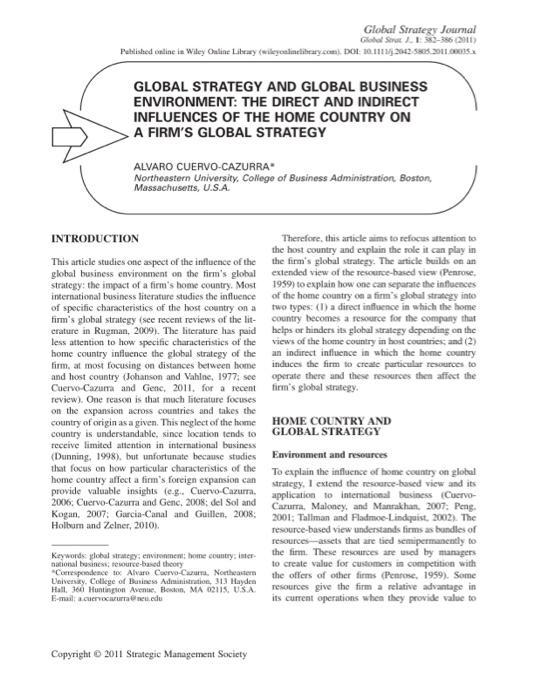
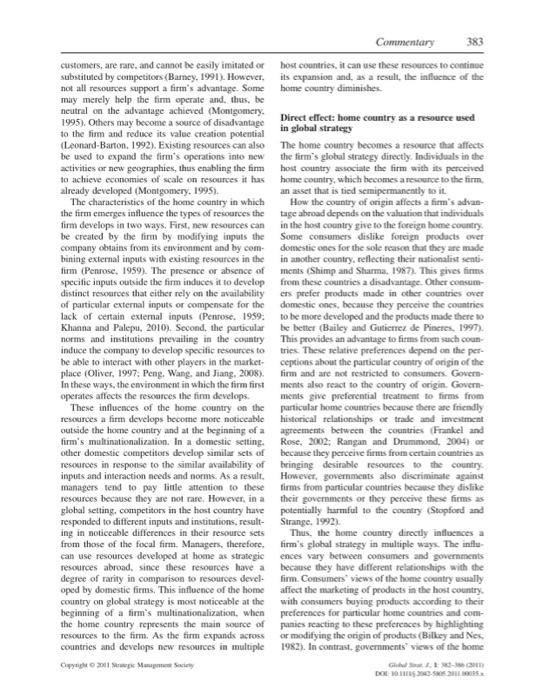
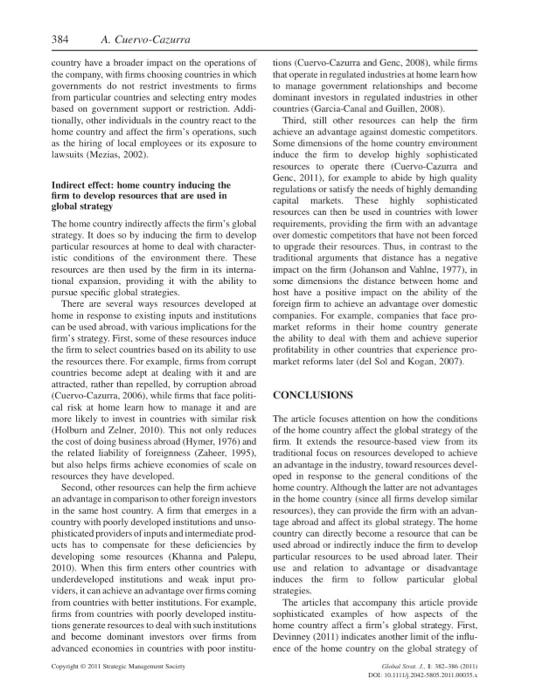
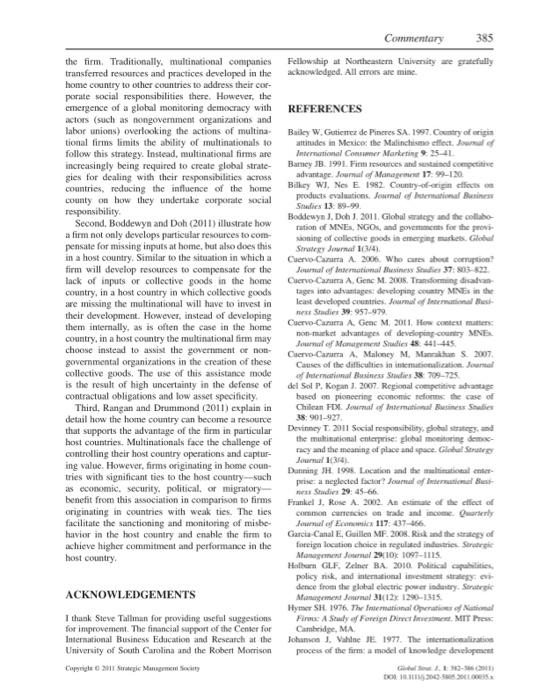
Global Strategy Journal Global S.-286 (2011) Published online in Wiley Online Library Coilyonlinelibrary.com). DOI:10.112.212.8805_2011.00152 GLOBAL STRATEGY AND GLOBAL BUSINESS ENVIRONMENT: THE DIRECT AND INDIRECT INFLUENCES OF THE HOME COUNTRY ON A FIRM'S GLOBAL STRATEGY ALVARO CUERVO-CAZURRA Northeastern University College of Business Administration Boston, Massachusetts, U.S.A. INTRODUCTION Therefore, this article aims to refocus attention to the host country and explain the role it can play in This article studies one aspect of the influence of the the firm's global strategy. The article builds on an global business environment on the firm's global extended view of the resource-based view Penrose, strategy: the impact of a firm's bome country. Most 1959) to explain how one can separate the influences international business literature studies the influence of the home country on a fir's global strategy into of specific characteristics of the host country on a two types: (1) a direct influence in which the home firm's global strategy (see recent reviews of the lit- country becomes a resource for the company that crature in Rugman, 2009). The literature has paid helps or hinders its global strategy depending on the less attention to how specific characteristics of the views of the home country in host countries and (2) home country influence the global strategy of the an indirect influence in which the home country firm, at most focusing on distances between home induces the firm to create particular resources to and host country (Johanson and Vahine, 1977, see operate there and these resources then affect the Cuervo Cazuma and Genc. 2011. for a recent firm's global strategy review). One reason is that much literature focuses on the expansion across countries and takes the country of origin as a given. This neglect of the home HOME COUNTRY AND country is understandable, since location tends to GLOBAL STRATEGY receive limited attention in international business (Dunning, 1998), but unfortunate because studies Environment and resources that focus on how particular characteristics of the To explain the influence of home country on global home country affect a firm's foreign expansion can strategy, I extend the resource-based view and its provide valuable insights (eg. Cuervo Cazurra. application to interational business Cuervo 2006 Cuervo-Cazurra and Genc. 2008: del Sol and Cazurra, Maloney, and Manakhart. 2007. Peng. Kogan, 2007: Garcia-Canal and Guillen, 2008, 2001: Tallman and Fladmoe-Lindquist, 2002). The Holbum and Zelner, 2010). resource-based view understands firms as bundles of resources-assets that are tied semipermanently to Keywords global strategy: environment home country: inter the firm. These resources are used by managers national business, resource-based theory to create value for customers in competition with Correspondence to Alvaro Corvo Car Northeastern the offers of other firms (Pense, 1959). Some University College of Buiness Administration, 313 Hayden Hall. 301 Huntington Avenue, Boston, MA 02115, USA resources give the firm a relative advantage in E- mail: cunciu.edu its current operations when they provide value to Copyright 2011 Strategic Management Society Commentary 383 customers, are rare, and cannot be easily imitated or host countries, it can use these resources to continue substituted by competitors (Barney, 1991). However, its expansion and as a result, the influence of the not all resources support a firm's advantage. Some home country diminishes may merely help the fimm operate and thus, be neutral on the advantage achieved (Montgomery, 1995). Others may become a source of disadvantage Direct effect: home country as a resource used in global strategy to the firm and reduce its value creation potential (Leonard-Barton, 1992). Existing resources can also the home country becomes a resource that affects be used to expand the firm's operations into new the firm's global strategy directly. Individuals in the activities or new geographies, thus enabling the fim host country associate the firm with its perceived to achieve economies of scale on resources it has home country, which becomes a resource to the firm, already developed (Montgomery. 1995). an asset that is tied semipermanently to it. The characteristics of the home country in which How the country of origin affects afirm's advan the firm emerges influence the types of resources the tage abroad depends on the valuation that individuals firm develops in two ways. First, new resources can in the host country give to the foreign home country be created by the firm by modifying inputs the Some consumers dislike foreign products over company obtains from its environment and by com- domestic ones for the sole seas that they are made bining external inputs with existing resources in the in another country, reflecting their nationalist senti- firm (Penrose, 1959). The presence or absence of monts (Shimp and Sharma, 1987). This gives firms specific inputs outside the firm induces it to develop from these countries a disadvantage. Other consum- distinct resources that either rely on the availability ers prefer products made in other countries over of particular external inputs or compensate for the domestic ones, because they perceive the countries lack of certain external inputs (Penrose. 1959. to be more developed and the products made there to Khanna and Palepu, 2010). Second, the particular be better (Bailey and Gutierrez de Pineres. 1997). norms and institutions prevailing in the country This provides an advantage to firms from such coun induce the company to develop specific resources to tries. These relative preferences depend on the per he able to interact with other players in the market- ceptions about the particular country of origin of the place (Oliver, 1997, Peng, Wang, and Jiang, 2008). firm and are not restricted to consumers. Govern In these ways, the environment in which the firm first ments also react to the country of origin. Govern- operates affects the resources the firm develops ments give preferential treatment to firms from These influences of the home country on the particular home countries because there are friendly resources a firm develops become more noticeable historical relationships or trade and investment outside the home country and at the beginning of a agreement between the countries (Frankel and firm's multinationalization. In a domestic setting. Rose, 2002: Rangan and Drummond, 2004) or other domestic competitors develop similar sets of because they perceive firms from certain countries as resources in response to the similar availability of bringing desirable resources to the country inputs and interaction needs and norms. As a result. However, governments also discriminate against managers tend to pay title attention to these firms from particular countries because they dislike resources because they are not rare. However, in a their governments or they perceive these firms as global setting, competitors in the host country have potentially harmful to the country (Stopford and responded to different inputs and institutions, result- Strange. 1992). ing in noticeable differences in their resource sets Thus, the home country directly influences a from those of the focal firm. Managers, therefore, firm's global strategy in multiple ways. The ini can use resources developed at home as strategic ences vary between consumers and governments resources abroad, since these resources have a because they have different relationships with the degree of rarity in comparison to resources devel- firm. Consumers' views of the home country usually oped by domestic firms. This influence of the home affect the marketing of products in the host country country on global strategy is most noticeable at the with consumers buying products according to their beginning of a firm's multinationalization, when preferences for particular home countries and com the home country represents the main source of panies reacting to these preferences by highlighting Tesources to the firm. As the firm expands across or modifying the origin of products (Bilkey and Nes countries and develops new resources in multiple 1982). In contrast, governments views of the home Chow Macie 384 A. Cuero-Cazurra country have a broader impact on the operations of tions (Cuervo-Cazurra and Genc, 2008), while firms the company, with firms choosing countries in which that operate in regulated industries at home learn how governments do not restrict investments to firms to manage government relationships and become from particular countries and selecting entry modes dominant investors in regulated industries in other based on government support of restriction. Addi- countries (Garcia-Canal and Guillen, 2008). tionally, other individuals in the country react to the Third, still other resources can help the firm home country and affect the firm's operations, such achieve an advantage against domestic competitors. as the hiring of local employees or its exposure to Some dimensions of the home country environment lawsuits (Mezias, 2002) induce the firm to develop highly sophisticated Tesources to operate there (Cuervo-Cazurra and Genc, 2011), for example to abide by high quality Indirect effect: home country inducing the firm to develop resources that are used in regulations or satisfy the needs of highly demanding capital markets. These highly sophisticated global strategy resources can then be used in countries with lower The home country indirectly affects the firm's global requirements, providing the firm with an advantage strategy. It does so by inducing the firm to develop over domestic competitors that have not been forced particular resources at home to deal with character to upgrade their resources. Thus, in contrast to the istic conditions of the environment there. These traditional arguments that distance has a negative resources are then used by the firm in its interna- impact on the firm Johanson and Vahine, 1977), in tional expansion, providing it with the ability to some dimensions the distance between home and pursue specific global strategies. host have a positive impact on the ability of the There are several ways resources developed at foreign firm to achieve an advantage over domestic home in response to existing inputs and institutions companies. For example, companies that face pro can be used abroad with various implications for the market reforms in their home country generate firm's strategy. First, some of these resources induce the ability to deal with them and achieve superior the firm to select countries based on its ability to use profitability in other countries that experience pro- the resources there. For example, firms from corrupt market reforms later (del Sol and Kogan, 2007), countries become adept at dealing with it and are attracted, rather than repelled, by corruption abroad (Cuervo-Cazurra, 2006), while firms that face politi- CONCLUSIONS cal risk at home learn how to manage it and are more likely to invest in countries with similar risk The article focuses attention on how the conditions (Holbum and Zelner, 2010). This not only reduces of the home country affect the global strategy of the the cost of doing business abroad (Hymer, 1976) and firm. It extends the resource-based view from its the related liability of foreignness (Zaheer, 1995), traditional focus on resources developed to achieve but also helps firms achieve economies of scale on an advantage in the industry, toward resources devel- resources they have developed. oped in response to the general conditions of the Second, other resources can help the firm achieve home country. Although the latter are not advantages an advantage in comparison to other foreign investors in the home country since all firms develop similar in the same host country. A fimm that emerges in a resources, they can provide the firm with an advan- country with poorly developed institutions and unsotage abroad and affect its global strategy. The home phisticated providers of inputs and intermediate prod- country can directly become a resource that can be ucts has to compensate for these deficiencies by used abroad or indirectly induce the firm to develop developing some resources (Khanna and Palepu. particular resources to be used abroad later. Their 2010). When this firm enters other countries with use and relation to advantage or disadvantage underdeveloped institutions and weak input pro- induces the firm to follow particular global viders, it can achieve an advantage over fimms coming strategies from countries with better institutions. For example. The articles that accompany this article provide firms from countries with poorly developed institu- sophisticated examples of how aspects of the tions generate resources to deal with such institutions home country affect a firm's global strategy. First, and become dominant investors over firms from Devinney (2011) indicates another limit of the influ- advanced cconomies in countries with poor institu- ence of the home country on the global strategy of C20 Mg Sim DOC 110110 Commentary 385 the fimm Traditionally, multinational companies Fellowship of Northeastern University we gratefully transferred resources and practices developed in the acknowledged. All errors are mine home country to other countries to address their cor- porate social responsibilities there. However, the emergence of a global monitoring democracy with REFERENCES actors (such as nongovernment organizations and labor unions) overlooking the actions of multina. Baiky W. Gutierrez de Pines SA. 1997. Coetry of origin tional firms limits the ability of multinationals 10 attitudes in Mexico the Malinchisme effect of follow this strategy. Instead, multinational firms are International Comer Marketing 2541 increasingly being required to create global strate- Bamey B. 1991. Fimm resources and sustained competitive gies for dealing with their responsibilities across advantage. Journal of Mana 17. 99-120 countries, reducing the influence of the home Bilkey W. Ne E 1982 Country-of-in effects on county on how they undertake corporate social products evaluations. Jamal of International Business Studies 13: 89-99 responsibility Boddewyn). Doh J. 2011 Global Stegy and the collabo Second, Boddewyn and Doh (2011) illustrate how ration of MNE, NGOs, and government for the peo a firm not only develops particular resources to com soning of collective poods in emerging markets. Global pensate for missing inputs at home, but also does this Strategy anal 14 in a host country. Similar to the situation in which a Cuervo-Cauta A. 2006. Who cares about corruption firm will develop resources to compensate for the Journal of baserational Business Studies 37: 03-622 lack of inputs or collective goods in the home Cuervo-Camera A. Genc M. 2005. Torming dalam country, in a host country in which collective goods tages into advantages developing country MNE in the are missing the multinational will have to invest in least developed countries. Journal of International Best their development. However, instead of developing Stadier 39: 957.979 them internally, as is often the case in the home Cuervo-Cara A Genc M. 2011. How ce matters country, in a host country the multinational fimm may non market avantages of developing country MNE Journal of Me Swix 48 441-445 choose instead to assist the government or non- Cuervo-Canim A. Maloney M. MS 2007 governmental organizations in the creation of these Causes of the difficulties in stomatolation. Journal collective goods. The use of this assistance mode of International Business Studies 38 709-725 is the result of high uncertainty in the defense of del Sol P. Kogan 1.2007 Regional competitive advantage contractual obligations and low asset specificity based on pioneering cconomic reforms the case of Third, Rangan and Drummond (2011) explain in Chilean FOX: Journal of Internal Business Sabie detail how the home country can become a resource 38: 901-927 that supports the advantage of the firm in particular Devinney T 2011 Social responsibility, global strategy and host countries. Multinational face the challenge of the multinational enterprise global meeting demi- controlling their host country operations and captur- racy and the meaning of place and space. Global Strings Journal 34 ing value. However, firms originating in home coun Dutning JH 1993. Location and the total enter tries with significant ties to the host country-such prise: a neglected factor Journal of International Best as economic, security, political, or migratory Sud 29: 45-66 benefit from this association in comparison to firms Frankel J. Rene A. 2002. An estimate of the effect of originating in countries with weak ties. The ties Common currencies on trade and income Quarterly facilitate the sanctioning and monitoring of misbe- Journal of 117: 437-466 havior in the host country and enable the firm to Garcia Canal E. Guillen MF. 2008. Rick and the strategy of achieve higher commitment and performance in the foreign location choice in regulated intestries Strategic host country, Moment Journal 2910 1097-1115 Helburn GLF, Zeiner BA, 2010. Political capabilities policy risk and international investment strategy dience from the global electric power industry. Strategic ACKNOWLEDGEMENTS Management Journal 31(12% 1290-3315 Hymer SH. 1976. The femati mal price of National I thank Steve Talman for providing useful suggestions Firme A Stay of Foreign Dire MIT Press for improvement. The financial support of the Center for Cambridge, MA International Business Education and Research at the Johnson J. Vahine JE 1977. The internationalization University of South Carolina and the Robert Morrison process of the forma model of knowledge development Copyright 2011 Strategic Management GEO- DOLOR 386 A. Cuervo-Cazurra and increasing foreign market commitments. Journal of Intemational Busine Studier 8: 23-32 Khanna T, Palepu K. 2010. Winning in Emerging Markets: A Road Map for Stufegy and Execution. Harvard Busi- ness Press Boston, MA Leonard-Barton D. 1992. Core capabilities and core rigidi- ties, a paradox in managing new product development Strategic Management Journal, Summer Special Issue 13. 111-126 Mezas IM. 2002. Identifying liabilities of foreignness and strategies to minimize their effect the case of labor law suits judgments in the United States. Suteple Manage men Journal 2.3): 220-244. Montgomery CA. 1995. Of diamonds and nast: a new look at resources. In Resource-Band and Evolutionary Theo ples of the Fire: Towards a 'whesis. Montgomery CA (od). Kluwer Academic Publishers: Boston, MA, 251- 268 Oliver C. 1997. Sustainable competitive advantage combin ing institutional and resource-based views. Strategic Management Journal 1819): 697-713. Peng MW 2001. The resource-based view and international business. Journal of Management 27-803-829 Peng MW, Wang DYL. Jiang Y. 2008. An institution-based view of international business strategy: a focus on emerging economies Journal of International Be Studies 39.920-936. Penrose ET. 1959. The Theory of the Growth of the Fim. Oxford University Pres: Oxford, UK Rangan S. Drummond A. 2004. Explaining Outcomes in competition among foreign multinationals in a focalhost market, Strategie Management Journal 253 285-293. Rangan S. Drummond A. 2011. The problem of control and the role of home-bostties in explaining multinational foreign operations competitiveness, and performance Global Strategy Joumal 13/4). Rugman AM (ed. 2009. The Oxford Handbook of Intern Honal Bus (2nd edn. Oxford University Press Oxford, UK Ship TA. Shurma S. 1987. Consumer ethnocentes con struction and validation of the CETSCALE.Jownal of Marketing Research 24: 280-289 Stopford J. Strange S. 1992. Rival Sites Rival Firmw. Competition for World Marker Shures. Cambridge Uni versity Press New York Tillman S. Fadmoe Lindquist K. 2009. Internationaliza tion, globalization, and capability-based strategy. Call- fornia Management Review 45. 116-135 Zaheer S. 1995, Overcoming the liability of foreigness, Academy of Management Jowmal 38 341-363 Copyright Stig Man Society G13011 DOL 10.03.2011









 Study Help