







Question: *summarize the article *write three arguments to support *write conclusion use simple language Can the Global Community Successfully Confront the Global Water Shortage? by Harf,
*summarize the article *write three arguments to support *write conclusion use simple language
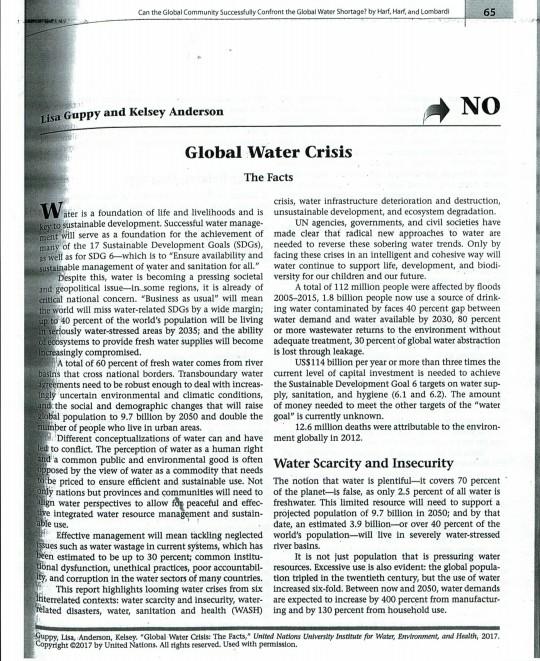
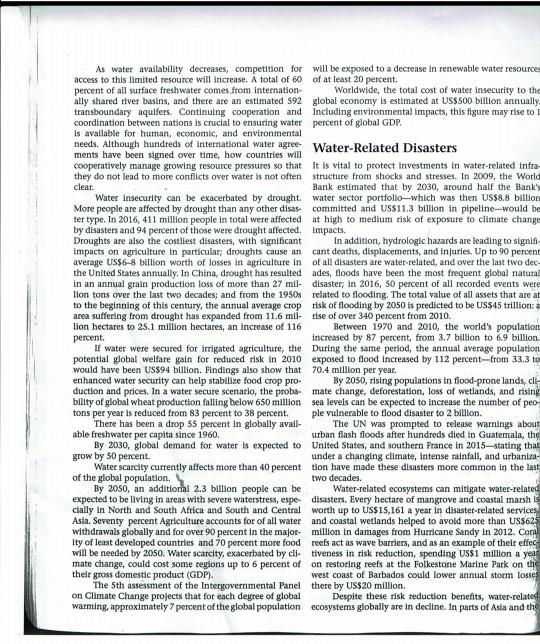
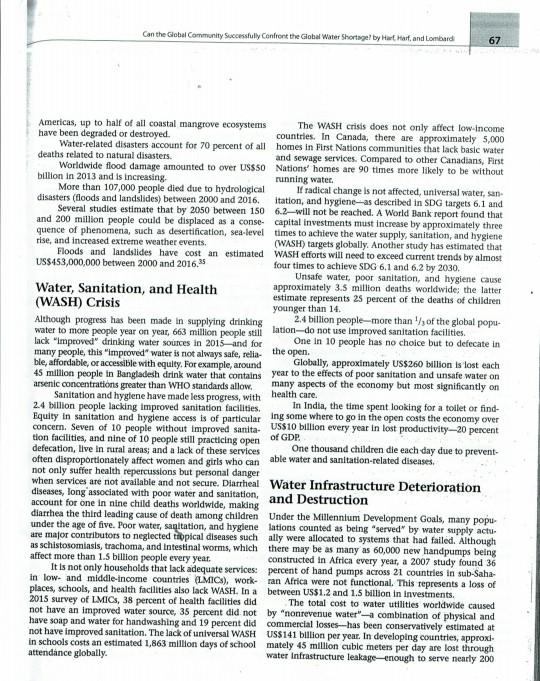
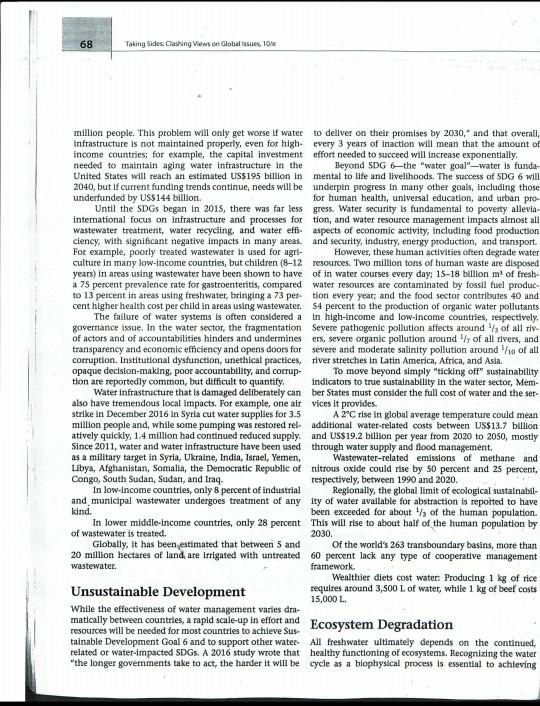
Can the Global Community Successfully Confront the Global Water Shortage? by Harf, Hart, and Lombardi 65 NO Lisa Guppy and Kelsey Anderson Global Water Crisis The Facts , Water is a foundation of life and livelihoods and is unsustainable development, and ecosystem degradation koy to sustainable development. Successful water manage UN agencies, governments, and civil societies have ment will serve as a foundation for the achievement of made clear that radical new approaches to water are many of the 17 Sustainable Development Goals (SDGs), needed to reverse these sobering water trends. Only by well as for SDG 6-which is to ensure availability and facing these crises in an intelligent and cohesive way will sustainable management of water and sanitation for all." water continue to support life, development, and biodi- Despite this, water is becoming a pressing societal versity for our children and our future. and geopolitical issue-In some regions. It is already of A total of 112 million people were affected by floods critical national concern. "Business as usual" will mean 2005-2015, 1.8 billion people now use a source of drink the world will miss water-related SDGs by a wide margin; ing water contaminated by faces 40 percent gap between up to 40 percent of the world's population will be living water demand and water available by 2030, 80 percent fint seriously water-stressed areas by 2035; and the ability or more wastewater returns to the environment without ecosystems to provide fresh water supplies will become adequate treatment, 30 percent of global water abstraction Increasingly compromised. Is lost through leakage. A total of 60 percent of fresh water comes from river US$ 114 billion per year or more than three times the basins that cross national borders. Transboundary water current level of capital investment is needed to achieve greements need to be robust enough to deal with increas- the Sustainable Development Goal 6 targets on water sup- ingly uncertain environmental and climatic conditions, ply, sanitation, and hygiene (6.1 and 6.2). The amount and the social and demographic changes that will raise of money needed to meet the other targets of the water lobal population to 9.7 billion by 2050 and double the goal is currently unknown. mumber of people who live in urban areas. 12.6 million deaths were attributable to the environ- Different conceptualizations of water can and have ment globally in 2012, led to conflict. The perception of water as a human right and a common public and environmental good is often Water Scarcity and Insecurity be priced to ensure efficient and sustainable use Not The notion that water is plentiful-It covers 70 percent only nations but provinces and communities will need to of the planet-is false, as only 25 percent of all water is ign water perspectives to allow for peaceful and effec freshwater. This limited resource will need to support a sive integrated water resource management and sustain- projected population of 9.7 billion in 2050; and by that date, an estimated 3.9 billion-or over 40 percent of the Effective management will mean tackling neglected world's population-will live in severely water-stressed sues such as water wastage in current systems, which has river basins. lxen estimated to be up to 30 percent; common Institu It is not just population that is pressuring water Uonal dysfunction, unethical practices, poor accountabil resources, Excessive use is also evident: the global popula- lty, and corruption in the water sectors of many countries. tion tripled in the twentieth century, but the use of water This report highlights looming water crises from six increased six-fold. Between now and 2050, water demands Interrelated contexts: water scarcity and insecurity, water are expected to increase by 400 percent from manufactur- related disasters, water, sanitation and health (WASH) ing and by 130 percent from household use. able use Guppy, Lisa, Anderson, Kelsey. "Global Water Crisis: The Facts, United Nations Calversity Institute for Water, Erronment, and Health, 2017 Copyright 2017 by United Nations. All rights reserved. Used with permission As water availability decreases, competition for will be exposed to a decrease in renewable water resources access to this limited resource will increase. A total of 60 of at least 20 percent. percent of all surface freshwater comes from internation Worldwide, the total cost of water insecurity to the ally shared river basins, and there are an estimated 592 global economy is estimated at US$500 billion annually transboundary aqulfers. Continuing cooperation and including environmental impacts, this figure may rise to coordination between nations is crucial to ensuring water percent of global GDP. is available for human, economic, and environmental needs. Although hundreds of international water agree- ments have been signed over time, how countries will Water-Related Disasters cooperatively manage growing resource pressures so that it is vital to protect investments in water-related infra they do not lead to more conflicts over water is not often structure from shocks and stresses. In 2009, the World clear. Bank estimated that by 2030, around half the Bank's Water Insecurity can be exacerbated by drought. water sector portfoliowhich was then US$8.8 billion More people are affected by drought than any other disas committed and US$11.3 billion in pipeline-would be ter type. In 2016, 411 million people in total were affected at high to medium risk of exposure to climate change by disasters and 94 percent of those were drought affected.impacts. Droughts are also the costliest disasters, with significant In addition, hydrologic hazards are leading to signifi impacts on agriculture in particular; droughts cause an cant deaths, displacements, and injuries. Up to 90 percent average US$6-8 billion worth of losses in agriculture in of all disasters are water-related, and over the last two dec the United States annually. In China, drought has resulted ades, floods have been the most frequent global natural in an annual grain production loss of more than 27 mil. disaster; in 2016, 50 percent of all recorded events were lion tons over the last two decades, and from the 1950s related to flooding. The total value of all assets that are at to the beginning of this century, the annual average crop risk of flooding by 2050 is predicted to be US$45 trillion: a area suffering from drought has expanded from 11.6 mil rise of over 340 percent from 2010. lion hectares to 25.1 million hectares, an increase of 116 Between 1970 and 2010, the world's population percent. Increased by 87 percent, from 3.7 billion to 6.9 billion If water were secured for irrigated agriculture, the During the same period, the annual average population potential global welfare gain for reduced risk in 2010 exposed to flood increased by 112 percent--from 33.3 to would have been US$94 billion. Findings also show that 70.4 million per year. enhanced water security can help stabilize food crop pro By 2050, rising populations in flood-prone lands, cli- duction and prices. In a water secure scenario, the proba mate change, deforestation, loss of wetlands, and rising bility of global wheat production falling below 650 million sea levels can be expected to increase the number of peo tons per year is reduced from 83 percent to 38 percent. ple vulnerable to flood disaster to 2 billion. There has been a drop 55 percent in globally avail The UN was prompted to release warnings about able freshwater per capita since 1960, urban flash floods after hundreds died in Guatemala, the By 2030, global demand for water is expected to United States, and southern France in 2015stating that grow by 50 percent. under a changing climate, intense rainfall, and urbaniza- Water scarcity currently affects more than 40 percent tion have made these disasters more common in the last of the global population. two decades. By 2050, an additional 2.3 billion people can be Water-related ecosystems can mitigate water-related expected to be living in areas with severe waterstress, espe- disasters. Every hectare of mangrove and coastal marsh is cially in North and South Africa and South and Central worth up to US$15,161 a year in disaster-related services Asia. Seventy percent Agriculture accounts for of all water and coastal wetlands helped to avold more than US$625 withdrawals globally and for over 90 percent in the major million in damages from Hurricane Sandy in 2012. Coral ity of least developed countries and 70 percent more food reefs act as wave barriers, and as an example of their effec will be needed by 2050. Water scarcity, exacerbated by cli- tiveness in risk reduction, spending US$1 million a year mate change, could cost some regions up to 6 percent of on restoring reefs at the Folkestone Marine Park on the their gross domestic product (GDP). west coast of Barbados could lower annual storm losses The 5th assessment of the Intergovernmental Panel there by US$20 million. on Climate Change projects that for each degree of global Despite these risk reduction benefits, water-related warming, approximately 7 percent of the global population ecosystems globally are in decline. In parts of Asia and the Can the Global Community Successfully Confront the Global Water Shortage by Hart Hart, and Lombard 67 Americas, up to half of all coastal mangrove ecosystems The WASH crisis does not only affect low-income have been degraded or destroyed. countries. In Canada, there are approximately 5,000 Water-related disasters account for 70 percent of all homes in First Nations communities that lack basic water deaths related to natural disasters. and sewage services. Compared to other Canadians, First Worldwide flood damage amounted to over US$50 Nations' homes are 90 times more likely to be without billion in 2013 and is increasing running water More than 107,000 people died due to hydrological If radical change is not affected, universal water, san. disasters (floods and landslides) between 2000 and 2016. itation, and hygieneas described in SDG targets 6.1 and Several studies estimate that by 2050 between 150 6.2-will not be reached. A World Bank report found that and 200 million people could be displaced as a conse capital investments must increase by approximately three quence of phenomena, such as desertification, sea-level times to achieve the water supply, sanitation, and hygiene rise, and increased extreme weather events. (WASH) targets globally. Another study has estimated that Floods and landslides have cost an estimated WASH efforts will need to exceed current trends by almost US$453,000,000 between 2000 and 2016.35 four times to achieve SDG 6.1 and 6.2 by 2030, Unsafe water, poor sanitation, and hygiene cause Water, Sanitation, and Health approximately 3.5 million deaths worldwide: the latter estimate represents 25 percent of the deaths of children (WASH) Crisis younger than 14. Although progress has been made in supplying drinking 2.4 billion people more than of the global popu- water to more people year on year, 663 million people still lation-do not use Improved sanitation facilities lack "Improved drinking water sources in 2015 and for One in 10 people has no choice but to defecate in many people, this improved water is not always safe, relia- the open. ble, affordable, or accessible with equity. For example, around Globally, approximately US$260 billion is lost each 45 million people in Bangladesh drink water that contains year to the effects of poor sanitation and unsafe water on arsenic concentrations greater than WHO standards allow, many aspects of the economy but most significantly on Sanitation and hygiene have made less progress, with health care. 2.4 billion people lacking improved sanitation facilities. In India, the time spent looking for a toilet or find- Equity in sanitation and hygiene access is of particular ing some where to go in the open costs the economy over concern. Seven of 10 people without improved sanita- US$10 billion every year in lost productivity 20 percent tion facilities, and nine of io people still practicing open of GDP. defecation, live in rural areas; and a lack of these services One thousand children dle each day due to prevent- often disproportionately affect women and girls who can able water and sanitation-related diseases, not only suffer health repercussions but personal danger when services are not available and not secure Diarrheal Water Infrastructure Deterioration diseases, long associated with poor water and sanitation, and Destruction account for one in nine child deaths worldwide, making diarrhea the third leading cause of death among children Under the Millennium Development Goals, many popu- under the age of five. Poor water, sanitation, and hygiene lations counted as being "served by water supply actu are major contributors to neglected topical diseases such ally were allocated to systems that had failed. Although as schistosomiasis, trachoma, and intestinal worms, which there may be as many as 60,000 new handpumps being affect more than 1.5 billion people every year. constructed in Africa every year, a 2007 study found 36 It is not only households that lack adequate services: percent of hand pumps across 21 countries in sub-Saha- in low and middle-Income countries (MICA), work-ran Africa were not functional. This represents a loss of places, schools, and health facilities also lack WASH. In a between US$1.2 and 1.5 billion in investments, 2015 survey of LMICS, 38 percent of health facilities did The total cost to water utilities worldwide caused not have an improved water source, 35 percent did not by "nonrevenue water"-a combination of physical and have soap and water for handwashing and 19 percent did commercial losses--has been conservatively estimated at not have improved sanitation. The lack of universal WASH US$141 billion per year. In developing countries, approxi. in schools costs an estimated 1,863 million days of school mately 45 million cubic meters per day are lost through attendance globally. water Infrastructure leakage-enough to serve nearly 200 68 Taking Sides: Clasing views on Global Issues, 10% million people. This problem will only get worse if water to deliver on their promises by 2030," and that overall infrastructure is not maintained properly, even for high every 3 years of inaction will mean that the amount of income countries; for example, the capital investment effort needed to succeed will increase exponentially. needed to maintain aging water infrastructure in the Beyond SDG 6the "water goal"-water is funda- United States will reach an estimated US$195 billion in mental to life and livelihoods. The success of SDG 6 will 2040, but If current funding trends continue needs will be underpin progress in many other goals, including those underfunded by US$144 billion. for human health, universal education, and urban pro Until the SDGs began in 2015, there was far less gress. Water security is fundamental to poverty allevia- international focus on infrastructure and processes for tion, and water resource management impacts almost all wastewater treatment, water recycling, and water effi- aspects of economic activity, cluding food production ciency, with significant negative impacts in many areas. and security, industry, energy production, and transport For example, poorly treated wastewater is used for agri However, these human activities often degrade water culture in many low-income countries, but children (8-12 resources. Two million tons of human waste are disposed years) in areas using wastewater have been shown to have of in water courses every day, 15-18 billion m. of fresh- a 75 percent prevalence rate for gastroenteritis, compared water resources are contaminated by fossil fuel produc- to 13 percent in areas using freshwater, bringing a 73 per. tion every year, and the food sector contributes 40 and cent higher health cost per child in areas using wastewater. 54 percent to the production of organic water pollutants The failure of water systems is often considered a In high-Income and low-income countries, respectively, governance issue. In the water sector, the fragmentation Severe pathogenic pollution affects around of all tiv. of actors and of accountabilities hinders and undermines ers, severe organic pollution around of all rivers, and transparency and economic efficiency and opens doors for severe and moderate salinity pollution around 10 of all corruption. Institutional dysfunction, unethical practices, river stretches in Latin America, Africa, and Asia opaque decision-making, poor accountability, and corrup To move beyond simply ticking off sustainability tion are reportedly common, but difficult to quantify. indicators to true sustainability in the water sector, Mem- Water infrastructure that is damaged deliberately can ber States must consider the full cost of water and the ser- also have tremendous local impacts. For example, one ait vices it provides strike in December 2016 in Syria cut water supplies for 3.5 A 2C rise in global average temperature could mean million people and, while some pumping was restored rel- additional water-related costs between US$13.7 billion atively quickly, 1.4 million had continued reduced supply and US$19.2 billion per year from 2020 to 2050, mostly Since 2011, water and water infrastructure have been used through water supply and flood management as a military target in Syria, Ukraine, India, Israel, Yemen, Wastewater-related emissions of methane and Libya, Afghanistan, Somalia, the Democratic Republic of nitrous oxide could rise by 50 percent and 25 percent, Congo, South Sudan, Sudan, and Iraq. respectively, between 1990 and 2020. In low-income countries, only 8 percent of industrial Regionally, the global limit of ecological sustainabil- and municipal wastewater undergoes treatment of any ity of water available for abstraction is reported to have kind. been exceeded for abouts of the human population. In lower middle-income countries, only 28 percent This will rise to about half of the human population by of wastewater is treated. 2030 Globally, it has been estimated that between 5 and Of the world's 263 transboundary basins, more than 20 million hectares of land are Irrigated with untreated 60 percent lack any type of cooperative management Wastewater framework Wealthier diets cost water: Producing 1 kg of rice Unsustainable Development requires around 3,500 L of water, while 1 kg of beef costs 15,000 L.. While the effectiveness of water management varies dra- matically between countries, a rapid scale-up in effort and Ecosystem Degradation resources will be needed for most countries to achieve Sus- tainable Development Goal 6 and to support other water. All freshwater ultimately depends on the continued related or water-impacted SDGs. A 2016 study wrote that healthy functioning of ecosystems. Recognizing the water "the longer governments take to act, the harder it will be cycle as a biophysical process is essential to achieving Can the Global Community Success Contront the Global Water Shortage? by Harl Hart and Lombardi 69 sustainable water management and securing the ecosys- half (45 percent) of the peatlands in the Nordic and Baltic tem services that humans rely on. States have been drained and emit almost 80 megatons of The water-related services provided by tropical for carbon dioxide annually-which is 25 percent of the total ests include the regulation of water flows, waste treatment, carbon dioxide emissions of these countries. and water purification and erosion prevention; these col It is estimated that the number of people living in Jectively account for a value of up to US$7,236 per hectare environments with high-water quality risks due to exces per yearmore than 44 percent of the total value of forests, sive biochemical oxygen demand will affects of the exceeding the values of carbon storage, food, timber, and global population in 2050, while people facing risks from Tecreation and tourism services combined. Despite this, excessive nitrogen and phosphorous will increase to of between 1997 and 2011, US$4.3.20.2 trillion per year worth the global population over the same period. of ecosystem services were lost due to land-use change. Eutrophication of surface water and coastal zones is Freshwater ecosystems themselves provide more than expected to increase almost everywhere until 2030. Glob- US$75 billion in goods and ecosystem services for peo- ally, the number of lakes with harmful algal blooms will ple annually, they also sustain a disproportionately large increase by at least 20 percent until 2050. number of species, including a quarter of all known ver Inefficient use of water for crop production has tebrates. However, wetlands are being increasingly threat caused salinization of 20 percent of the global irrigated ened by a host of problems. Since 1900, 64 percent of the land area. world's wetlands have disappeared. This degradation has There has been a 30 percent decline in biodiversity been valued at US$20 trillion in lost ecosystem services health since 1970, annually. According to some estimates, the populations of Between US$4.3 and US$20.2 trillion per year worth freshwater species declined by 76 percent between 1970 of ecosystem services were lost between 1997 and 2011 and 2010. Nearly, of the world's amphibians are at risk due to land-use change. of extinction and in some regions, more than 50 percent of native freshwater Ash species are at risk of extinction. Wetlands are also carbon sinks. Peatlands -lands with peat at the surface-over only 3 percent of the Lisa Guppy is Project Officer at the United Nations Uni- Earth's land surface, but store nearly double the carbon versity Institute for Water, Environment and Health in than all the world's forests combined, if they are kept Hamilton, Canada. wet. An overall loss of 15 percent of peatlands has been reported, which translates to a contribution of 5 percent of Kasey ANDERSON is a communications Associate and all global anthropogenic carbon dioxide emissions. Almost Graphic Designer at the United Nations UniversityStep by Step Solution
There are 3 Steps involved in it
1 Expert Approved Answer
Step: 1 Unlock

Question Has Been Solved by an Expert!
Get step-by-step solutions from verified subject matter experts
Step: 2 Unlock
Step: 3 Unlock
 Study Help