Question: summarize this into bullet points for a procedure that explains step by step how to do part B of the experiment Part B: Separation of
summarize this into bullet points for a procedure that explains step by step how to do part B of the experiment
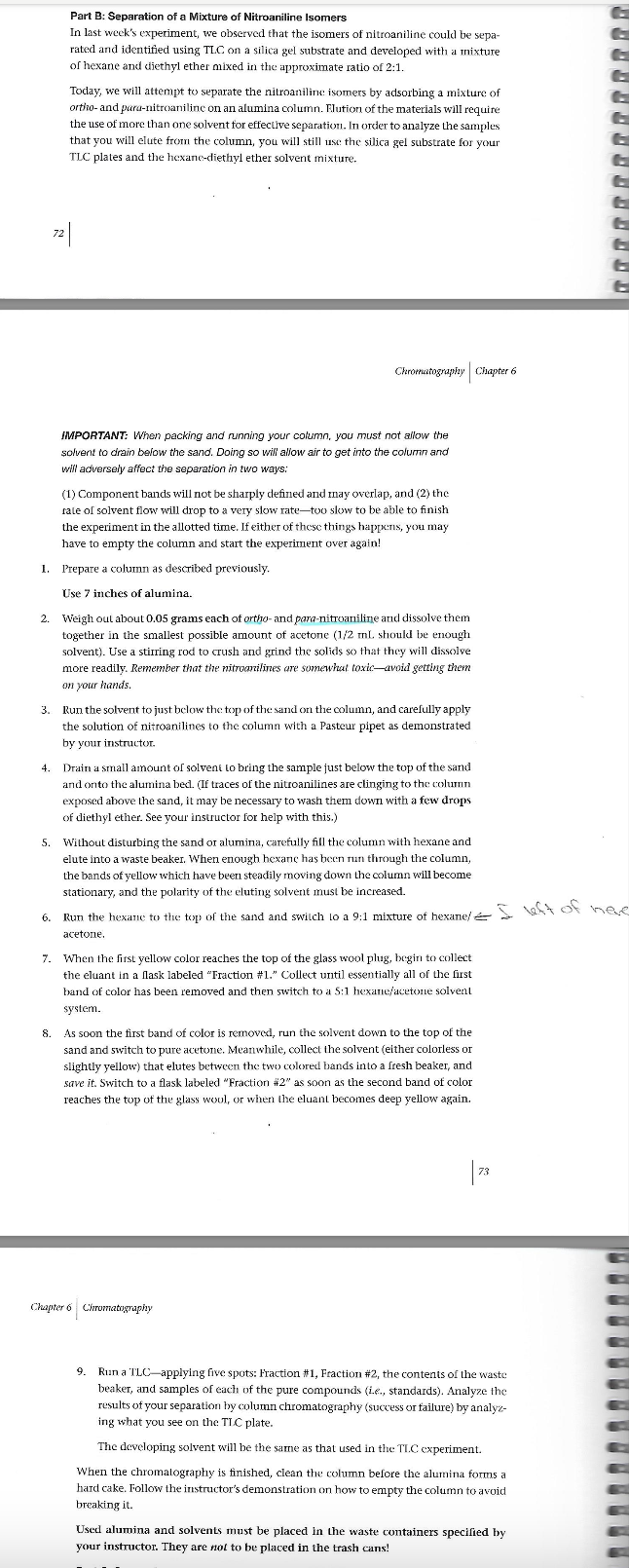
Part B: Separation of a Mixture of Nitroaniline Isomers In last week's experiment, we observed that the isomers of nitroaniline could be sepa- rated and identified using TLC on a silica gel substrate and developed with a mixture of hexane and diethyl ether mixed in the approximate ratio of 2:1. Today, we will attempt to separate the nitroaniline isomers by adsorbing a mixture of ortho- and para-nitroaniline on an alumina column. Elution of the materials will require the use of more than one solvent for effective separation. In order to analyze the samples that you will elute from the column, you will still use the silica gel substrate for your TLC plates and the hexane-diethyl ether solvent mixture. 72 Chromatography Chapter 6 IMPORTANT: When packing and running your column, you must not allow the solvent to drain below the sand. Doing so will allow air to get into the column and will adversely affect the separation in two ways: (1) Component bands will not be sharply defined and may overlap, and (2) the ale of solvent flow will drop to a very slow rate-too slow to be able to finish the experiment in the allotted time. If either of these things happens, you may have to empty the column and start the experiment over again! 1. Prepare a column as described previously. Use 7 inches of alumina. 2. Weigh out about 0.05 grams each of ortho- and pare-nitroaniline and dissolve them together in the smallest possible amount of acetone (1/2 ml should be enough solvent). Use a stirring rod to crush and grind the solids so that they will dissolve more readily. Remember that the nitroanilines are somewhat toxic-avoid getting them on your hands. 3. Run the solvent to just below the top of the sand on the column, and carefully apply the solution of nitroanilines to the column with a Pasteur pipet as demonstrated by your instructor. 4. Drain a small amount of solvent to bring the sample just below the top of the sand and onto the alumina bed. (If traces of the nitroanilines are clinging to the column exposed above the sand, it may be necessary to wash them down with a few drops of diethyl ether. See your instructor for help with this.) 5. Without disturbing the sand or alumina, carefully fill the column with hexane and elute into a waste beaker. When enough hexane has been run through the column, the bands of yellow which have been steadily moving down the column will become stationary, and the polarity of the eluting solvent must be increased. 6. Run the hexane to the top of the sand and switch to a 9:1 mixture of hexane/ = > test of me acetone. 7. When the first yellow color reaches the top of the glass wool plug, begin to collect the eluant in a flask labeled "Fraction #1." Collect until essentially all of the first band of color has been removed and then switch to a 5:1 hexane/acetone solvent system. 8. As soon the first band of color is removed, run the solvent down to the top of the sand and switch to pure acetone. Meanwhile, collect the solvent (either colorless or slightly yellow) that elutes between the two colored bands into a fresh beaker, and save it. Switch to a flask labeled "Fraction #2" as soon as the second band of color reaches the top of the glass wool, or when the eluant becomes deep yellow again. 73 Chapter 6 Chromatography 9. Run a TLC-applying five spots: Fraction #1, Fraction #2, the contents of the waste beaker, and samples of each of the pure compounds (ie., standards). Analyze the results of your separation by column chromatography (success or failure) by analyz- ing what you see on the TIC plate. The developing solvent will be the same as that used in the TIC experiment. When the chromatography is finished, clean the column before the alumina forms a hard cake. Follow the instructor's demonstration on how to empty the column to avoid breaking it. Used alumina and solvents must be placed in the waste containers specified by your instructor. They are not to be placed in the trash cans









 Study Help