summerize of case study about supply dynamics
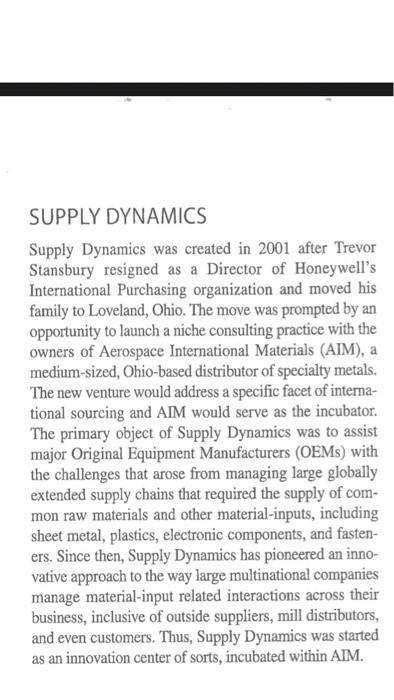
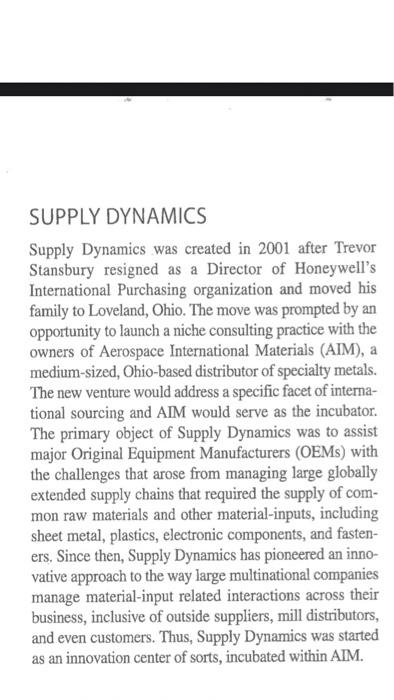
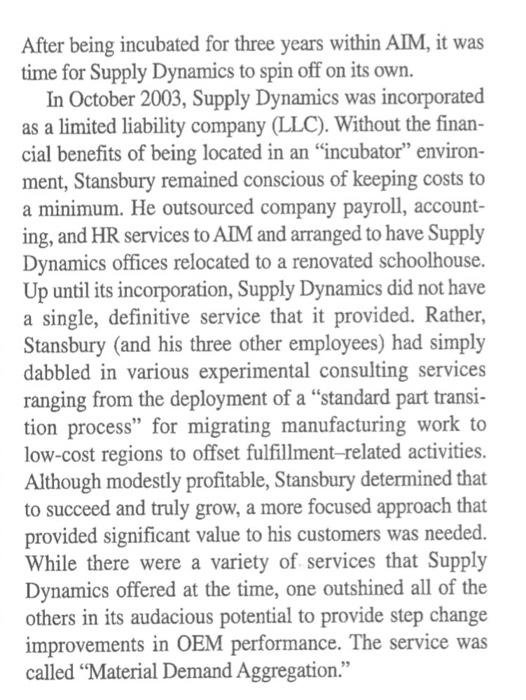
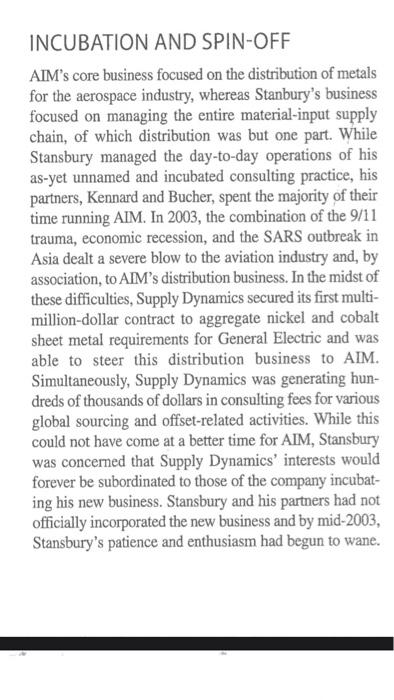
SUPPLY DYNAMICS Supply Dynamics was created in 2001 after Trevor Stansbury resigned as a Director of Honeywell's International Purchasing organization and moved his family to Loveland, Ohio. The move was prompted by an opportunity to launch a niche consulting practice with the owners of Aerospace International Materials (AIM), a medium-sized, Ohio-based distributor of specialty metals. The new venture would address a specific facet of interna- tional sourcing and AIM would serve as the incubator. The primary object of Supply Dynamics was to assist major Original Equipment Manufacturers (OEMs) with the challenges that arose from managing large globally extended supply chains that required the supply of com- mon raw materials and other material-inputs, including sheet metal, plastics, electronic components, and fasten- ers. Since then, Supply Dynamics has pioneered an inno- vative approach to the way large multinational companies manage material-input related interactions across their business, inclusive of outside suppliers, mill distributors, and even customers. Thus, Supply Dynamics was started as an innovation center of sorts, incubated within AIM. SUPPLY DYNAMICS Supply Dynamics was created in 2001 after Trevor Stansbury resigned as a Director of Honeywell's International Purchasing organization and moved his family to Loveland, Ohio. The move was prompted by an opportunity to launch a niche consulting practice with the owners of Aerospace International Materials (AIM), a medium-sized, Ohio-based distributor of specialty metals. The new venture would address a specific facet of interna- tional sourcing and AIM would serve as the incubator. The primary object of Supply Dynamics was to assist major Original Equipment Manufacturers (OEMs) with the challenges that arose from managing large globally extended supply chains that required the supply of com- mon raw materials and other material-inputs, including sheet metal, plastics, electronic components, and fasten- ers. Since then, Supply Dynamics has pioneered an inno- vative approach to the way large multinational companies manage material-input related interactions across their business, inclusive of outside suppliers, mill distributors, and even customers. Thus, Supply Dynamics was started as an innovation center of sorts, incubated within AIM. After being incubated for three years within AIM, it was time for Supply Dynamics to spin off on its own. In October 2003, Supply Dynamics was incorporated as a limited liability company (LLC). Without the finan- cial benefits of being located in an "incubator" environ- ment, Stansbury remained conscious of keeping costs to a minimum. He outsourced company payroll, account- ing, and HR services to AIM and arranged to have Supply Dynamics offices relocated to a renovated schoolhouse. Up until its incorporation, Supply Dynamics did not have a single, definitive service that it provided. Rather, Stansbury (and his three other employees) had simply dabbled in various experimental consulting services ranging from the deployment of a "standard part transi- tion process for migrating manufacturing work to low-cost regions to offset fulfillment-related activities. Although modestly profitable, Stansbury determined that to succeed and truly grow, a more focused approach that provided significant value to his customers was needed. While there were a variety of services that Supply Dynamics offered at the time, one outshined all of the others in its audacious potential to provide step change improvements in OEM performance. The service was called "Material Demand Aggregation." INCUBATION AND SPIN-OFF AIM's core business focused on the distribution of metals for the aerospace industry, whereas Stanbury's business focused on managing the entire material-input supply chain, of which distribution was but one part. While Stansbury managed the day-to-day operations of his as-yet unnamed and incubated consulting practice, his partners, Kennard and Bucher, spent the majority of their time running AIM. In 2003, the combination of the 9/11 trauma, economic recession, and the SARS outbreak in Asia dealt a severe blow to the aviation industry and, by association, to AIM's distribution business. In the midst of these difficulties, Supply Dynamics secured its first multi- million-dollar contract to aggregate nickel and cobalt sheet metal requirements for General Electric and was able to steer this distribution business to AIM. Simultaneously, Supply Dynamics was generating hun- dreds of thousands of dollars in consulting fees for various global sourcing and offset-related activities. While this could not have come at a better time for AIM, Stansbury was concerned that Supply Dynamics' interests would forever be subordinated to those of the company incubat- ing his new business. Stansbury and his partners had not officially incorporated the new business and by mid-2003, Stansbury's patience and enthusiasm had begun to wane