Question: . Supply Chain Cost to Serve Analysis This application problem is intended to reinforce concepts of Supply Chain Cost to Serve Analysis and prepare you
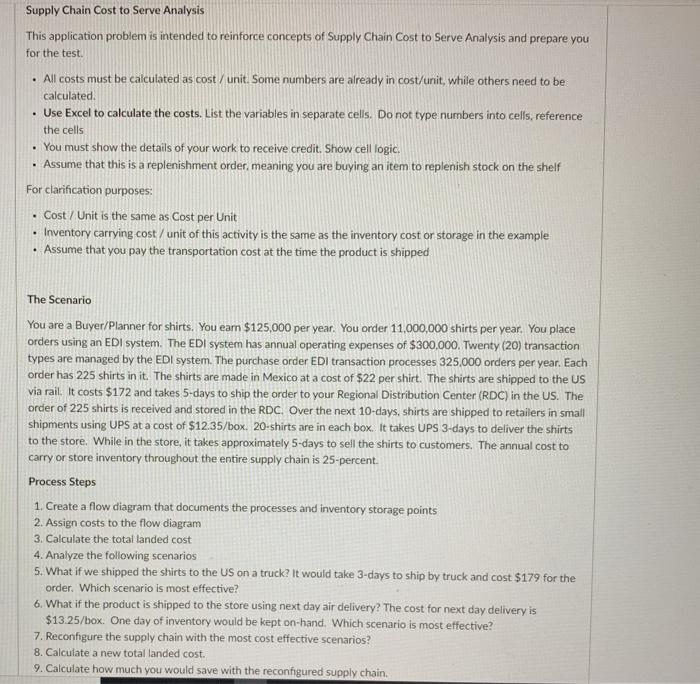
. Supply Chain Cost to Serve Analysis This application problem is intended to reinforce concepts of Supply Chain Cost to Serve Analysis and prepare you for the test. . All costs must be calculated as cost / unit. Some numbers are already in cost/unit, while others need to be calculated. Use Excel to calculate the costs. List the variables in separate cells. Do not type numbers into cells, reference the cells You must show the details of your work to receive credit. Show cell logic. Assume that this is a replenishment order, meaning you are buying an item to replenish stock on the shelf For clarification purposes: Cost / Unit is the same as Cost per Unit Inventory carrying cost / unit of this activity is the same as the inventory cost or storage in the example Assume that you pay the transportation cost at the time the product is shipped . The Scenario You are a Buyer/Planner for shirts. You earn $125,000 per year. You order 11,000,000 shirts per year. You place orders using an EDI system. The EDI system has annual operating expenses of $300,000. Twenty (20) transaction types are managed by the EDI system. The purchase order EDI transaction processes 325,000 orders per year. Each order has 225 shirts in it. The shirts are made in Mexico at a cost of $22 per shirt. The shirts are shipped to the US via rail. It costs $172 and takes 5-days to ship the order to your Regional Distribution Center (RDC) in the US. The order of 225 shirts is received and stored in the RDC. Over the next 10-days, shirts are shipped to retailers in small shipments using UPS at a cost of $12.35/box. 20-shirts are in each box. It takes UPS 3-days to deliver the shirts to the store. While in the store, it takes approximately 5-days to sell the shirts to customers. The annual cost to carry or store inventory throughout the entire supply chain is 25-percent Process Steps 1. Create a flow diagram that documents the processes and inventory storage points 2. Assign costs to the flow diagram 3. Calculate the total landed cost 4. Analyze the following scenarios 5. What if we shipped the shirts to the US on a truck? It would take 3-days to ship by truck and cost $179 for the order. Which scenario is most effective? 6. What if the product is shipped to the store using next day air delivery? The cost for next day delivery is $13.25/box. One day of inventory would be kept on-hand. Which scenario is most effective? 7. Reconfigure the supply chain with the most cost effective scenarios? 8. Calculate a new total landed cost. 9. Calculate how much you would save with the reconfigured supply chain. . Supply Chain Cost to Serve Analysis This application problem is intended to reinforce concepts of Supply Chain Cost to Serve Analysis and prepare you for the test. . All costs must be calculated as cost / unit. Some numbers are already in cost/unit, while others need to be calculated. Use Excel to calculate the costs. List the variables in separate cells. Do not type numbers into cells, reference the cells You must show the details of your work to receive credit. Show cell logic. Assume that this is a replenishment order, meaning you are buying an item to replenish stock on the shelf For clarification purposes: Cost / Unit is the same as Cost per Unit Inventory carrying cost / unit of this activity is the same as the inventory cost or storage in the example Assume that you pay the transportation cost at the time the product is shipped . The Scenario You are a Buyer/Planner for shirts. You earn $125,000 per year. You order 11,000,000 shirts per year. You place orders using an EDI system. The EDI system has annual operating expenses of $300,000. Twenty (20) transaction types are managed by the EDI system. The purchase order EDI transaction processes 325,000 orders per year. Each order has 225 shirts in it. The shirts are made in Mexico at a cost of $22 per shirt. The shirts are shipped to the US via rail. It costs $172 and takes 5-days to ship the order to your Regional Distribution Center (RDC) in the US. The order of 225 shirts is received and stored in the RDC. Over the next 10-days, shirts are shipped to retailers in small shipments using UPS at a cost of $12.35/box. 20-shirts are in each box. It takes UPS 3-days to deliver the shirts to the store. While in the store, it takes approximately 5-days to sell the shirts to customers. The annual cost to carry or store inventory throughout the entire supply chain is 25-percent Process Steps 1. Create a flow diagram that documents the processes and inventory storage points 2. Assign costs to the flow diagram 3. Calculate the total landed cost 4. Analyze the following scenarios 5. What if we shipped the shirts to the US on a truck? It would take 3-days to ship by truck and cost $179 for the order. Which scenario is most effective? 6. What if the product is shipped to the store using next day air delivery? The cost for next day delivery is $13.25/box. One day of inventory would be kept on-hand. Which scenario is most effective? 7. Reconfigure the supply chain with the most cost effective scenarios? 8. Calculate a new total landed cost. 9. Calculate how much you would save with the reconfigured supply chain









 Study Help