



Question: Suppose an elastic bar has constant density, , and Young's modulus, E, uniform cross section, and length L. The bar is initially at the rest
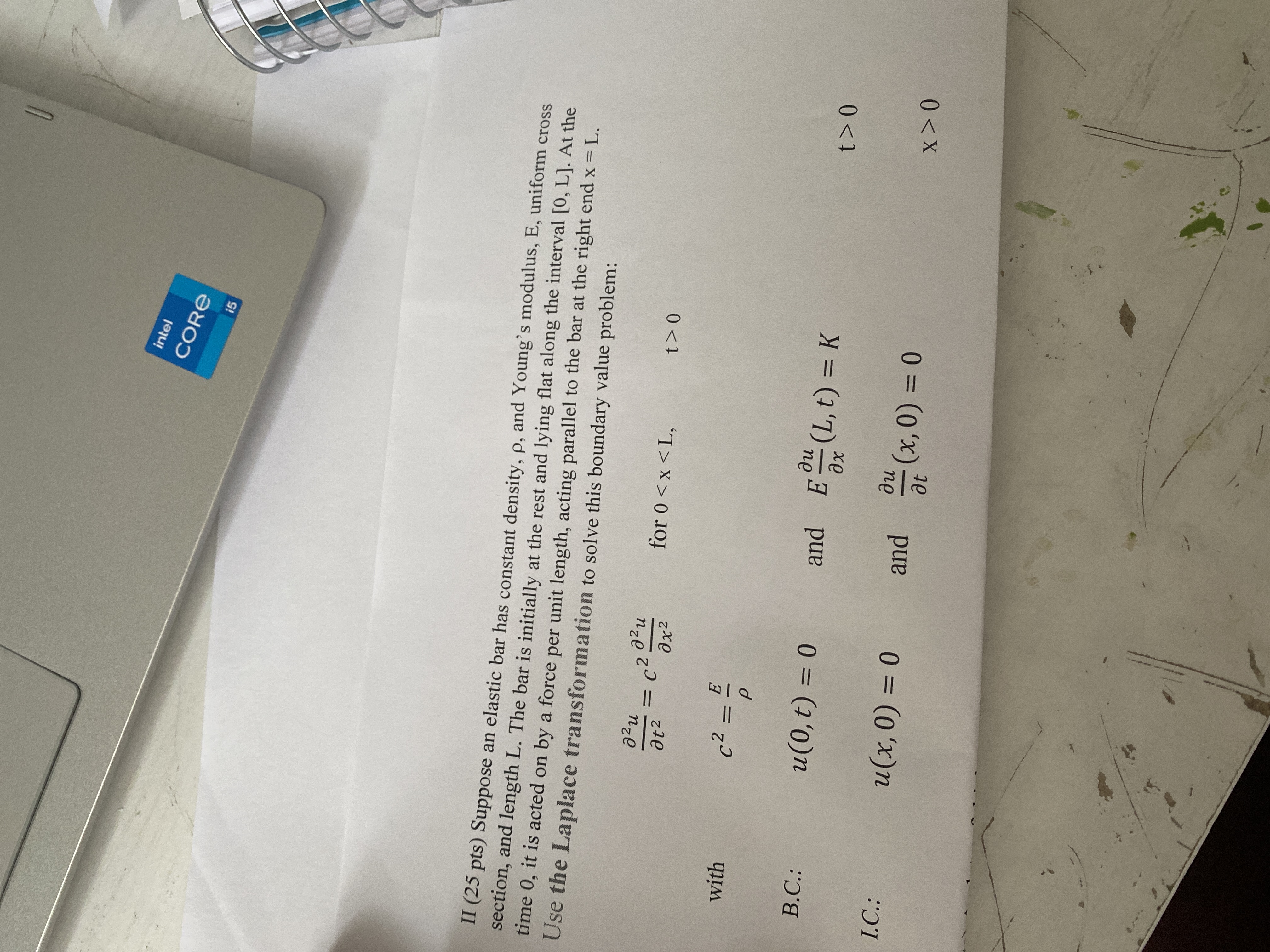
Suppose an elastic bar has constant density, , and Young's modulus, E, uniform cross section, and length L. The bar is initially at the rest and lying flat along the interval [0, L]. At the time 0, it is acted on by a force per unit length, acting parallel to the bar at the right end x = L. Use the Laplace transformation to solve this boundary value problem: with B.C.: I.C.: (0,)=0 (, 0) = 0 t>0 x > 0 2 = 2 2 for 0 0 and (,)= and (, 0) = 0 2 2 =
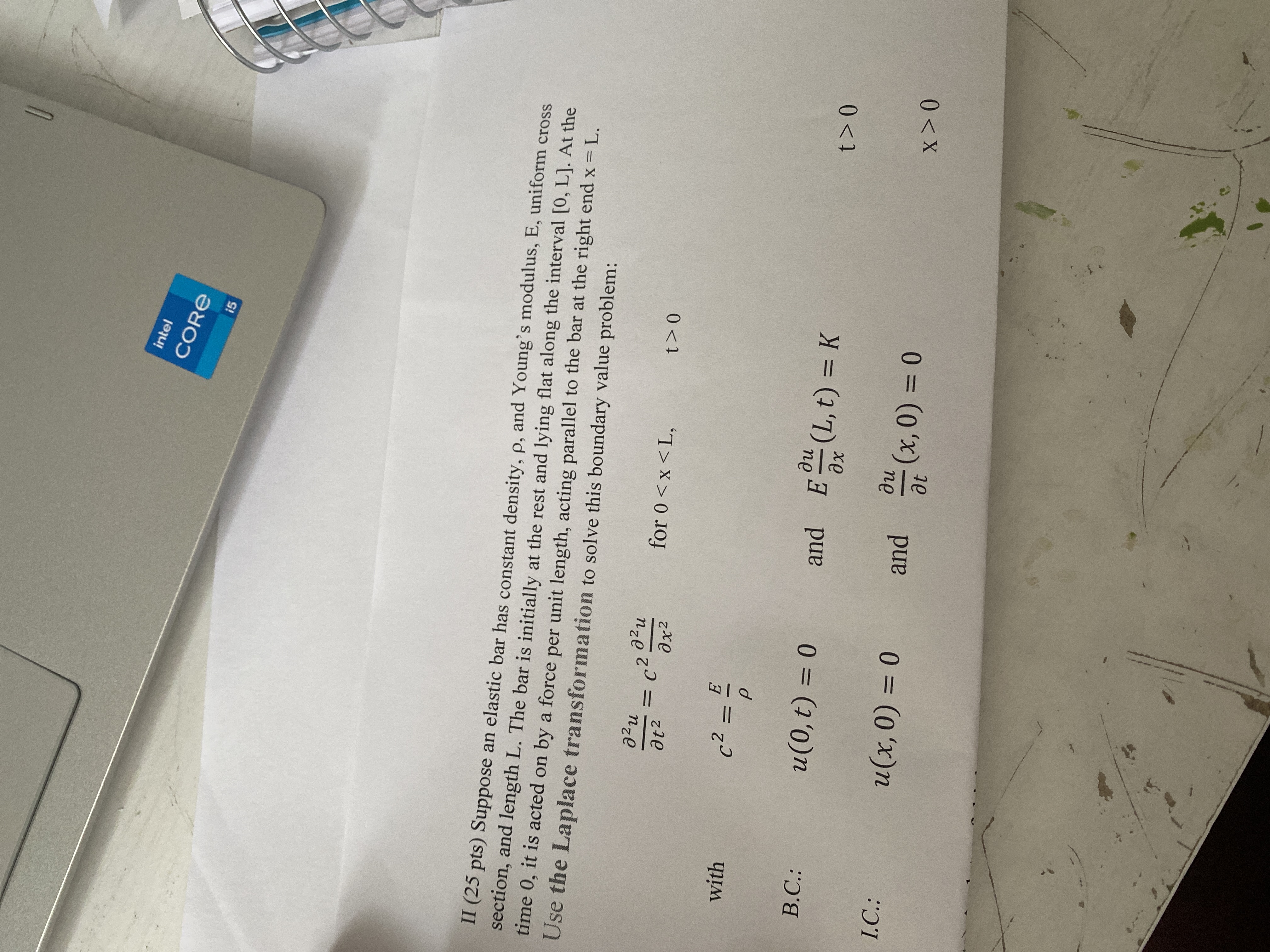
intel CORE 15 II (25 pts) Suppose an elastic bar has constant density, p, and Young's modulus, E, uniform cross section, and length L. The bar is initially at the rest and lying flat along the interval [0, L]. At the time 0, it is acted on by a force per unit length, acting parallel to the bar at the right end x = L. Use the Laplace transformation to solve this boundary value problem: azu at2 for 0 0 2x2 with CZ = B.C.: u(0, t) = 0 ax and E -(L, t) = K t >0 I.C.: u(x, 0) =0 and au at ( x, 0 ) = 0 X > 0
Step by Step Solution
There are 3 Steps involved in it

Get step-by-step solutions from verified subject matter experts