







Question: Suppose one is given a three-layer network that processes a pair of inputs and produces a single output. Assume the first (hidden) layer uses an
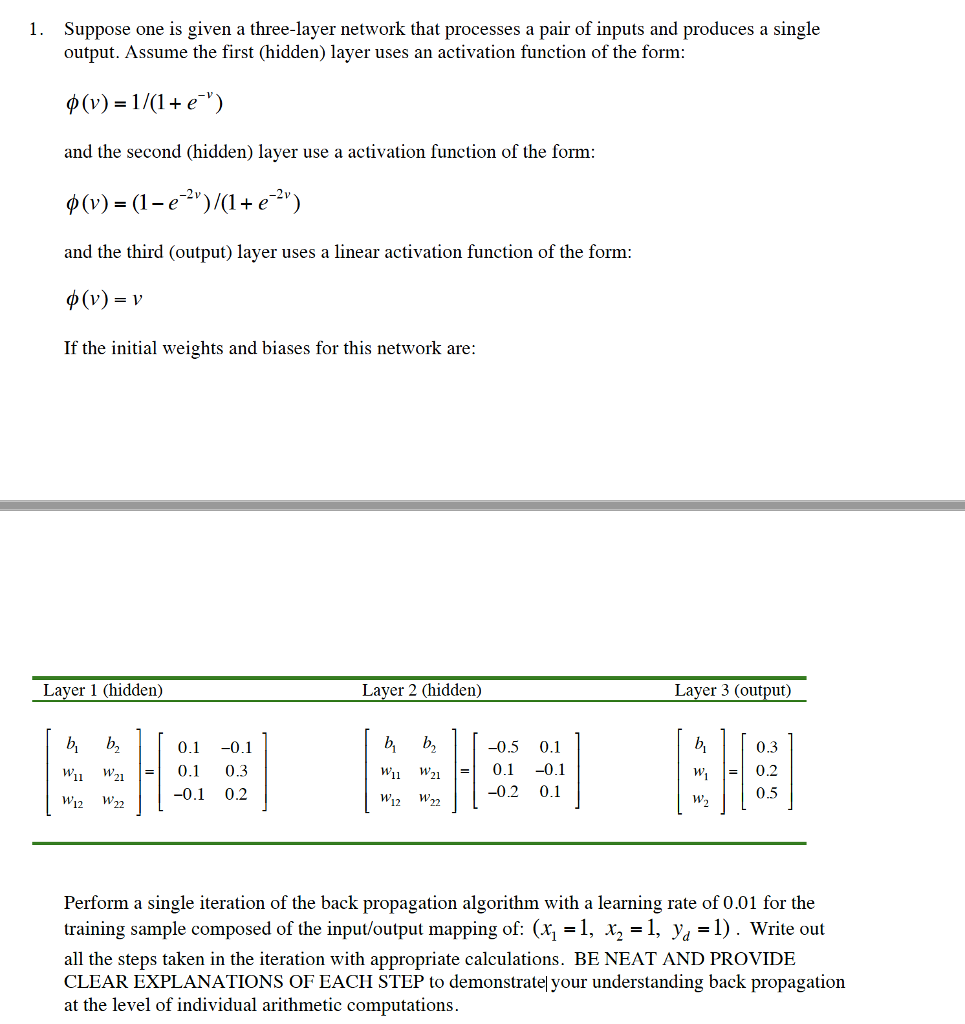
Suppose one is given a three-layer network that processes a pair of inputs and produces a single output. Assume the first (hidden) layer uses an activation function of the form: v) = 1/(1+ e^v) and the second (hidden) layer use a activation function of the form: phi (v) = (1 - e^2v)/(1 + e^2v) and the third (output) layer uses a linear activation function of the form: If the initial weights and biases for this network are: Perform a single iteration of the back propagation algorithm with a learning rate of 0.01 for the training sample composed of the input/output mapping of: (x_1 = 1, x_2 = 1, y_d = 1). Write out all the steps taken in the iteration with appropriate calculations. BE NEAT AND PROVIDE CLEAR EXPLANATIONS OE EACII STEP to demonstrate your understanding back propagation at the level of individual arithmetic computations. Suppose one is given a three-layer network that processes a pair of inputs and produces a single output. Assume the first (hidden) layer uses an activation function of the form: v) = 1/(1+ e^v) and the second (hidden) layer use a activation function of the form: phi (v) = (1 - e^2v)/(1 + e^2v) and the third (output) layer uses a linear activation function of the form: If the initial weights and biases for this network are: Perform a single iteration of the back propagation algorithm with a learning rate of 0.01 for the training sample composed of the input/output mapping of: (x_1 = 1, x_2 = 1, y_d = 1). Write out all the steps taken in the iteration with appropriate calculations. BE NEAT AND PROVIDE CLEAR EXPLANATIONS OE EACII STEP to demonstrate your understanding back propagation at the level of individual arithmetic computations
Step by Step Solution
There are 3 Steps involved in it

Get step-by-step solutions from verified subject matter experts
 Study Help