



Question: Suppose that are to design a wireless network with the following constraints and properties: Cells are arranged in a conventional hexagonal layout, with equal sized
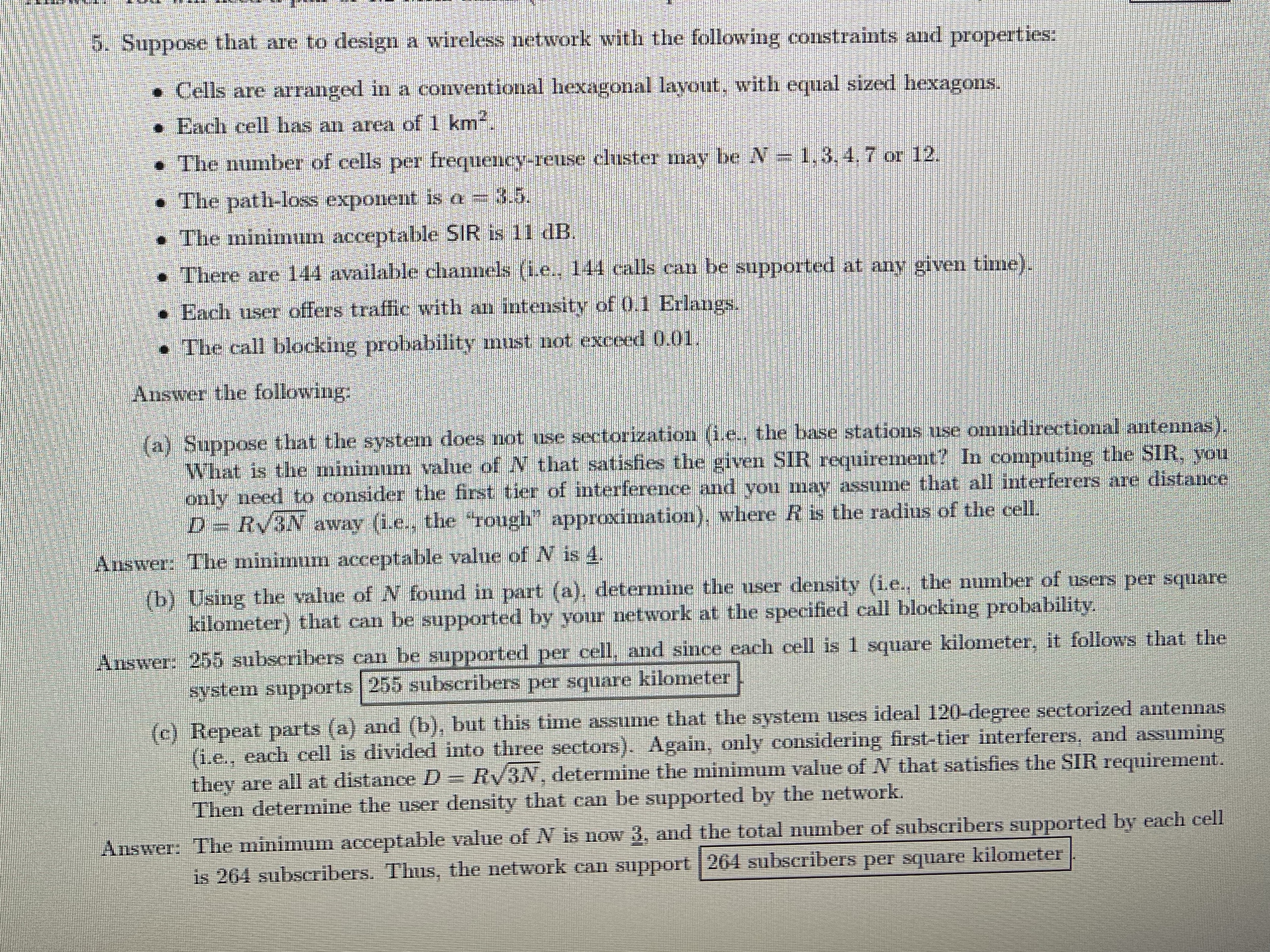
Suppose that are to design a wireless network with the following constraints and properties:
Cells are arranged in a conventional hexagonal layout, with equal sized hexagons.
Each cell has an area of
The number of cells per frequencyreuse cluster may be or
The pathloss exponent is
The minimum acceptable SIR is dB
There are available channels ie calls can be supported at any given time
Each user offers traffic with an intensity of Erlangs.
The call blocking probability must not exceed
Answer the following:
a Suppose that the system does not use sectorization ie the base stations use omnidirectional antennas What is the minimum value of that satisfies the given SIR requirement? In computing the SIR, you only need to consider the first tier of interference and you may assume that all interferers are distance away ie the "rough" approximation where is the radius of the cell.
Answer: The minimum acceptable value of is
b Using the value of found in part a determine the user density ie the number of users per square kilometer that can be supported by your network at the specified call blocking probability.
Answer: subscribers can be supported per cell, and since each cell is square kilometer, it follows that the system supports subscribers per square kilometer
c Repeat parts a and b but this time assume that the system uses ideal degree sectorized antemnas ie each cell is divided into three sectors Again, only considering firsttier interferers, and assuming they are all at distance determine the minimum value of that satisfies the SIR requirement. Then determine the user density that can be supported by the network.
Answer: The minimum acceptable value of is now and the total number of subscribers supported by each cell is subscribers. Thus, the network can support subscribers per square kilometer.
Step by Step Solution
There are 3 Steps involved in it
1 Expert Approved Answer
Step: 1 Unlock

Question Has Been Solved by an Expert!
Get step-by-step solutions from verified subject matter experts
Step: 2 Unlock
Step: 3 Unlock