







Question: Suppose that the representative consumer has the following utility function overconsumption (c) and labour (n):u(c, l) = ln c ?A1 + ?n1+? (1)where, as usual,
Suppose that the representative consumer has the following utility function overconsumption (c) and labour (n):u(c, l) = ln c ?A1 + ?n1+? (1)where, as usual, c denotes consumption and n denotes the number of hoursof labour the consumer chooses to work, The constants A and ? are outsidethe control of the individual, but each is strictly positive. Suppose the budgetconstraint (in real terms) faced by the individual is given by:c = (1 ? t) w n (2)where t is the labour tax rate, w is the real hourly wage rate, and n is thenumber of hours the individual works. Remember, as seen in class, n + l = 1is always true. Using the static consumption-leisure framework, answer thequestions that follow.
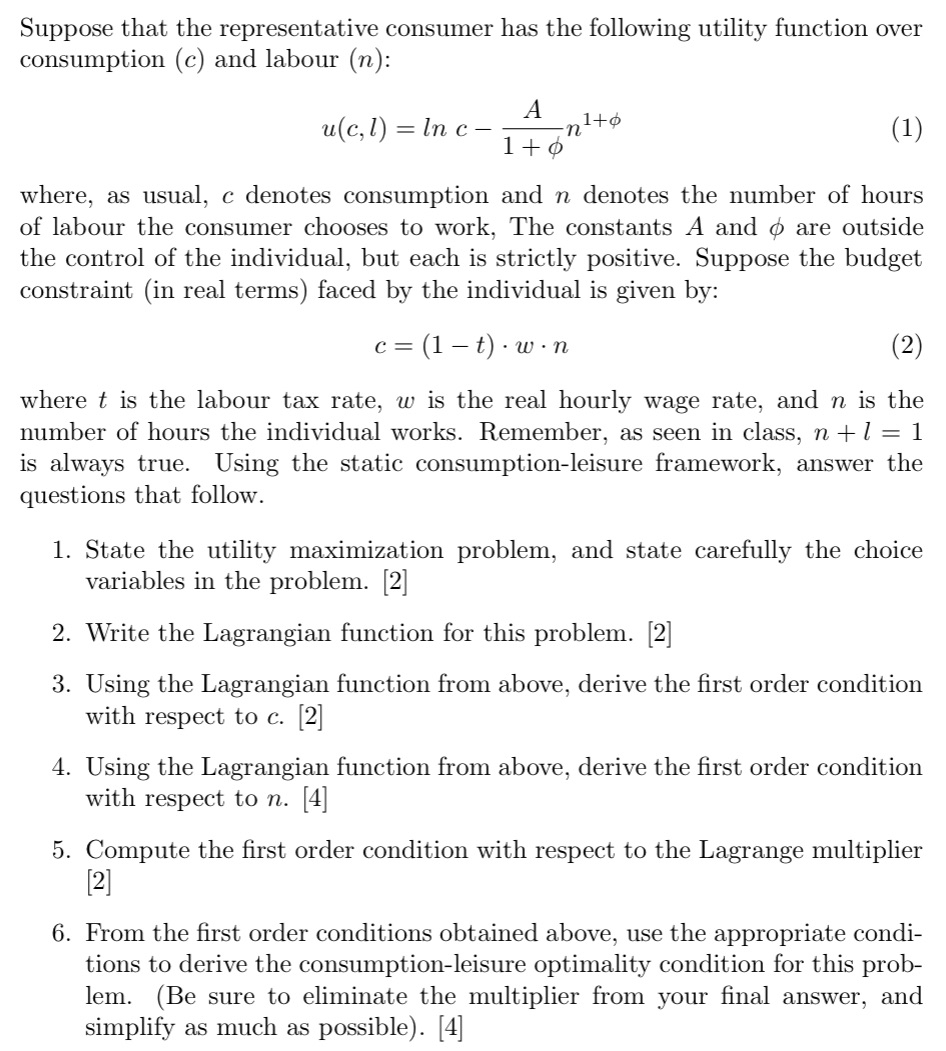
Suppose that the representative consumer has the following utility function over consumption () and labour (n): u(e,l) =1ln c i (1) 1+ where, as usual, denotes consumption and n denotes the number of hours of labour the consumer chooses to work, The constants A and are outside the control of the individual, but each is strictly positive. Suppose the budget constraint (in real terms) faced by the individual is given by: c=(1-t)-w-n (2) where is the labour tax rate, w is the real hourly wage rate, and n is the number of hours the individual works. Remember, as seen in class, n +1 =1 is always true. Using the static consumption-leisure framework, answer the questions that follow. 1. State the utility maximization problem, and state carefully the choice variables in the problem. [2] 2. Write the Lagrangian function for this problem. [2] 3. Using the Lagrangian function from above, derive the first order condition with respect to c. [2] 4. Using the Lagrangian function from above, derive the first order condition with respect to n. [4] 5. Compute the first order condition with respect to the Lagrange multiplier 2] 6. From the first order conditions obtained above, use the appropriate condi- tions to derive the consumption-leisure optimality condition for this prob- lem. (Be sure to eliminate the multiplier from your final answer, and simplify as much as possible). [4]
Step by Step Solution
There are 3 Steps involved in it

Get step-by-step solutions from verified subject matter experts
 Study Help