







Question: Suppose we have a table, called S, where each row has all the following attributes in relation to the company, its departments, employees, and customers.
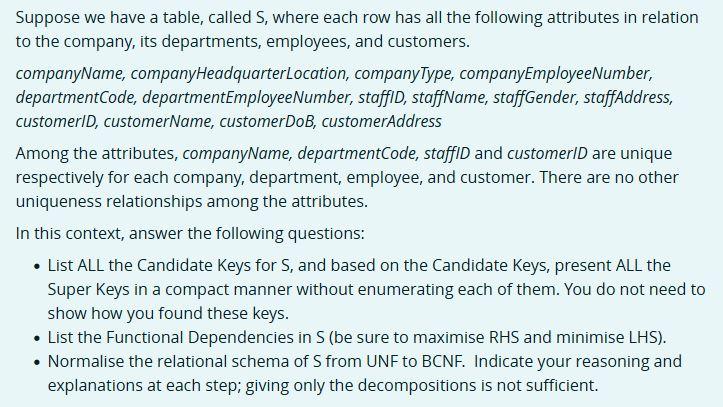
Suppose we have a table, called S, where each row has all the following attributes in relation to the company, its departments, employees, and customers. companyName, companyHeadquarterLocation, companyType, companyEmployeeNumber, departmentCode, departmentEmployeeNumber, staffiD, staffName, staffGender, staffAddress, customerID, customerName, customerDoB, customerAddress Among the attributes, companyName, departmentCode, staffID and customerID are unique respectively for each company, department, employee, and customer. There are no other uniqueness relationships among the attributes. In this context, answer the following questions: - List ALL the Candidate Keys for S, and based on the Candidate Keys, present ALL the Super Keys in a compact manner without enumerating each of them. You do not need to show how you found these keys. - List the Functional Dependencies in S (be sure to maximise RHS and minimise LHS). - Normalise the relational schema of S from UNF to BCNF. Indicate your reasoning and explanations at each step; giving only the decompositions is not sufficient
Step by Step Solution
There are 3 Steps involved in it

Get step-by-step solutions from verified subject matter experts
 Study Help