





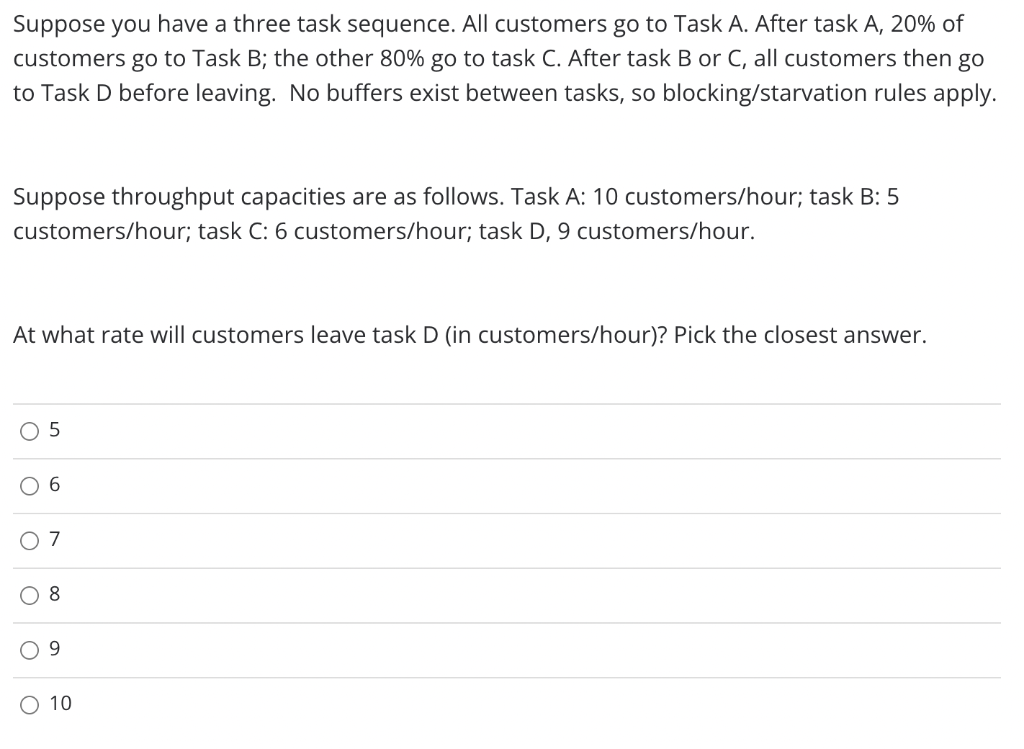
Question: Suppose you have a three task sequence. All customers go to Task A. After task A, 20% of customers go to Task B; the other
Suppose you have a three task sequence. AllSuppose you have a three task sequence. All

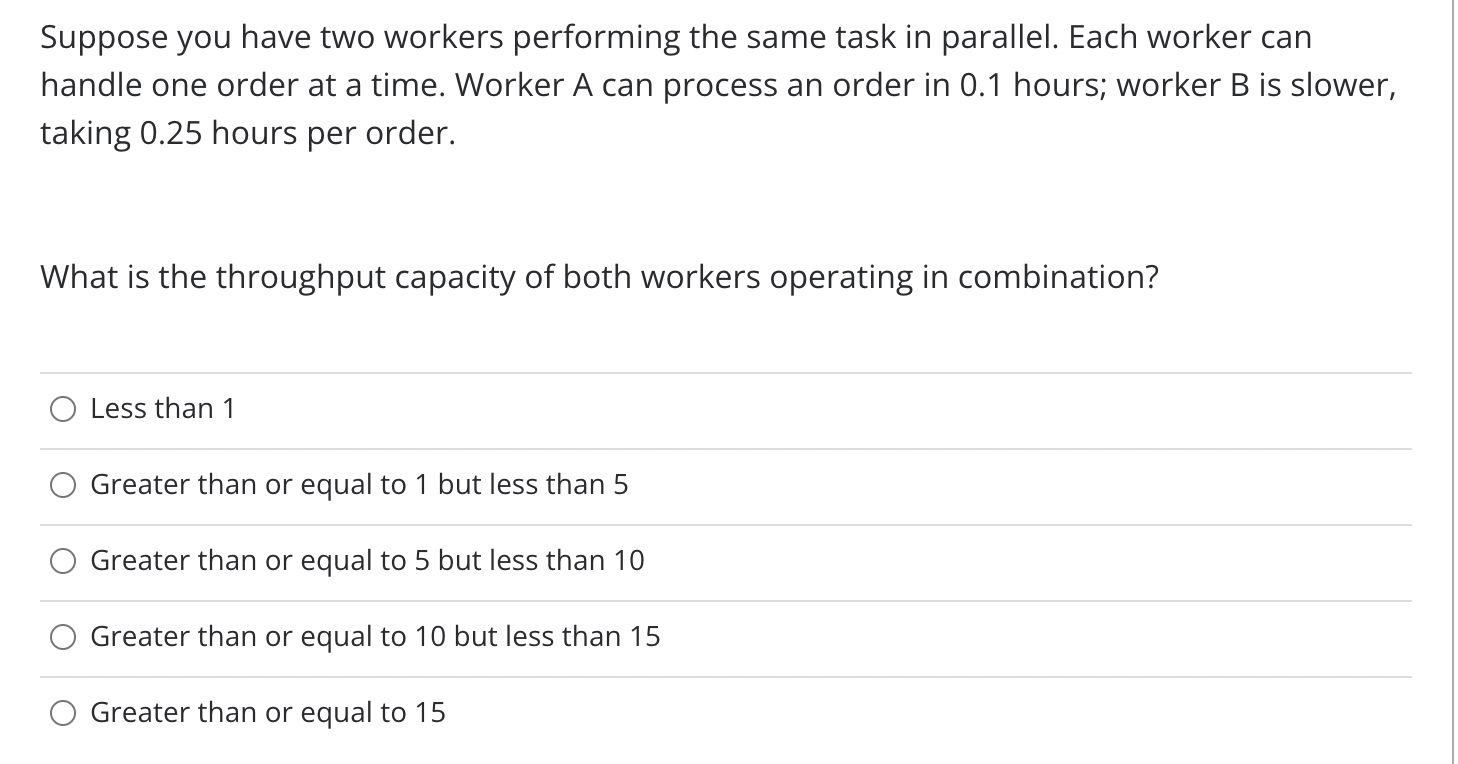
Suppose you have a three task sequence. All customers go to Task A. After task A, 20% of customers go to Task B; the other 80% go to task C. After task B or C, all customers then go to Task D before leaving. No buffers exist between tasks, so blocking/starvation rules apply. Suppose throughput capacities are as follows. Task A: 10 customers/hour; task B: 5 customers/hour; task C: 6 customers/hour; task D, 9 customers/hour. At what rate will customers leave task D (in customers/hour)? Pick the closest answer. O 5 06 o 7 8 o 9 O 10 Suppose you have two workers performing the same task in parallel. Each worker can handle one order at a time. Worker A can process an order in 0.1 hours; worker B is slower, taking 0.25 hours per order. What is the throughput capacity of both workers operating in combination? Less than 1 Greater than or equal to 1 but less than 5 Greater than or equal to 5 but less than 10 Greater than or equal to 10 but less than 15 Greater than or equal to 15

Step by Step Solution

There are 3 Steps involved in it

1 Expert Approved Answer
Step: 1 Unlock blur-text-image

Question Has Been Solved by an Expert!

Get step-by-step solutions from verified subject matter experts

Step: 2 Unlock
Step: 3 Unlock

Students Have Also Explored These Related General Management Questions!