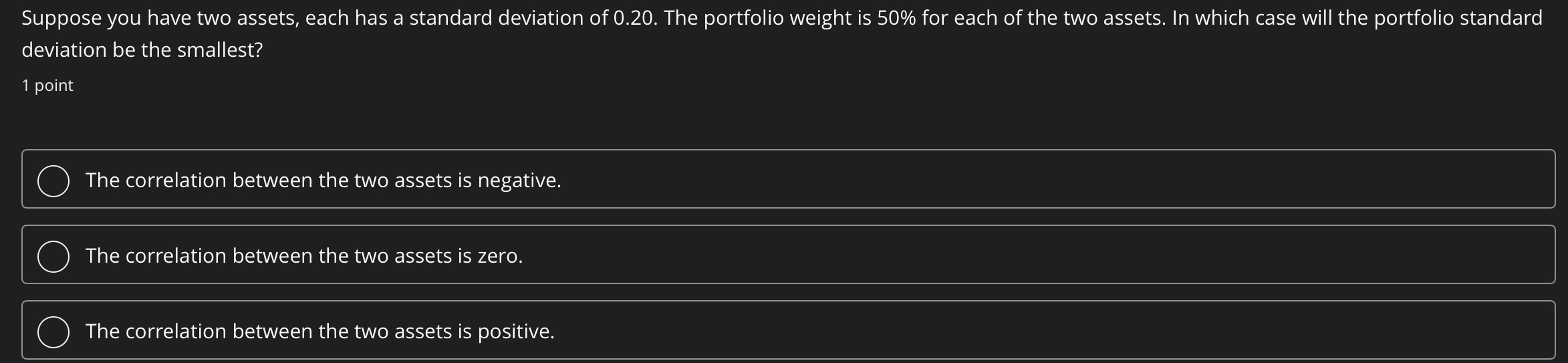
Question: Suppose you have two assets, each has a standard deviation of 0.20. The portfolio weight is 50% for each of the two assets. In which
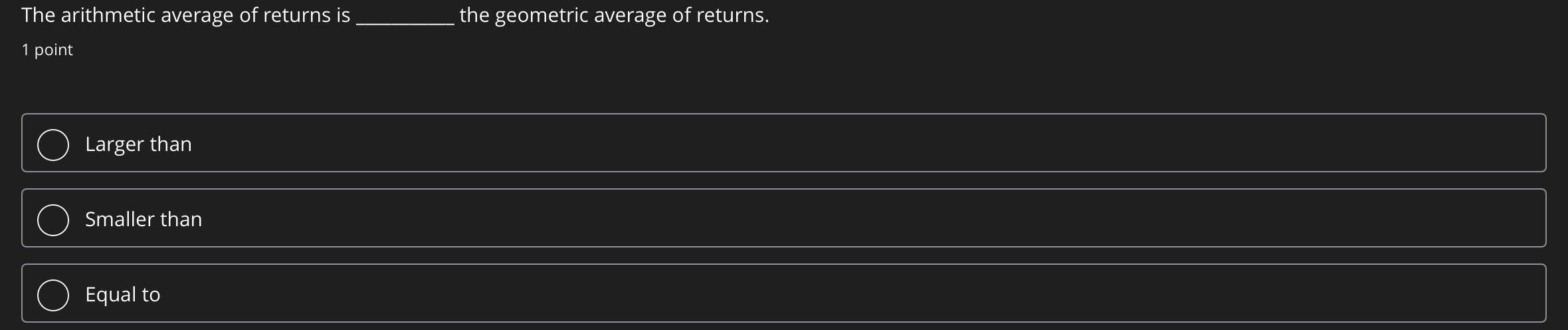
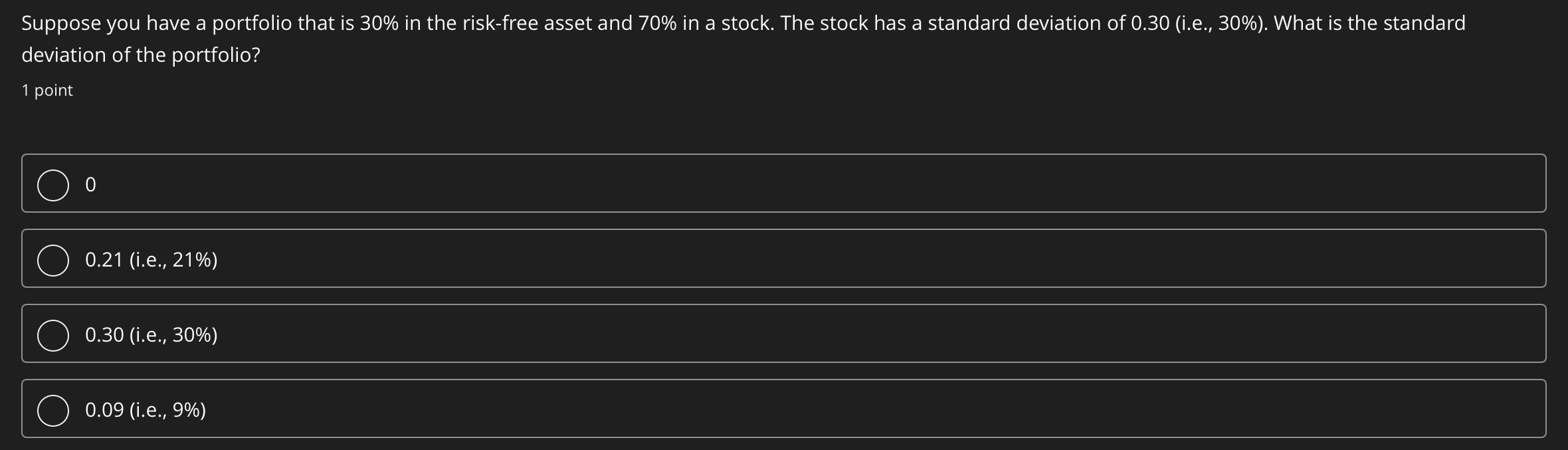
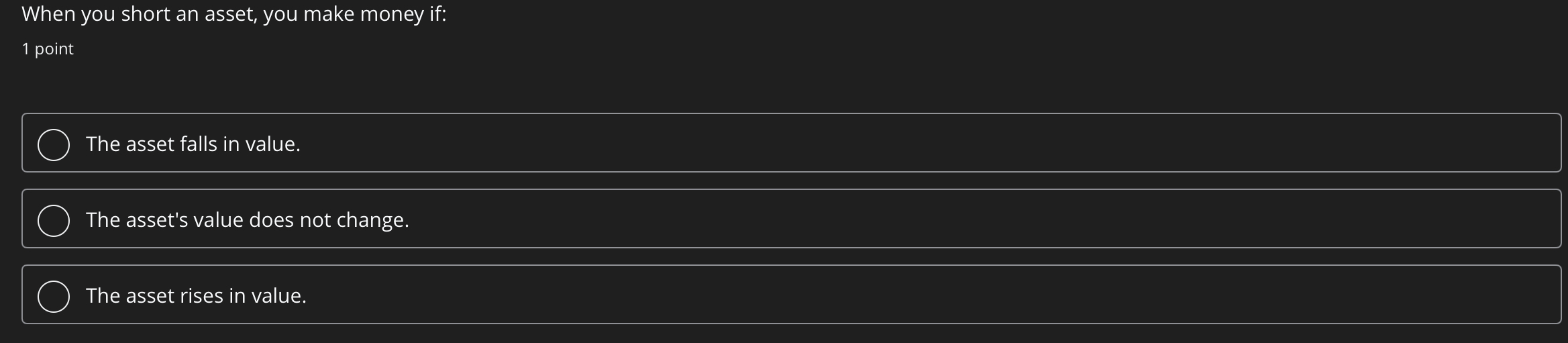
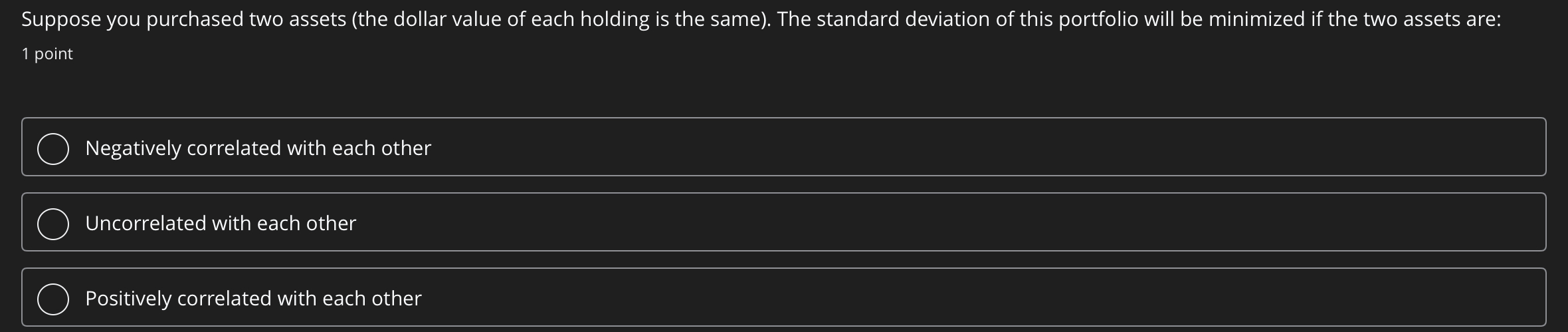
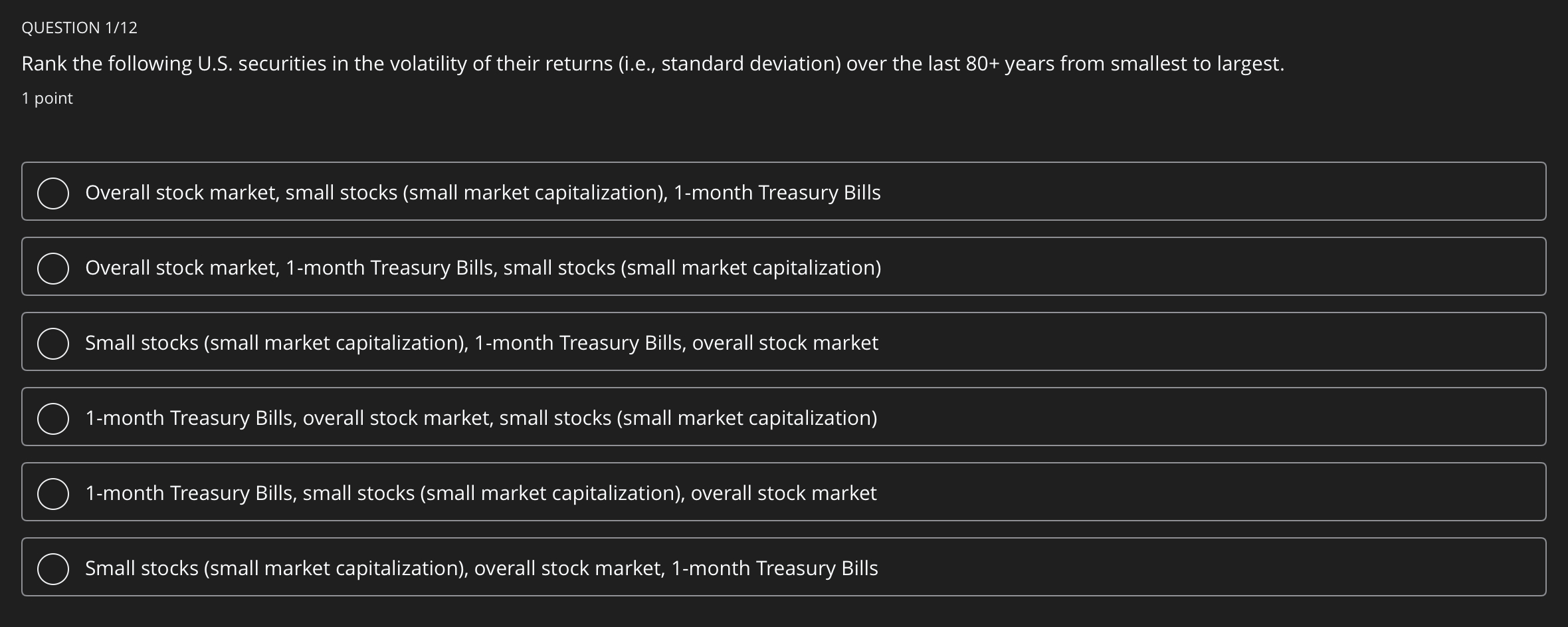
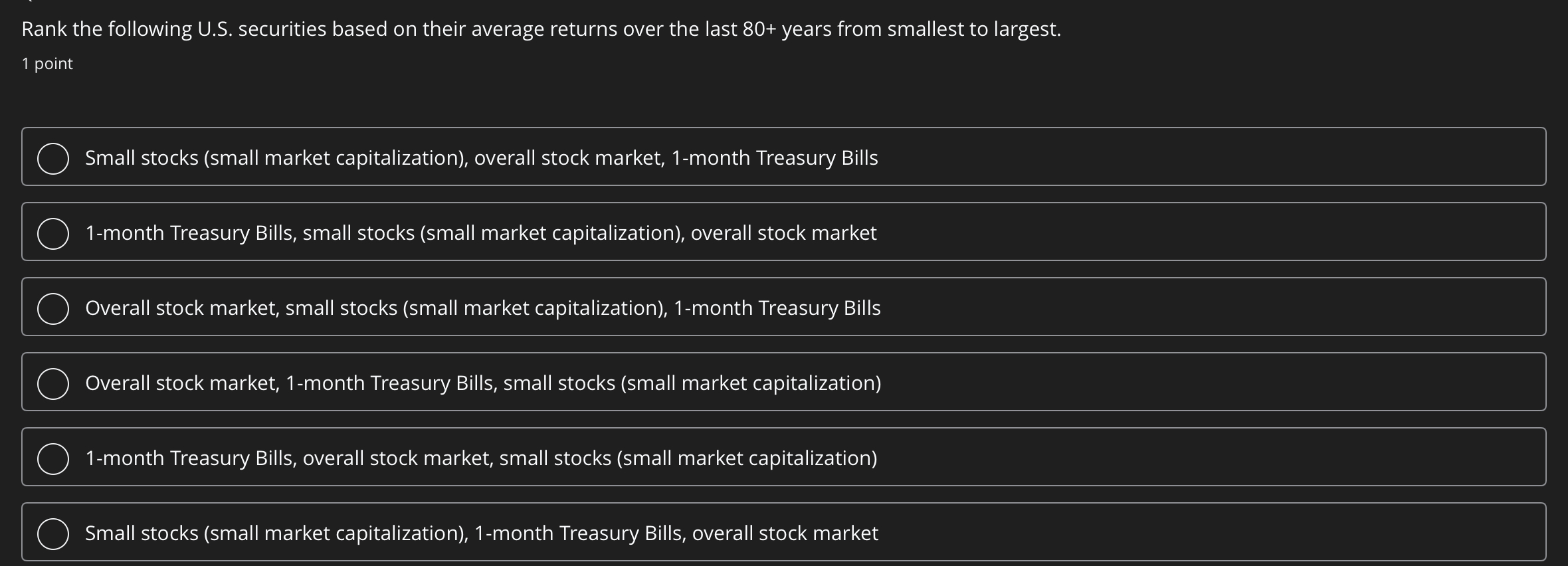
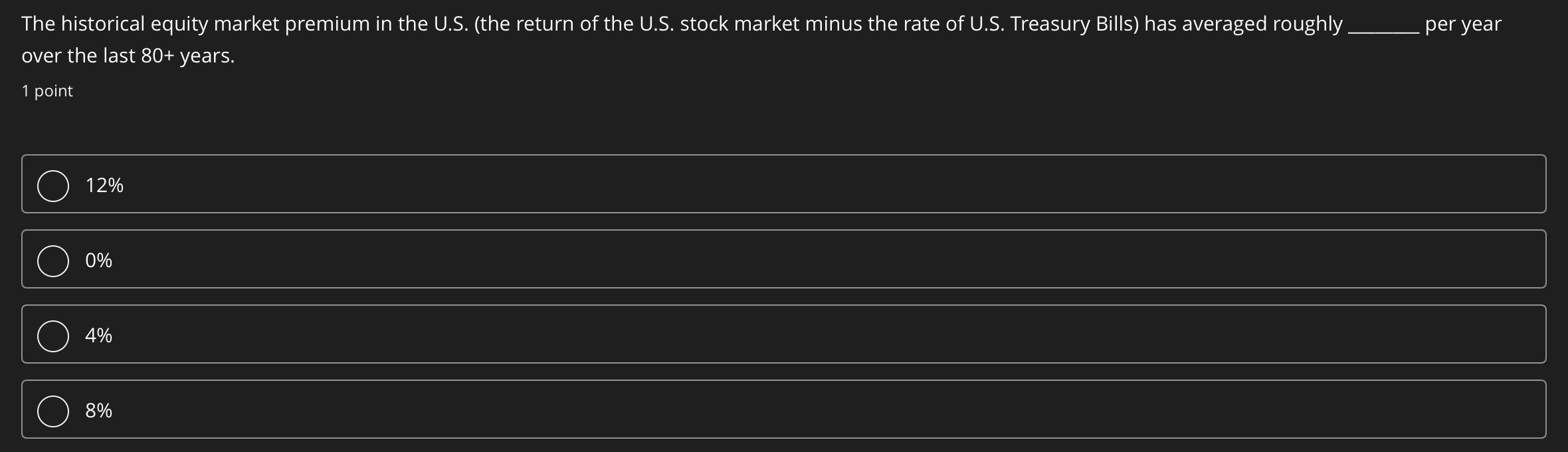
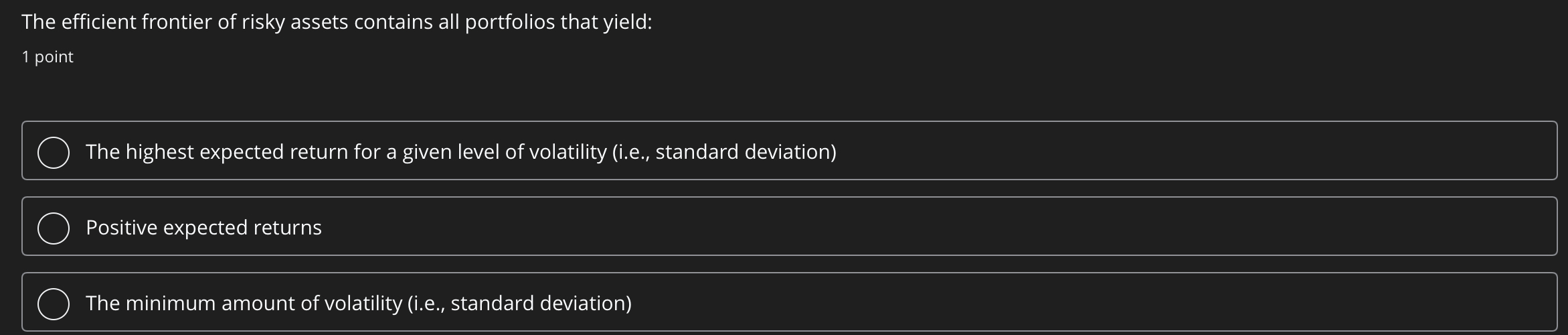
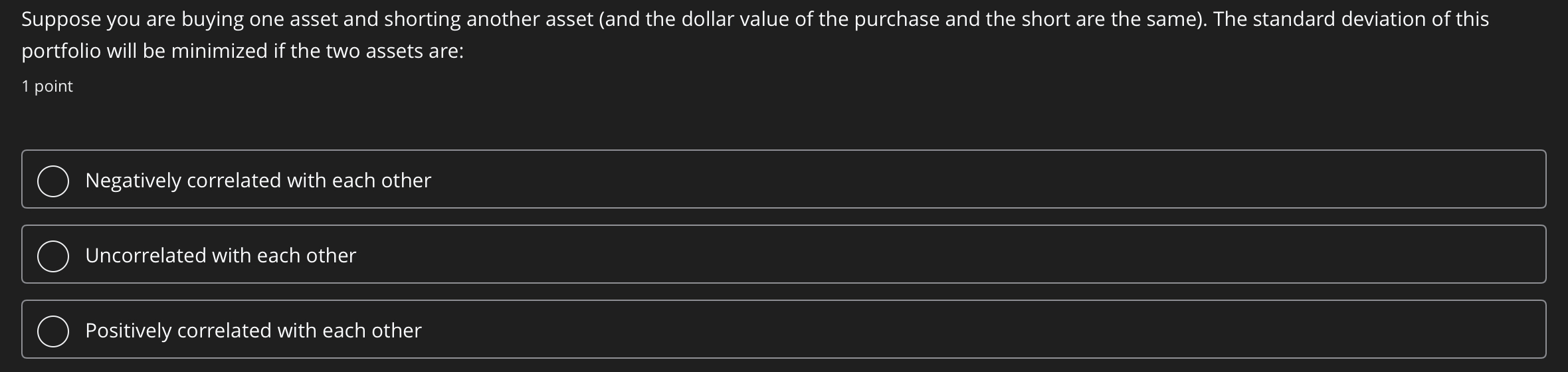
Suppose you have two assets, each has a standard deviation of 0.20. The portfolio weight is 50% for each of the two assets. In which case will the portfolio standard deviation be the smallest? i point l O The correlation between the two assets is negative. l m The correlation between the two assets is zero. V l O The correlation between the two assets is positive. The arithmetic average of returns is the geometric average of returns. 1 point O Larger than O Smaller than O Equal toSuppose you have a portfolio that is 30% in the risk-free asset and 70% in a stock. The stock has a standard deviation of 0.30 (i.e., 30%). What is the standard deviation of the portfolio? 1 point O 0 O 0.21 (i.e., 21%) O 0.30 (i.e., 30%) O 0.09 (i.e., 9%)When you short an asset, you make money if: 1 point O The asset falls in value. O The asset's value does not change. O The asset rises in value.Suppose you purchased two assets (the dollar value of each holding is the same). The standard deviation ofthis portfolio will be minimized if the two assets are: i point l O Negatively correlated with each other l O Uncorrelated with each other l O Positively correlated with each other QUESTION 1/12 Rank the following U.S. securities in the volatility of their returns (i.e., standard deviation) over the last 80+ years from smallest to largest. 1 point O Overall stock market, small stocks (small market capitalization), 1-month Treasury Bills O Overall stock market, 1-month Treasury Bills, small stocks (small market capitalization) O Small stocks (small market capitalization), 1-month Treasury Bills, overall stock market O 1-month Treasury Bills, overall stock market, small stocks (small market capitalization) O 1-month Treasury Bills, small stocks (small market capitalization), overall stock market O Small stocks (small market capitalization), overall stock market, 1-month Treasury BillsRank the following U.S. securities based on their average returns over the last 80+ years from smallest to largest. i point Small stocks (small market capitalization), overall stock market, 1-month Treasury Bills i-m th Treasury Bills, small stocks (small market capitalization), overall stock market Overall stock market, small stocks (small market capitalization), 1-month Treasury Bills Overall stock m rket, 1-month Treasury Bills, small stocks (small market capitalization) 1-month Treasury Bills, overall stock market, small stocks (small market capitalization) Small stocks (small market capitalization), 1-month Treasury Bills, overall stock market The return of the U.S. stock market has averaged roughly per year over the last 80+ years. 1 point O 0% 4% O 12% O 8%The historical equity market premium in the U.S. (the return of the U.S. stock market minus the rate of U.S. Treasury Bills) has averaged roughly per year over the last 80+ years. 1 point O 12% 0% 4% O 8%The efficient frontier of risky assets contains all portfolios that yield: 1 point 0 The highest expected return for a given level of volatility (i.e., standard deviation) 0 Positive expected returns 0 The minimum amount of volatility (i.e., standard deviation) Suppose you are buying one asset and shorting another asset (and the dollar value of the purchase and the short are the same). The standard deviation of this portfolio will be minimized if the two assets are: 1 point l O Negatively correlated with each other l O Uncorrelated with each other l O Positively correlated with each other A dominated portfolio of risky assets: i point l 0 Offers the lowest standard deviation of all possible portfolios of risky assets l 0 Has the same standard deviation as another portfolio of risky assets but offers a lower expected return V l 0 Offers the highest expected return possible given its standard deviation
Step by Step Solution
There are 3 Steps involved in it
1 Expert Approved Answer
Step: 1 Unlock
Question Has Been Solved by an Expert!
Get step-by-step solutions from verified subject matter experts
Step: 2 Unlock
Step: 3 Unlock
Students Have Also Explored These Related Accounting Questions!











 Study Help