







Question: Suppose you have two loops. A current flows through one loop and creates a magnetic field. Some of the magnetic field lines pass through the
Suppose you have two loops. A current flows through one loop and creates a magnetic field. Some of the magnetic field lines pass through the second loop and so there is a flux through the second loop.
Although it might be difficult to calculate the flux depending on how the loops are arranged it should be easy to convince yourself that the flux depends on the current in the first loop. Furthermore, if the sizes, shapes, and relative positions of the loops are not changing, then everything else can be grouped into a constant and the flux can be written as Where is the flux in loop is the current in loop and is our constant. If you switch things around and instead send the current through loop and look at the current in loop then you have The neat part is that since this constant only depends on the sizes, shapes, and relative positions of the loops. This constant is called the mutual inductance.
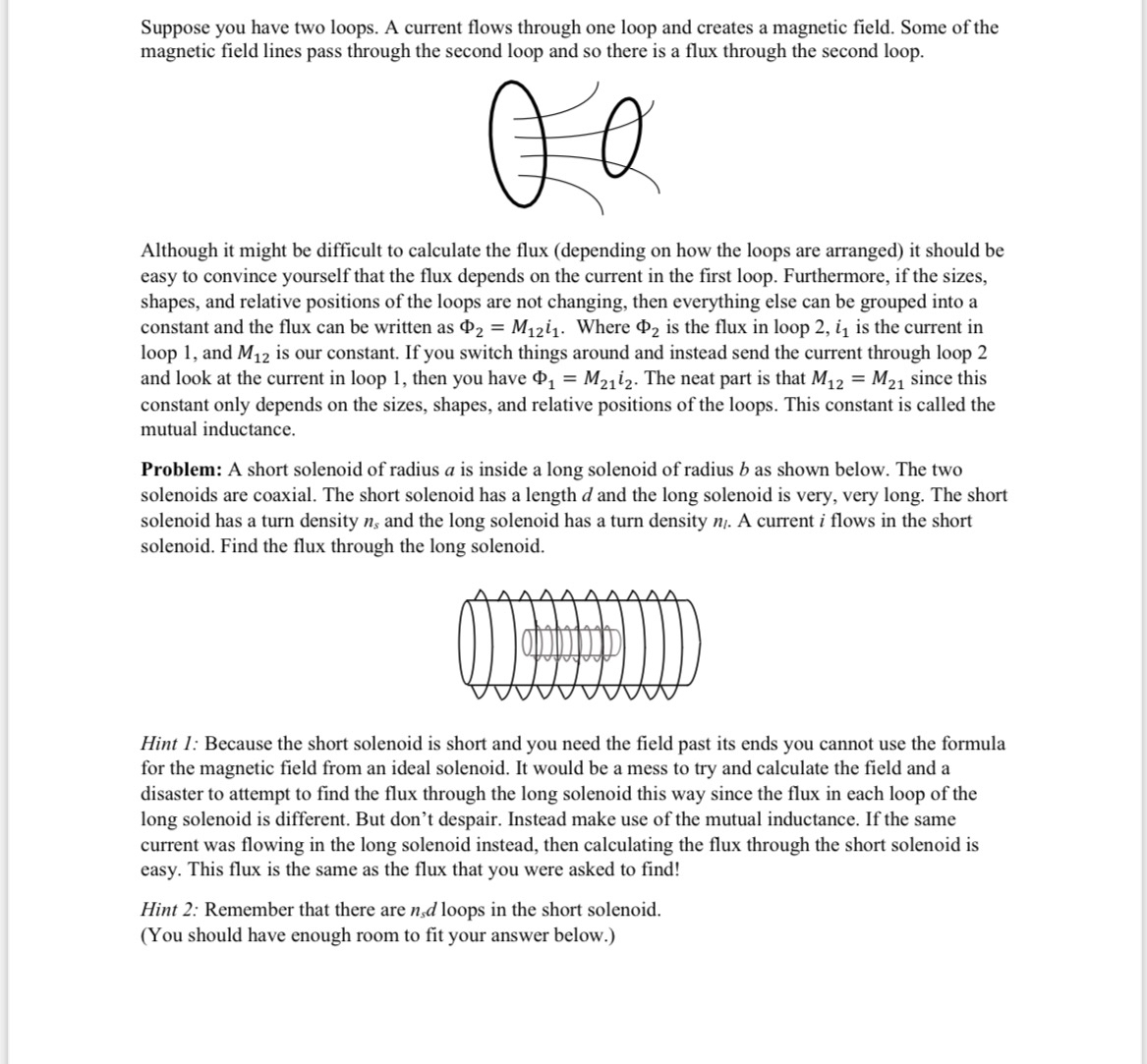
Problem: A short solenoid of radius is inside a long solenoid of radius as shown below. The two solenoids are coaxial. The short solenoid has a length and the long solenoid is very, very long. The short solenoid has a turn density and the long solenoid has a turn density A current i flows in the short solenoid. Find the flux through the long solenoid.
Hint : Because the short solenoid is short and you need the field past its ends you cannot use the formula for the magnetic field from an ideal solenoid. It would be a mess to try and calculate the field and a disaster to attempt to find the flux through the long solenoid this way since the flux in each loop of the long solenoid is different. But don't despair. Instead make use of the mutual inductance. If the same current was flowing in the long solenoid instead, then calculating the flux through the short solenoid is easy. This flux is the same as the flux that you were asked to find!
Hint : Remember that there are loops in the short solenoid. You should have enough room to fit your answer below.
Step by Step Solution
There are 3 Steps involved in it
1 Expert Approved Answer
Step: 1 Unlock

Question Has Been Solved by an Expert!
Get step-by-step solutions from verified subject matter experts
Step: 2 Unlock
Step: 3 Unlock
 Study Help