Question: systems engineering III. OOP & SysML (70 points) Question 1 (20 points): Build a block definition diagram of the overall system and clearly label all
systems engineering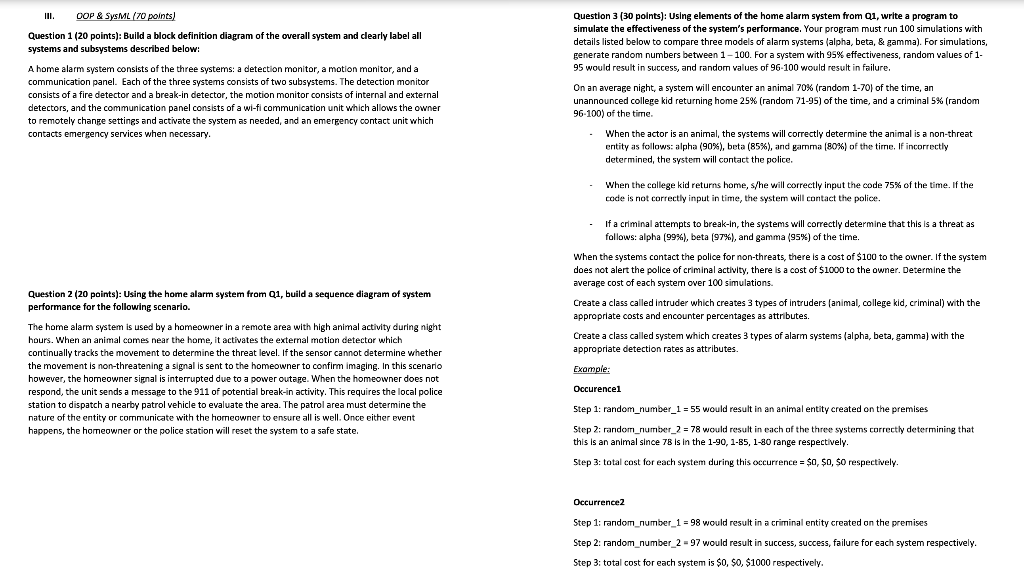
III. OOP & SysML (70 points) Question 1 (20 points): Build a block definition diagram of the overall system and clearly label all systems and subsystems described below: A home alarm system consists of the three systems: a detection monitor, a motion monitor, and a communication panel. Each of the three systems consists of two subsystems. The detection monitor consists of a fire detector and a break-in detector, the motion monitor consists of internal and external detectors, and the communication panel consists of a wi-fi communication unit which allows the owner to remotely change settings and activate the system as needed, and an emergency contact unit which contacts emergency services when necessary. Question 3 (30 points): Using elements of the home alarm system from Q1, write a program to simulate the effectiveness of the system's performance. Your program must run 100 simulations with details listed below to compare three models of alarm systems (alpha, beta, & gamma). For simulations, generate random numbers between 1-100. For a system with 95% effectiveness, random values of 1- 95 would result in success, and random values of 96-100 would result in failure. , . On an average night, a system will encounter an animal 70% (random 1-70) of the time, an unannounced college kid returning home 25% (random 71-95) of the time, and a criminal 5% (random 96-100) of the time. When the actor is an animal, the systems will correctly determine the animal is a non-threat entity as follows: alpha (90%), beta (85%), and gamma (80%) of the time. If incorrectly determined the system will contact the police. When the college kid returns home, s/he will correctly input the code 75% of the time. If the code is not correctly input in time, the system will contact the police. Question 2 (20 points): Using the home alarm system from Q1, build a sequence diagram of system performance for the following scenario. If a criminal attempts to break-in, the systems will correctly determine that this is a threat as follows: alpha (99%), beta (97%), and gamma (95%) of the time. When the systems contact the police for non-threats, there is a cost of $100 to the owner. If the system does not alert the police of criminal activity, there is a cost of $1000 to the owner. Determine the average cost of each system over 100 simulations. Create a class called intruder which creates 3 types of intruders (animal, college kid criminal) with the appropriate costs and encounter percentages as attributes. Create a class called system which creates 3 types of alarm systems (alpha, beta, gamma) with the appropriate detection rates as attributes. . Example: The home alarm system is used by a homeowner in a remote area with high animal activity during night hours. When an animal comes near the home, it activates the external motion detector which continually tracks the movement to determine the threat level. If the sensor cannot determine whether the movement is non-threatening a signal is sent to the homeowner to confirm imaging. In this scenario however, the homeowner signal is interrupted due to a power outage. When the homeowner does not respond, the unit sends a message to the 911 of potential break-in activity. This requires the local police station to dispatch a nearby patrol vehicle to evaluate the area. The patrol area must determine the nature of the entity or communicate with the homeowner to ensure all is well. Once either event happens, the homeowner or the police station will reset the system to a safe state. a Occurence1 Step 1: random_number_1 = 55 would result in an animal entity created on the premises Step 2: random_number_2 = 78 would result in each of the three systems correctly determining that this is an animal since 78 is in the 1-90, 1-85, 1-80 range respectively. Step 3: total cost for each system during this occurrence = $0, $0, $o respectively. Occurrence2 Step 1: random_number_1 = 98 would result in a criminal entity created on the premises Step 2: random_number_2-97 would result in success, success, failure for each system respectively. Step 3: total cost for each system is $0, $o, $1000 respectively. III. OOP & SysML (70 points) Question 1 (20 points): Build a block definition diagram of the overall system and clearly label all systems and subsystems described below: A home alarm system consists of the three systems: a detection monitor, a motion monitor, and a communication panel. Each of the three systems consists of two subsystems. The detection monitor consists of a fire detector and a break-in detector, the motion monitor consists of internal and external detectors, and the communication panel consists of a wi-fi communication unit which allows the owner to remotely change settings and activate the system as needed, and an emergency contact unit which contacts emergency services when necessary. Question 3 (30 points): Using elements of the home alarm system from Q1, write a program to simulate the effectiveness of the system's performance. Your program must run 100 simulations with details listed below to compare three models of alarm systems (alpha, beta, & gamma). For simulations, generate random numbers between 1-100. For a system with 95% effectiveness, random values of 1- 95 would result in success, and random values of 96-100 would result in failure. , . On an average night, a system will encounter an animal 70% (random 1-70) of the time, an unannounced college kid returning home 25% (random 71-95) of the time, and a criminal 5% (random 96-100) of the time. When the actor is an animal, the systems will correctly determine the animal is a non-threat entity as follows: alpha (90%), beta (85%), and gamma (80%) of the time. If incorrectly determined the system will contact the police. When the college kid returns home, s/he will correctly input the code 75% of the time. If the code is not correctly input in time, the system will contact the police. Question 2 (20 points): Using the home alarm system from Q1, build a sequence diagram of system performance for the following scenario. If a criminal attempts to break-in, the systems will correctly determine that this is a threat as follows: alpha (99%), beta (97%), and gamma (95%) of the time. When the systems contact the police for non-threats, there is a cost of $100 to the owner. If the system does not alert the police of criminal activity, there is a cost of $1000 to the owner. Determine the average cost of each system over 100 simulations. Create a class called intruder which creates 3 types of intruders (animal, college kid criminal) with the appropriate costs and encounter percentages as attributes. Create a class called system which creates 3 types of alarm systems (alpha, beta, gamma) with the appropriate detection rates as attributes. . Example: The home alarm system is used by a homeowner in a remote area with high animal activity during night hours. When an animal comes near the home, it activates the external motion detector which continually tracks the movement to determine the threat level. If the sensor cannot determine whether the movement is non-threatening a signal is sent to the homeowner to confirm imaging. In this scenario however, the homeowner signal is interrupted due to a power outage. When the homeowner does not respond, the unit sends a message to the 911 of potential break-in activity. This requires the local police station to dispatch a nearby patrol vehicle to evaluate the area. The patrol area must determine the nature of the entity or communicate with the homeowner to ensure all is well. Once either event happens, the homeowner or the police station will reset the system to a safe state. a Occurence1 Step 1: random_number_1 = 55 would result in an animal entity created on the premises Step 2: random_number_2 = 78 would result in each of the three systems correctly determining that this is an animal since 78 is in the 1-90, 1-85, 1-80 range respectively. Step 3: total cost for each system during this occurrence = $0, $0, $o respectively. Occurrence2 Step 1: random_number_1 = 98 would result in a criminal entity created on the premises Step 2: random_number_2-97 would result in success, success, failure for each system respectively. Step 3: total cost for each system is $0, $o, $1000 respectively









 Study Help