







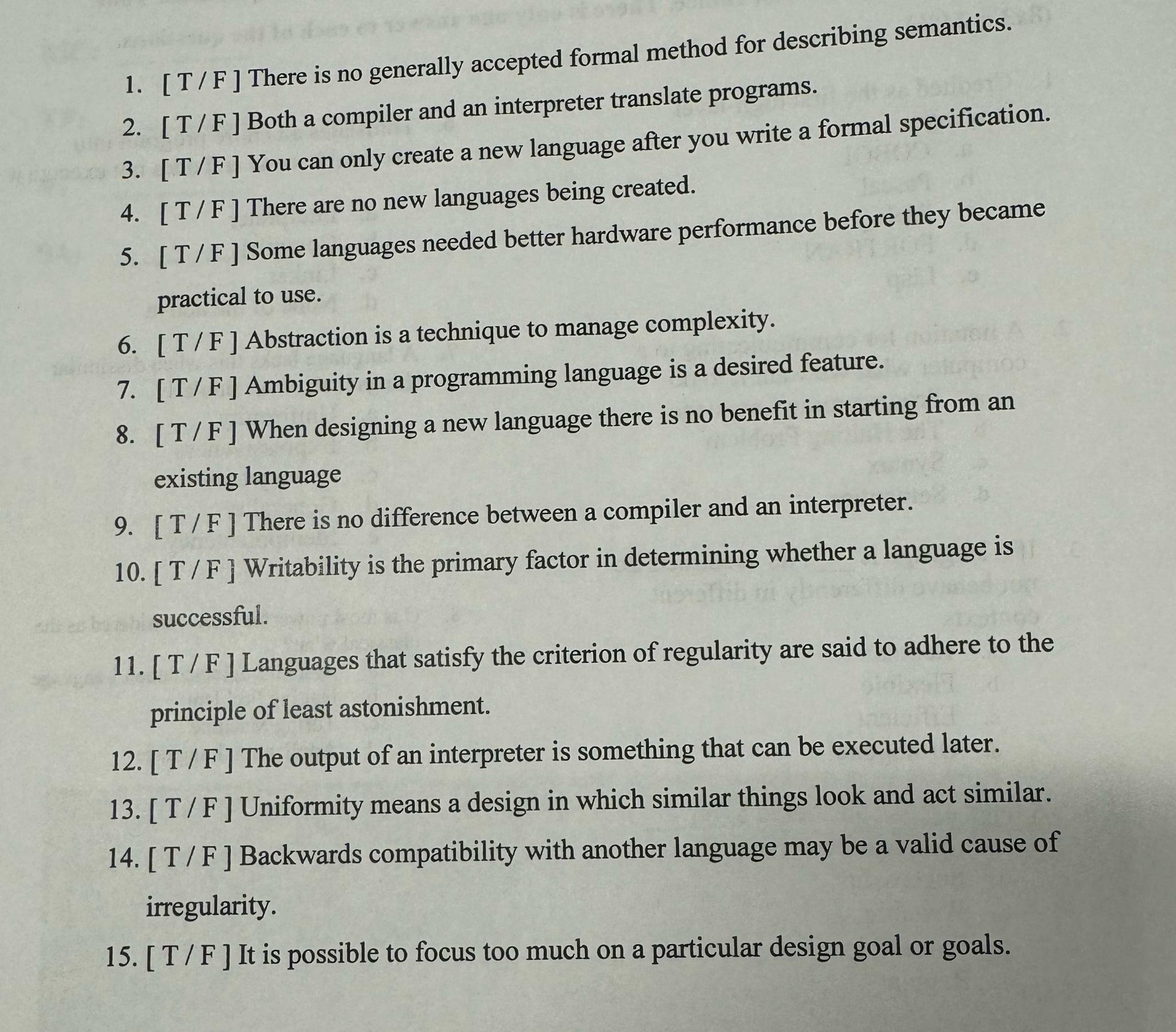
Question: T F There is no generally accepted formal method for describing semantics. T F Both a compiler and an interpreter translate programs. T F You
There is no generally accepted formal method for describing semantics.
Both a compiler and an interpreter translate programs.
You can only create a new language after you write a formal specification.
There are no new languages being created.
Some languages needed better hardware performance before they became practical to use.
Abstraction is a technique to manage complexity.
Ambiguity in a programming language is a desired feature.
When designing a new language there is no benefit in starting from an existing language
There is no difference between a compiler and an interpreter.
Writability is the primary factor in determining whether a language is successful.
Languages that satisfy the criterion of regularity are said to adhere to the principle of least astonishment.
The output of an interpreter is something that can be executed later.
Uniformity means a design in which similar things look and act similar.
Backwards compatibility with another language may be a valid cause of irregularity.
F
Step by Step Solution
There are 3 Steps involved in it
1 Expert Approved Answer
Step: 1 Unlock

Question Has Been Solved by an Expert!
Get step-by-step solutions from verified subject matter experts
Step: 2 Unlock
Step: 3 Unlock
 Study Help