Question: T1T2 answer all questions correctly please L A system is put into operation at time t=. Its lime of failure is a random variable X
T1T2 answer all questions correctly please
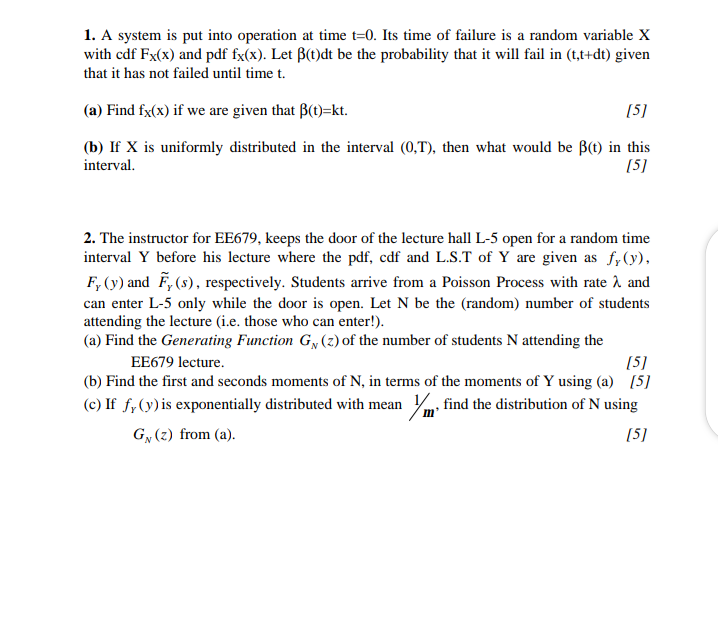
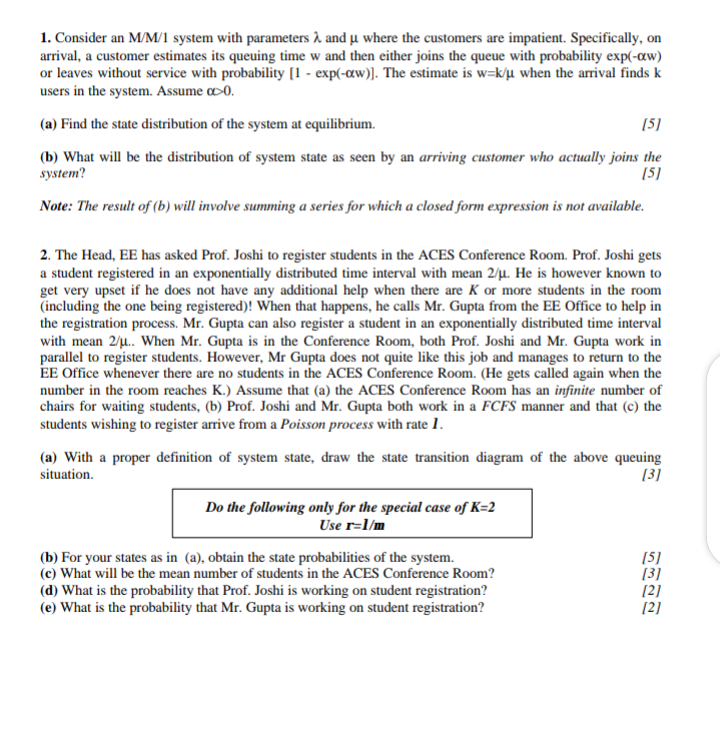
L A system is put into operation at time t=. Its lime of failure is a random variable X 1with cdf Fxfx] and pdf fxfx]. Let itldt be the probability that it will fail in [t,t+dt} given that it has not failed unlil time t. {:1} Find fx{x} if we are given that (t}=kt. {.5} {b} If X is uniformly distributed in the interval (llT), then what would be Brit) in this interval. {.5} 2. The instructor for EEET'}, keeps the door of the lecture hall LS open for a random time interval Y before his lecture where the pdf, cdf and L.S.T of Y are given as fry}, F1. {y} and E, (s), respectively. Students arrive from a Poisson Process with rate is and can enter LS only while the door is open. Let N be the (random) number of students attending the lecture (Le. those who can enterl}. {a} Find the Genemting Function GM {3) of the number of students N attending the BEE-'9 lecture. {5} {b} Find the rst and seconds moments of N, in terms of the moments of Y using [a] {5} {c} If f]. (y) is exponentially distributed with mean )4\1. Consider an M/M/1 system with parameters ) and u where the customers are impatient. Specifically, on arrival, a customer estimates its queuing time w and then either joins the queue with probability exp(-ow) or leaves without service with probability [1 - exp(-ow)]. The estimate is w=k/u when the arrival finds k users in the system. Assume coO. (a) Find the state distribution of the system at equilibrium. [5) (b) What will be the distribution of system state as seen by an arriving customer who actually joins the system? 15] Note: The result of (b) will involve summing a series for which a closed form expression is not available. 2. The Head, EE has asked Prof. Joshi to register students in the ACES Conference Room. Prof. Joshi gets a student registered in an exponentially distributed time interval with mean 2/u. He is however known to get very upset if he does not have any additional help when there are K or more students in the room (including the one being registered)! When that happens, he calls Mr. Gupta from the EE Office to help in the registration process. Mr. Gupta can also register a student in an exponentially distributed time interval with mean 2/u.. When Mr. Gupta is in the Conference Room, both Prof. Joshi and Mr. Gupta work in parallel to register students. However, Mr Gupta does not quite like this job and manages to return to the EE Office whenever there are no students in the ACES Conference Room. (He gets called again when the number in the room reaches K.) Assume that (a) the ACES Conference Room has an infinite number of chairs for waiting students, (b) Prof. Joshi and Mr. Gupta both work in a FCFS manner and that (c) the students wishing to register arrive from a Poisson process with rate 1. (a) With a proper definition of system state, draw the state transition diagram of the above queuing situation. 13] Do the following only for the special case of K=2 Use r=1/m (b) For your states as in (a), obtain the state probabilities of the system. [3) (c) What will be the mean number of students in the ACES Conference Room? (d) What is the probability that Prof. Joshi is working on student registration? [2] (e) What is the probability that Mr. Gupta is working on student registration? [2]









 Study Help