







Question: Table 1 Number of competitors Table 2 Expected values (13} (Cl Class Away Home Class Away Home Under 16 9 3 Under 15 5.27 5.73
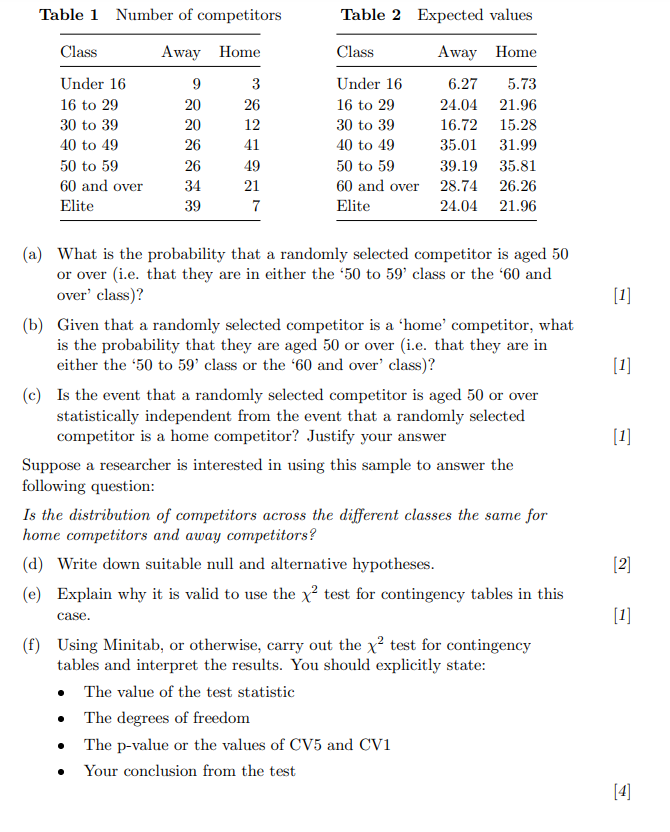
Table 1 Number of competitors Table 2 Expected values (13} (Cl Class Away Home Class Away Home Under 16 9 3 Under 15 5.27 5.73 16 to 29 20' 25 16 to 29 24.04 21.96 30 to 39 20 12 39 to 39 16.72 15.23 40 to 49 26 41 49 to 49 35.01 31.99 50 to 59 26 49 51] to 59 39.19 35.31 60 and over 34 21 El] and over 28.74 26.26 Elite 39 7 Elite 24.04 21.96 What is the probability that a randomly selected competitor is aged 51] or over (Le. that they are in either the '51] to 59' class or the '60 and over\" class)? Given that a randomly selected competitor is a 'home' competitor, what is the probability that they are aged 50 or over (i.e. that they are in either the '50 to 59' class or the '60 and over\" class}? Is the event that a randomly selected competitor is aged 50 or over statistically independent -cnn the event that a randomly selected competitor is a home competitor? Justify your answer Suppose a researcher is interested in using this sample to answer the following question: Is the distribution of competitors across the different classes the same for home competitors and away competitors? ('1) (El (1') Write down suitable null and alternative hypotheses. Explain why it is valid to use the X2 test for contingency tables in this case. Using Minitah, or otherwise, carry out the 3:2 test for contingency tables and interpret the results. You should explicitly state: a The value of the test statistic - The degrees of freedom - The pvalue or the values of CV5 and CV1 - Your conclusion from the test
Step by Step Solution
There are 3 Steps involved in it

Get step-by-step solutions from verified subject matter experts
 Study Help