







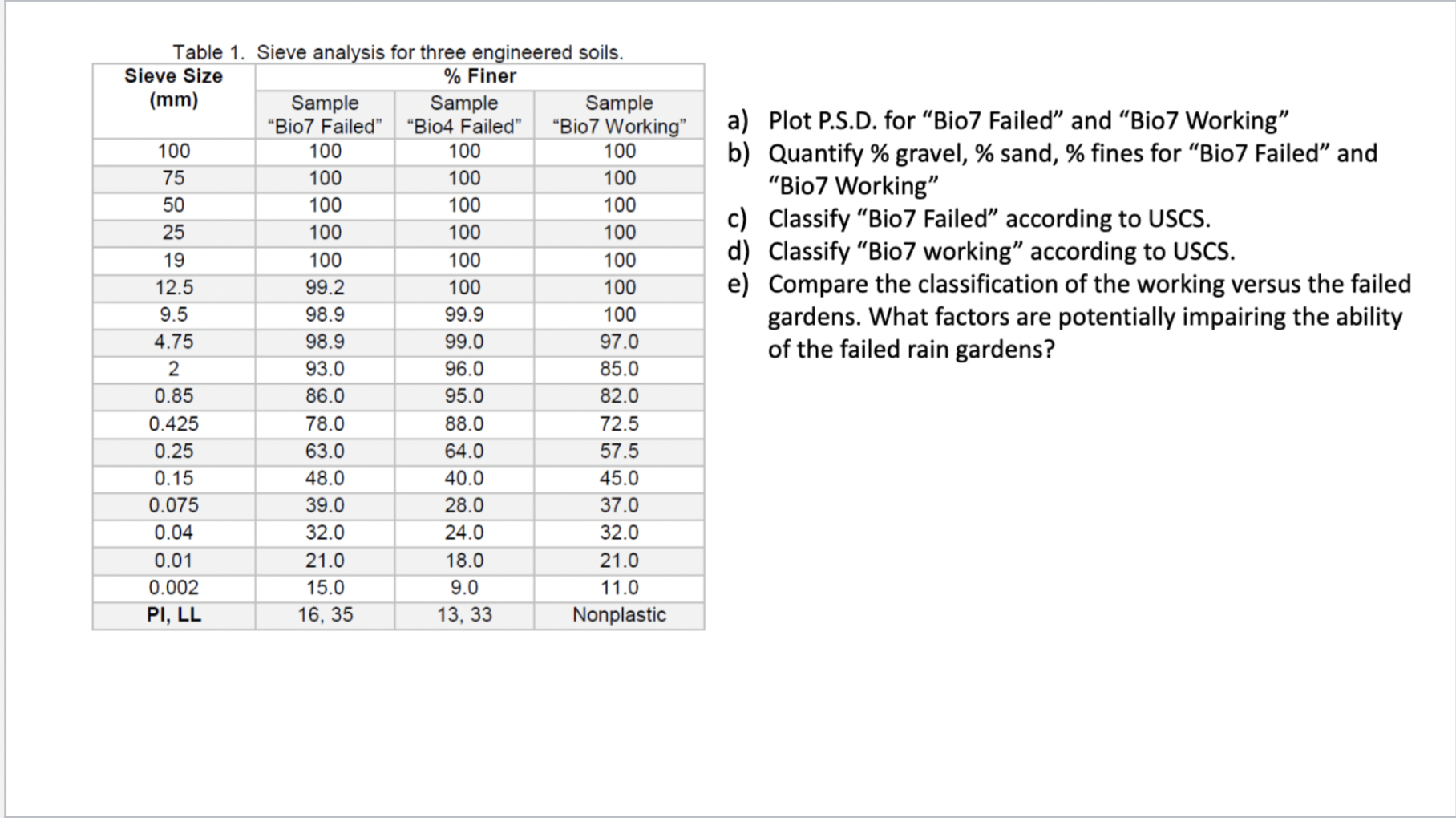
Question: Table 1 . Sieve analysis for three engineered soils. table [ [ table [ [ Sieve Size ] , [ ( mm )
Table Sieve analysis for three engineered soils.
tabletableSieve Sizemm FinertableSampleBio Failed"tableSampleBio Failed"tableSampleBio Working"PI LLNonplastic
a Plot PSD for "Bio Failed" and "Bio Working"
b Quantify gravel, sand, fines for "Bio Failed" and "Bio Working"
c Classify "Bio Failed" according to USCS.
d Classify "Bio working" according to USCS.
e Compare the classification of the working versus the failed gardens. What factors are potentially impairing the ability of the failed rain gardens?
Step by Step Solution
There are 3 Steps involved in it
1 Expert Approved Answer
Step: 1 Unlock

Question Has Been Solved by an Expert!
Get step-by-step solutions from verified subject matter experts
Step: 2 Unlock
Step: 3 Unlock
 Study Help