







Question: Table 2 . 3 : Values of Manning's Roughness Coefficient ( n ) for Open Drains and Pipes ( Chow , 1 9 5 9
Table : Values of Manning's Roughness Coefficient for Open Drains and Pipes
Chow; DID, and French,
where,
Average rainfall intensity ;
Average recurrence interval month and year;
Storm duration hours; and
and Fitting constants dependent on the raingauge location Table B in Appendix B Table : Recommended Runoff Coefficients for Various Landuses
DID; Chow et al; QUDM, and Darwin Harbour,
Note: The runoff coefficients in this table are given as a guide for designers. The nearfield
runoff coefficient for any single or mixed landuse should be determined based on
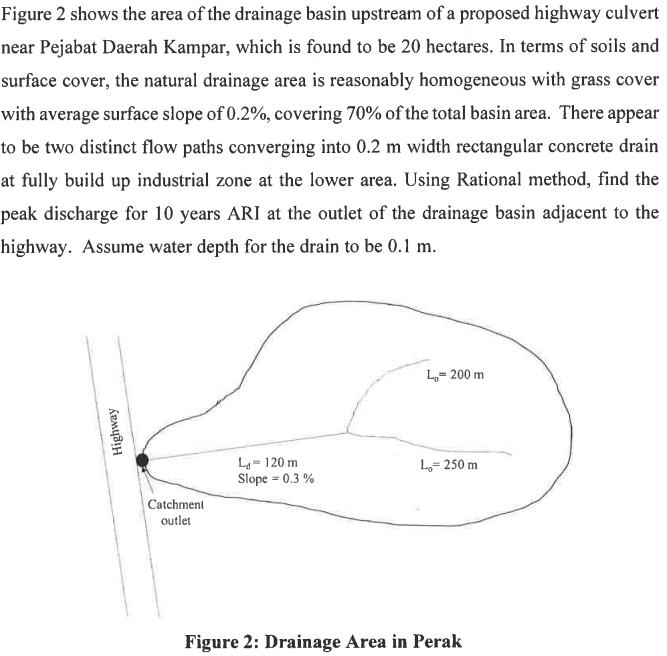
the imperviousness of the area.Figure shows the area of the drainage basin upstream of a proposed highway culvert
near Pejabat Daerah Kampar, which is found to be hectares. In terms of soils and
surface cover, the natural drainage area is reasonably homogeneous with grass cover
with average surface slope of covering of the total basin area. There appear
to be two distinct flow paths converging into width rectangular concrete drain
at fully build up industrial zone at the lower area. Using Rational method, find the
peak discharge for years ARI at the outlet of the drainage basin adjacent to the
highway. Assume water depth for the drain to be
Figure : Drainage Area in Perak
Step by Step Solution
There are 3 Steps involved in it
1 Expert Approved Answer
Step: 1 Unlock

Question Has Been Solved by an Expert!
Get step-by-step solutions from verified subject matter experts
Step: 2 Unlock
Step: 3 Unlock
 Study Help