







Question: Task 2: Programs 2 and 3 given below can be employed to generate a complex and real-value exponential sequence respectively. % Program P 2, Generation
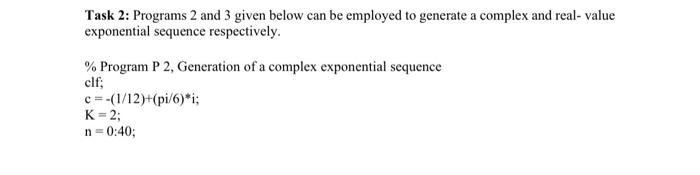
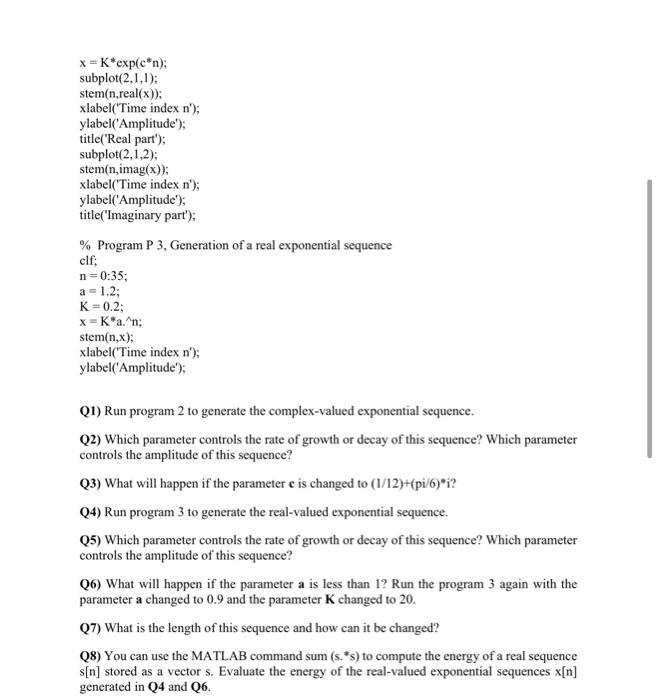
Task 2: Programs 2 and 3 given below can be employed to generate a complex and real-value exponential sequence respectively. % Program P 2, Generation of a complex exponential sequence clf; c=-(1/12)+(pi/6)*i; K = 2; n=0:40: x=K*exp(c*n); subplot(2,1,1); stem(n,real(x)); xlabel('Time index n'); ylabel('Amplitude'); title('Real part'); subplot(2,1,2); stem(n,imag(x)); xlabel('Time index n'); ylabel('Amplitude'); title('Imaginary part'); % Program P 3, Generation of a real exponential sequence clf: n=0:35; a-1.2; K=0.2; x=K*a."n; stem(n,x); xlabel('Time index n'); ylabel('Amplitude'); Q1) Run program 2 to generate the complex-valued exponential sequence. (2) Which parameter controls the rate of growth or decay of this sequence? Which parameter controls the amplitude of this sequence? (3) What will happen if the parameter e is changed to (1/12)+(pi/6)*i? (4) Run program 3 to generate the real-valued exponential sequence. 05) Which parameter controls the rate of growth or decay of this sequence? Which parameter controls the amplitude of this sequence? (6) What will happen if the parameter a is less than 1? Run the program 3 again with the parameter a changed to 0.9 and the parameter K changed to 20. Q7) What is the length of this sequence and how can it be changed? Q8) You can use the MATLAB command sum (s.*s) to compute the energy of a real sequence S[n] stored as a vector s. Evaluate the energy of the real-valued exponential sequences x[n] generated in Q4 and 26
Step by Step Solution
There are 3 Steps involved in it

Get step-by-step solutions from verified subject matter experts
 Study Help