Question: Task 2: Sub-task a: Underlying scenario You are working for Modern Garden Design GmbH (or in short: MGD), a retailer of outdoor furniture (chairs, deckchairs,
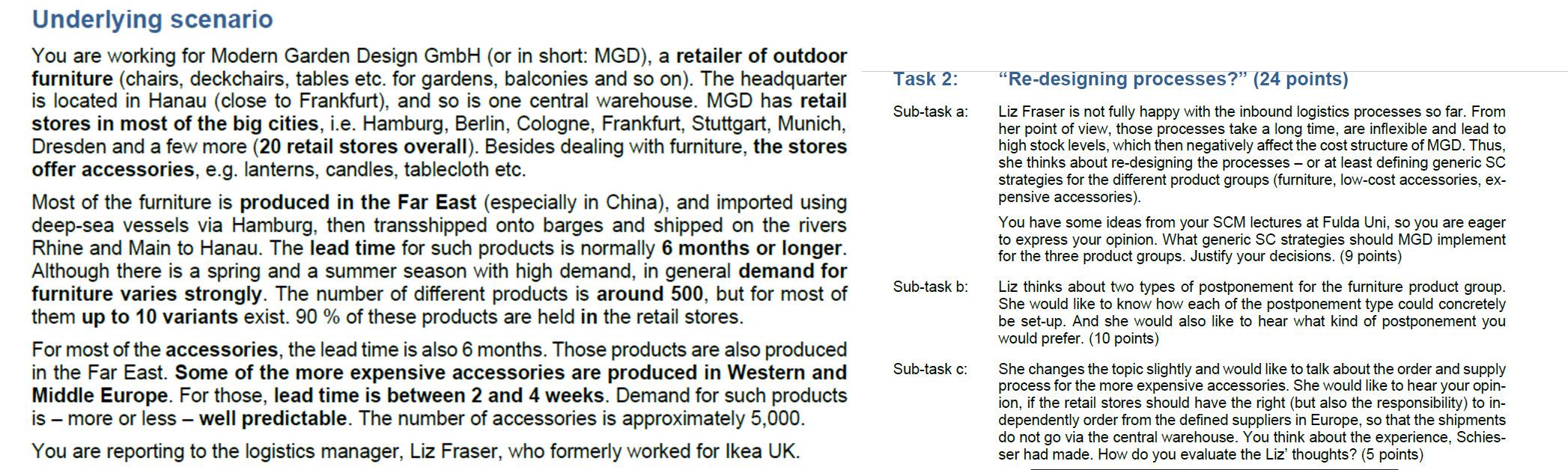
Task 2: Sub-task a: Underlying scenario You are working for Modern Garden Design GmbH (or in short: MGD), a retailer of outdoor furniture (chairs, deckchairs, tables etc. for gardens, balconies and so on). The headquarter is located in Hanau (close to Frankfurt), and so is one central warehouse. MGD has retail stores in most of the big cities, i.e. Hamburg, Berlin, Cologne, Frankfurt, Stuttgart, Munich, Dresden and a few more (20 retail stores overall). Besides dealing with furniture, the stores offer accessories, e.g. lanterns, candles, tablecloth etc. Most of the furniture is produced in the Far East (especially in China), and imported using deep-sea vessels via Hamburg, then transshipped onto barges and shipped on the rivers Rhine and Main to Hanau. The lead time for such products is normally 6 months or longer. Although there is a spring and a summer season with high demand, in general demand for furniture varies strongly. The number of different products is around 500, but for most of them up to 10 variants exist. 90 % of these products are held in the retail stores. For most of the accessories, the lead time is also 6 months. Those products are also produced in the Far East. Some of the more expensive accessories are produced in Western and Middle Europe. For those, lead time is between 2 and 4 weeks. Demand for such products is - more or less - well predictable. The number of accessories is approximately 5,000. You are reporting to the logistics manager, Liz Fraser, who formerly worked for Ikea UK. "Re-designing processes?" (24 points) Liz Fraser is not fully happy with the inbound logistics processes so far. From her point of view, those processes take a long time, are inflexible and lead to high stock levels, which then negatively affect the cost structure of MGD. Thus, she thinks about re-designing the processes - or at least defining generic SC strategies for the different product groups (furniture, low-cost accessories, ex- pensive accessories). You have some ideas from your SCM lectures at Fulda Uni, so you are eager to express your opinion. What generic SC strategies should MGD implement for the three product groups. Justify your decisions. (9 points) Liz thinks about two types of postponement for the furniture product group. She would like to know how each of the postponement type could concretely be set-up. And she would also like to hear what kind of postponement you would prefer. (10 points) She changes the topic slightly and would like to talk about the order and supply process for the more expensive accessories. She would like to hear your opin- ion, if the retail stores should have the right (but also the responsibility) to in- dependently order from the defined suppliers in Europe, so that the shipments do not go via the central warehouse. You think about the experience, Schies- ser had made. How do you evaluate the Liz' thoughts? (5 points) Sub-task b: Sub-task c: Task 2: Sub-task a: Underlying scenario You are working for Modern Garden Design GmbH (or in short: MGD), a retailer of outdoor furniture (chairs, deckchairs, tables etc. for gardens, balconies and so on). The headquarter is located in Hanau (close to Frankfurt), and so is one central warehouse. MGD has retail stores in most of the big cities, i.e. Hamburg, Berlin, Cologne, Frankfurt, Stuttgart, Munich, Dresden and a few more (20 retail stores overall). Besides dealing with furniture, the stores offer accessories, e.g. lanterns, candles, tablecloth etc. Most of the furniture is produced in the Far East (especially in China), and imported using deep-sea vessels via Hamburg, then transshipped onto barges and shipped on the rivers Rhine and Main to Hanau. The lead time for such products is normally 6 months or longer. Although there is a spring and a summer season with high demand, in general demand for furniture varies strongly. The number of different products is around 500, but for most of them up to 10 variants exist. 90 % of these products are held in the retail stores. For most of the accessories, the lead time is also 6 months. Those products are also produced in the Far East. Some of the more expensive accessories are produced in Western and Middle Europe. For those, lead time is between 2 and 4 weeks. Demand for such products is - more or less - well predictable. The number of accessories is approximately 5,000. You are reporting to the logistics manager, Liz Fraser, who formerly worked for Ikea UK. "Re-designing processes?" (24 points) Liz Fraser is not fully happy with the inbound logistics processes so far. From her point of view, those processes take a long time, are inflexible and lead to high stock levels, which then negatively affect the cost structure of MGD. Thus, she thinks about re-designing the processes - or at least defining generic SC strategies for the different product groups (furniture, low-cost accessories, ex- pensive accessories). You have some ideas from your SCM lectures at Fulda Uni, so you are eager to express your opinion. What generic SC strategies should MGD implement for the three product groups. Justify your decisions. (9 points) Liz thinks about two types of postponement for the furniture product group. She would like to know how each of the postponement type could concretely be set-up. And she would also like to hear what kind of postponement you would prefer. (10 points) She changes the topic slightly and would like to talk about the order and supply process for the more expensive accessories. She would like to hear your opin- ion, if the retail stores should have the right (but also the responsibility) to in- dependently order from the defined suppliers in Europe, so that the shipments do not go via the central warehouse. You think about the experience, Schies- ser had made. How do you evaluate the Liz' thoughts? (5 points) Sub-task b: Sub-task c









 Study Help