







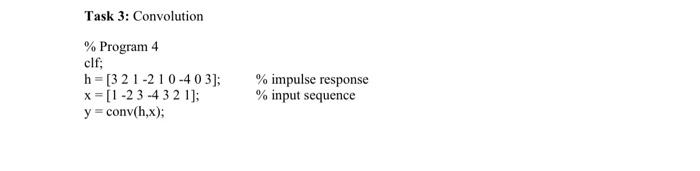
Question: Task 3: Convolution % Program 4 clf; h = [3 2 1 -2 10-403); x = [1 -2 3-4 3 2 1]; y = conv(h,x);
![1 -2 10-403); x = [1 -2 3-4 3 2 1]; y](https://dsd5zvtm8ll6.cloudfront.net/si.experts.images/questions/2024/09/66f450fa8c57d_54666f450fa25130.jpg)
Task 3: Convolution % Program 4 clf; h = [3 2 1 -2 10-403); x = [1 -2 3-4 3 2 1]; y = conv(h,x); % impulse response % input sequence n=0:14; subplot(2,1,1); stem(n,y); xlabel("Time index n'); ylabel('Amplitude'); title('Output Obtained by Convolution'); grid; x1 = [x zeros(1,8)); yl -filter(h, 1,x1); subplot(2,1,2); stem(nyl); xlabel('Time index n'); ylabel('Amplitude"); title('Output Generated by Filtering'); grid; Q1) Run program 4 to generate y[n] obtained by the convolution of the sequences h[n] and x[n], and to generate y![n] obtained by filtering the input x[n] by FIR filter h[n). Is there any difference between y[n] and yl [n]. What is the reason for using xl[n] obtained by zero-padding x[n] as the input for generating yl[n). Q2) Modify program 4 to develop the convolution of a length-15 sequence h[n] with a length- 10 sequence x[n), and repeat Q1. Use your own sample values for h[n] and [n]
Step by Step Solution
There are 3 Steps involved in it

Get step-by-step solutions from verified subject matter experts
 Study Help