



Question: Task: [50 marks] The arojoct is to design a controllar for a mixer. H blad dye for making shirts is injected into a stream of
![Task: [50 marks] The arojoct is to design a controllar for](https://dsd5zvtm8ll6.cloudfront.net/si.experts.images/questions/2024/09/66f8f5cd61fd3_88566f8f5cd0488a.jpg)
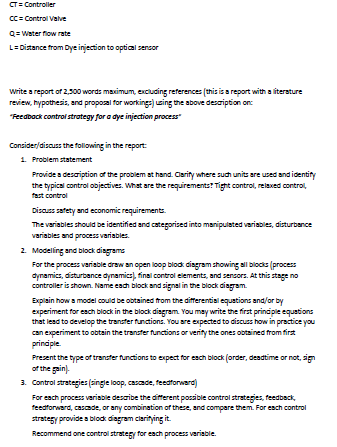
Task: [50 marks] The arojoct is to design a controllar for a mixer. H blad dye for making shirts is injected into a stream of water. The injected dye is blended into the water flow with constant spead mivers. A detector is used to monitor the dpe/water concentration. The output of the detector is sent to a controller, which then sends a signal to the dye-injection valve. One naeds to be careful with the location of the detector. The sensor has to be far enough away to ensure a well-mixed stream. However, if the detector is too far away, the traneport lag can destabilise the process. The regulating velve is eepecially designed so that the dye input rate, in mililiters per second, varies inearly with the velve position. The regulating valve thus is a first order with a time coratart of . [eccondes) and a steady state gain of K2[(mL/secmV). The mixirg process itvelf an be modeled as frst order with a steady-state gsin of K ( PPmsec/mL ) and a time constant of p /seconds/. cc= Control valve Q= Water flow rate L= Distance from Dye injection to optical sercer Write a report of 2,p00 words maximum, excluding references [this is a report with a literature review, hypothesis, and proposal for working:) ueing the above desaiption on: "Feedbock control strotegy for a dye injection process" Consider/discuss the following in the report: 1. Problem statement Provide a description of the problem st hand. Osrity where such units are used and identith the typical control objectives. What are the requirements? Tight control, relaxed cortrol, fast cortrol Disouss safety and economic requirements. The variables should be identified and categorised into manipulated variables, disturbance variables and procees variables. 2. Modeling and block disgrame For the process variable draw an open loop blodk diagram showing sll blocks (process dpramics, disturbance dpramics], finsl cortrol elements, and sercors. At this stsge no controller is shown. Name each block and aignal in the block diagram. Explain how a model could be obtained from the differentisl equations and/or by experiment for each block in the block diagram. You may write the first prinaple equations that lead to develop the transfer functions. You are expected to discues how in practice you can experiment to obtain the transfer functions or verify the ones obtsined from first: prinaple. Present the type of transfer functions to expect for each block (order, deadtime or not, aggn of the gain|. 3. Control strategies (ingie loop, casade, feedforward) For each process variable desaribe the different possible control strategies, feedbsck, feedforward, cascade, or any combiration of these, and compare them. For each control strates/ provide a blodk diagram clarifying it. Recommend one cortrol stratefy for each process veriable
Step by Step Solution
There are 3 Steps involved in it

Get step-by-step solutions from verified subject matter experts