







Question: Tesla's Entry into the U.S. Auto Industry TESLA'S ENTRY INTO THE U.S. AUTO INDUSTRY Donald Sull and Cate Reavis In The New York Times article,
Tesla's Entry into the U.S. Auto Industry
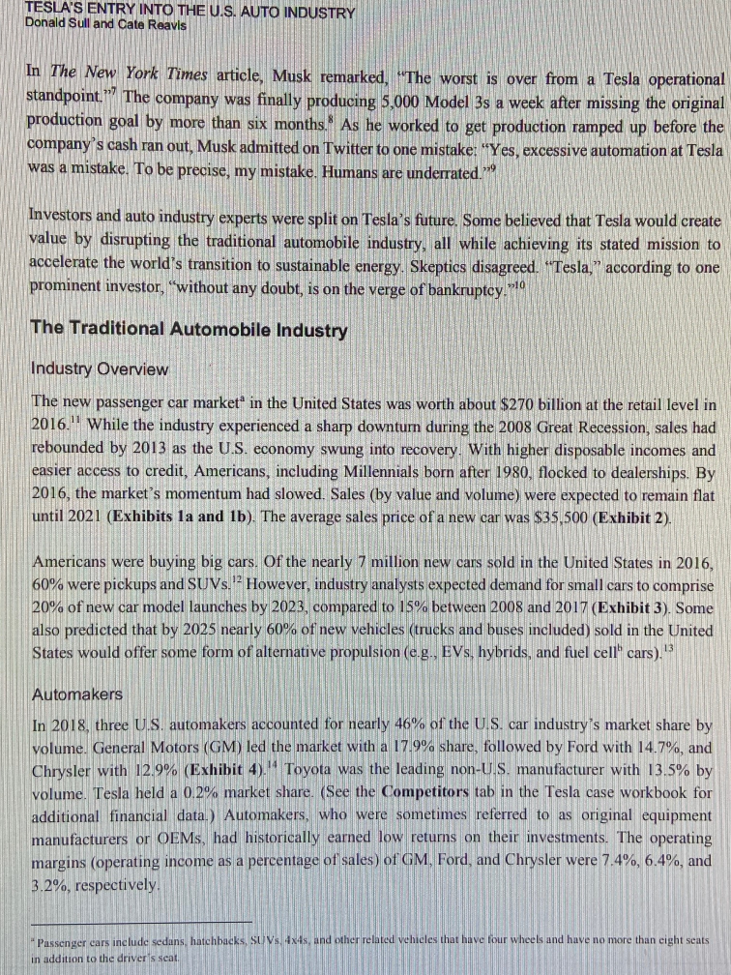
TESLA'S ENTRY INTO THE U.S. AUTO INDUSTRY Donald Sull and Cate Reavis In The New York Times article, Musk remarked, "The worst is over from a Tesla operational standpoint."/ The company was finally producing 5,000 Model 3s a week after missing the original production goal by more than six months." As he worked to get production ramped up before the company's cash ran out, Musk admitted on Twitter to one mistake: "Yes, excessive automation at Tesla was a mistake. To be precise, my mistake. Humans are underrated."" Investors and auto industry experts were split on Tesla's future. Some believed that Tesla would create value by disrupting the traditional automobile industry, all while achieving its stated mission to accelerate the world's transition to sustainable energy. Skeptics disagreed. "Tesla," according to one prominent investor, "without any doubt, is on the verge of bankruptcy."19 The Traditional Automobile Industry Industry Overview The new passenger car market" in the United States was worth about $270 billion at the retail level in 2016." While the industry experienced a sharp downturn during the 2008 Great Recession, sales had rebounded by 2013 as the U.S. economy swung into recovery. With higher disposable incomes and easier access to credit, Americans, including Millennials born after 1980, flocked to dealerships. By 2016, the market's momentum had slowed. Sales (by value and volume) were expected to remain flat until 2021 (Exhibits la and 1b). The average sales price of a new car was $35,500 (Exhibit 2) Americans were buying big cars. Of the nearly 7 million new cars sold in the United States in 2016, 60% were pickups and SUVs. However, industry analysts expected demand for small cars to comprise 20% of new car model launches by 2023, compared to 15% between 2008 and 2017 (Exhibit 3). Some also predicted that by 2025 nearly 60% of new vehicles (trucks and buses included) sold in the United States would offer some form of alternative propulsion (e.g., EVs, hybrids, and fuel cell" cars).13 Automakers In 2018, three U.S. automakers accounted for nearly 46% of the U.S. car industry's market share by volume. General Motors (GM) led the market with a 17.9% share, followed by Ford with 14.7%, and Chrysler with 12.9% (Exhibit 4). * Toyota was the leading non-U.S. manufacturer with 13.5% by volume. Tesla held a 0.2% market share. (See the Competitors tab in the Tesla case workbook for additional financial data.) Automakers, who were sometimes referred to as original equipment manufacturers or OEMs, had historically earned low returns on their investments. The operating margins (operating income as a percentage of sales) of GM, Ford, and Chrysler were 7.4%, 6.4%, and 3.2%, respectively "Passenger cars include sedans, hatchbacks, SUVs. 4x-is, and other related vehicles that have four wheels and have no more than eight seats in addition to the driver's seat
Step by Step Solution
There are 3 Steps involved in it

Get step-by-step solutions from verified subject matter experts
 Study Help