







Question: Tests on All Coefficients First, we present hypothesis tests to determine if sets of several coefficients are all simulta- neously equal to 0. Consider again
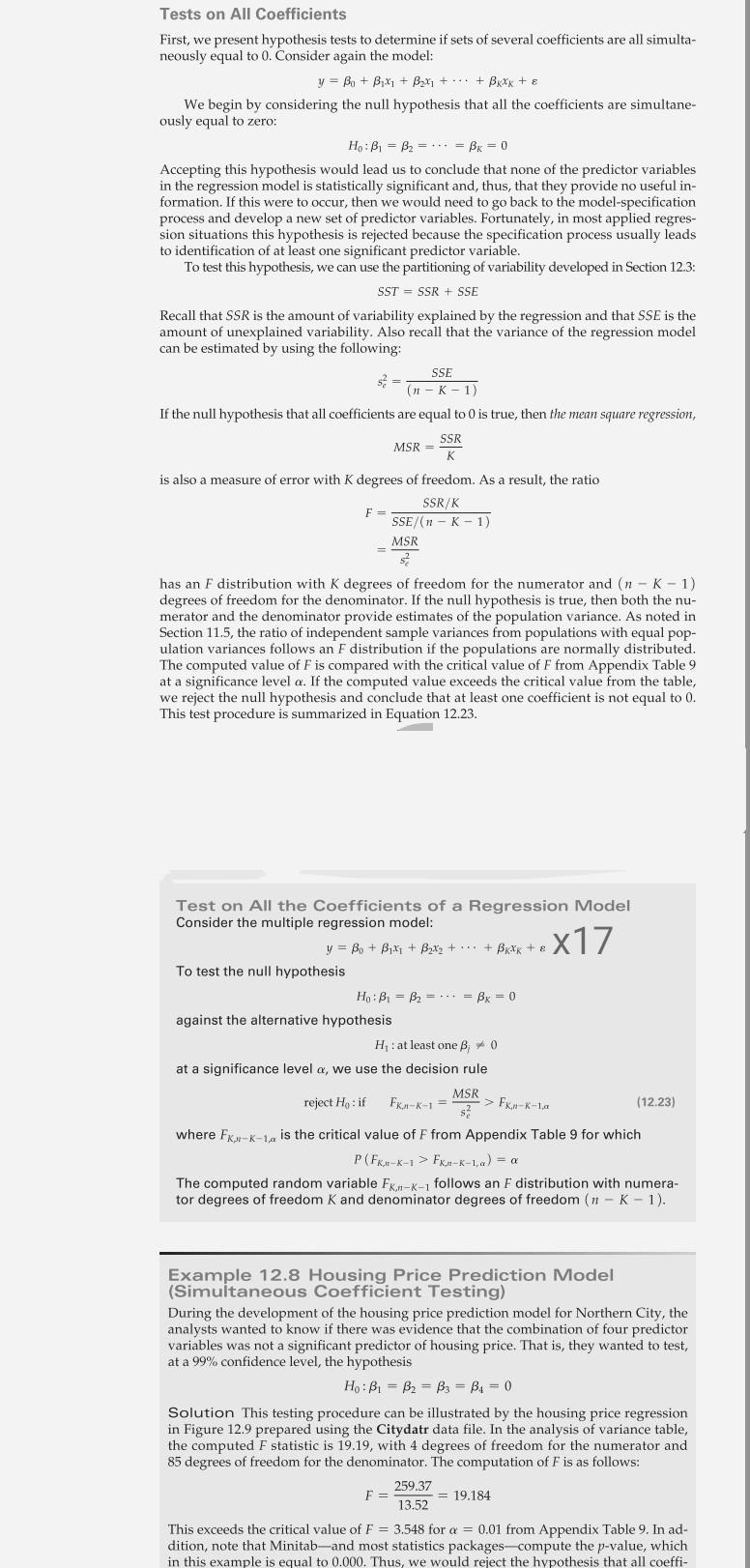
Tests on All Coefficients First, we present hypothesis tests to determine if sets of several coefficients are all simulta- neously equal to 0. Consider again the model: y = Bo + B1X1 + B2xy + ... + BxXx + 8 We begin by considering the null hypothesis that all the coefficients are simultane- ously equal to zero: Ho:B, = B2 = ... =Bk = 0 Accepting this hypothesis would lead us to conclude that none of the predictor variables in the regression model is statistically significant and, thus, that they provide no useful in- formation. If this were to occur, then we would need to go back to the model-specification process and develop a new set of predictor variables. Fortunately, in most applied regres- sion situations this hypothesis is rejected because the specification process usually leads to identification of at least one significant predictor variable. To test this hypothesis, we can use the partitioning of variability developed in Section 12.3: SST = SSR + SSE Recall that SSR is the amount of variability explained by the regression and that SSE is the amount of unexplained variability. Also recall that the variance of the regression model can be estimated by using the following: SSE S? (11-K-1) If the null hypothesis that all coefficients are equal to 0 is true, then the mean square regression, SSR MSR = K F= is also a measure of error with K degrees of freedom. As a result, the ratio SSR/K SSE/(n-K-1) MSR s has an F distribution with K degrees of freedom for the numerator and (n - K-1) degrees of freedom for the denominator. If the null hypothesis is true, then both the nu- merator and the denominator provide estimates of the population variance. As noted in Section 11.5, the ratio of independent sample variances from populations with equal pop- ulation variances follows an F distribution if the populations are normally distributed. The computed value of F is compared with the critical value of F from Appendix Table 9 at a significance level a. If the computed value exceeds the critical value from the table, we reject the null hypothesis and conclude that at least one coefficient is not equal to 0. This test procedure is summarized in Equation 12.23. X17 Test on All the Coefficients of a Regression Model Consider the multiple regression model: y = Bo + B1X1 + Baxy + ... + BK*K +8 To test the null hypothesis H:8, = B2 = ... = Bx = 0 against the alternative hypothesis H: at least one B; 0 at a significance level a, we use the decision rule MSR reject He: if FK1-K-1 = 2 > FK-K-1,4 (12.23) where Fxr-K-12 is the critical value of F from Appendix Table 9 for which P (FKK-1 > FK,-K-1a) = a The computed random variable FK.n-K-1 follows an F distribution with numera- tor degrees of freedom K and denominator degrees of freedom (n - K-1). Example 12.8 Housing Price Prediction Model (Simultaneous Coefficient Testing) During the development of the housing price prediction model for Northern City, the analysts wanted to know if there was evidence that the combination of four predictor variables was not a significant predictor of housing price. That is, they wanted to test, at a 99% confidence level, the hypothesis Ho:Bi = B2 = B3 B4 = 0 Solution This testing procedure can be illustrated by the housing price regression in Figure 12.9 prepared using the Citydatr data file. In the analysis of variance table, the computed F statistic is 19.19, with 4 degrees of freedom for the numerator and 85 degrees of freedom for the denominator. The computation of Fis as follows: 259.37 F= = 19.184 13.52 This exceeds the critical value of F = 3.548 for a = 0.01 from Appendix Table 9. In ad- dition, note that Minitab-and most statistics packages-compute the p-value, which in this example is equal to 0.000. Thus, we would reject the hypothesis that all coeffi
Step by Step Solution
There are 3 Steps involved in it

Get step-by-step solutions from verified subject matter experts
 Study Help