





Question: TF1 Quality control is typically more effective at improving a company's quality problems rather than quality assurance. TF 2 Hourly employees should not have any
TF1 Quality control is typically more effective

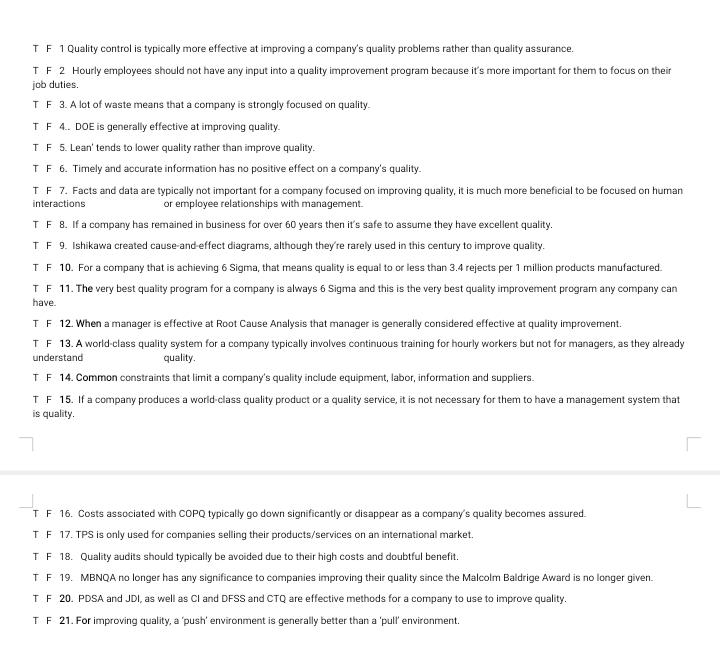
TF1 Quality control is typically more effective at improving a company's quality problems rather than quality assurance. TF 2 Hourly employees should not have any input into a quality improvement program because it's more important for them to focus on their job duties. TF 3. A lot of waste means that a company is strongly focused on quality TE 4.. DOE is generally effective at improving quality. IF 5. Lean' tends to lower quality rather than improve quality. T F 6. Timely and accurate information has no positive effect on a company's quality. TE 7. Facts and data are typically not important for a company focused on improving quality, it is much more beneficial to be focused on human interactions or employee relationships with management TE 8. If a company has remained in business for over 60 years then it's safe to assume they have excellent quality. T F 9. Ishikawa created cause-and-effect diagrams, although they're rarely used in this century to improve quality. TF 10. For a company that is achieving Sigma, that means quality is equal to or less than 3.4 rejects per 1 million products manufactured. TF 11. The very best quality program for a company is always 6 Sigma and this is the very best quality improvement program any company can have. IF 12. When a manager is effective at Root Cause Analysis that manager is generally considered effective at quality improvement. TF 13.A world-class quality system for a company typically involves continuous training for hourly workers but not for managers, as they already understand quality T F 14. Common constraints that limit a company's quality include equipment, labor, information and suppliers. TF 15. If a company produces a world-class quality product or a quality service, it is not necessary for them to have a management system that is quality TF 16. Costs associated with COPQ typically go down significantly or disappear as a company's quality becomes assured TF 17. TPS is only used for companies selling their products/services on an international market. TF 18. Quality audits should typically be avoided due to their high costs and doubtful benefit. TF 19. MBNQA no longer has any significance to companies improving their quality since the Malcolm Baldrige Award is no longer given. T F 20. PDSA and JDI, as well as Cl and DFSS and CTQ are effective methods for a company to use to improve quality. TF 21. For improving quality, a push' environment is generally better than a 'pull' environment

Step by Step Solution

There are 3 Steps involved in it

1 Expert Approved Answer
Step: 1 Unlock blur-text-image

Question Has Been Solved by an Expert!

Get step-by-step solutions from verified subject matter experts

Step: 2 Unlock
Step: 3 Unlock

Students Have Also Explored These Related General Management Questions!