


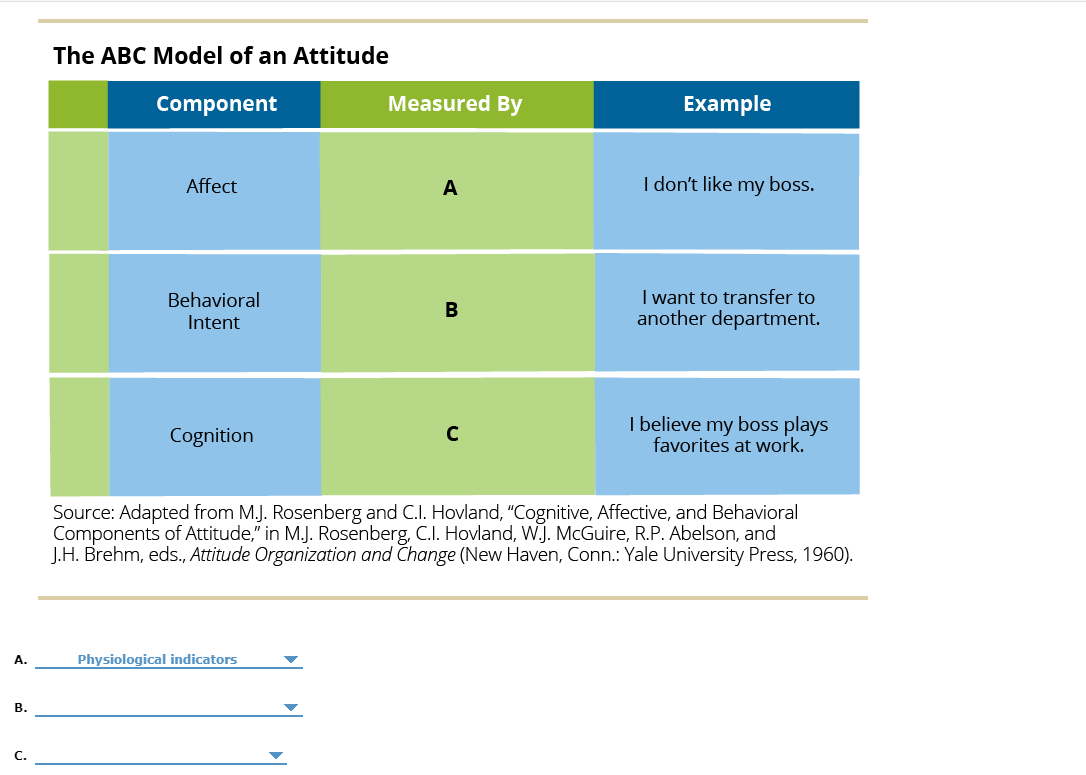
Question: The ABC Model of an Attitude Component Measured By Example Affect A I don't like my boss. Behavioral Intent B I want to transfer to
The ABC Model of an Attitude Component MeasuredThe ABC Model of an Attitude Component MeasuredThe ABC Model of an Attitude Component Measured

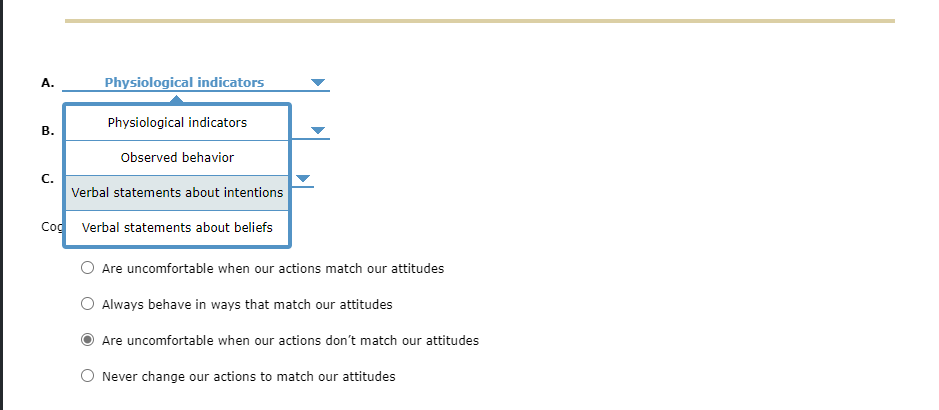
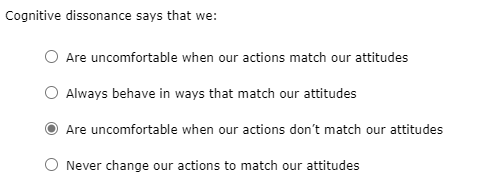
The ABC Model of an Attitude Component Measured By Example Affect A I don't like my boss. Behavioral Intent B I want to transfer to another department. Cognition I believe my boss plays favorites at work. Source: Adapted from M.J. Rosenberg and C.I. Hovland, "Cognitive, Affective, and Behavioral Components of Attitude," in M.J. Rosenberg, C.I. Hovland, W.J. McGuire, R.P. Abelson, and J.H. Brehm, eds., Attitude Organization and Change (New Haven, Conn.: Yale University Press, 1960). A. Physiological indicators B. C. A. Physiological indicators Physiological indicators B. Observed behavior C. Verbal statements about intentions Coc Verbal statements about beliefs Are uncomfortable when our actions match our attitudes Always behave in ways that match our attitudes Are uncomfortable when our actions don't match our attitudes Never change our actions to match our attitudes Cognitive dissonance says that we: Are uncomfortable when our actions match our attitudes Always behave in ways that match our attitudes Are uncomfortable when our actions don't match our attitudes Never change our actions to match our attitudes
Step by Step Solution

There are 3 Steps involved in it

1 Expert Approved Answer
Step: 1 Unlock blur-text-image

Question Has Been Solved by an Expert!

Get step-by-step solutions from verified subject matter experts

Step: 2 Unlock
Step: 3 Unlock

Students Have Also Explored These Related General Management Questions!