







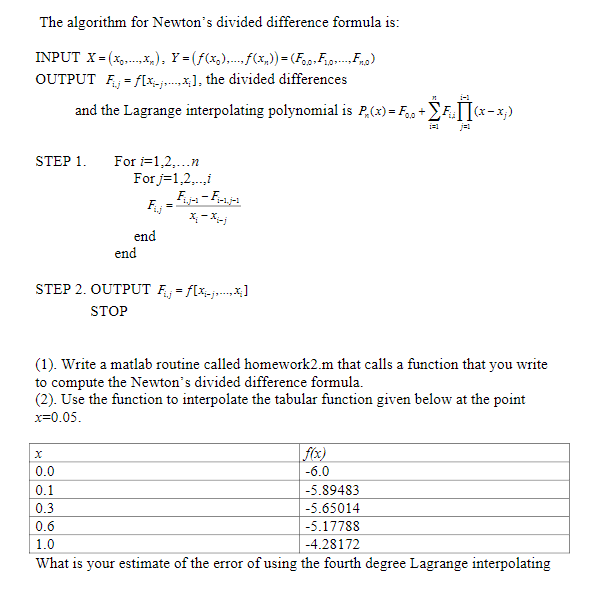
Question: The algorithm for Newton's divided difference formula is: INPUT X = (XO....X.), Y = f(x),...,f(x)) = (F.,F...,Fre) OUTPUT F.; = f[x:-;,X], the divided differences and
![(XO....X.), Y = f(x),...,f(x)) = (F.,F...,Fre) OUTPUT F.; = f[x:-;,X], the divided](https://dsd5zvtm8ll6.cloudfront.net/si.experts.images/questions/2024/09/66f39c082998e_22366f39c07c97e5.jpg)
The algorithm for Newton's divided difference formula is: INPUT X = (XO....X.), Y = f(x),...,f(x)) = (F.,F...,Fre) OUTPUT F.; = f[x:-;,X], the divided differences and the Lagrange interpolating polynomial is P. (x)= F. + [] (x-x;) -$41]6-3) STEP 1. For i=1,2,...n For j=1,2..., F end end STEP 2. OUTPUT F, = f[x-jo...,*] STOP (1). Write a matlab routine called homework2.m that calls a function that you write to compute the Newton's divided difference formula. (2). Use the function to interpolate the tabular function given below at the point x=0.05. X f(x) 0.0 -6.0 0.1 -5.89483 0.3 -5.65014 0.6 -5.17788 1.0 -4.28172 What is your estimate of the error of using the fourth degree Lagrange interpolating polynomial? Justify your answer. (3) Add the point x=1.1, f(1.1)=-3.99583 to the table, and construct the interpolating polynomial of degree 5. Evaluate the Lagrange polynomial at x=1.05. What is your estimate of the error? Justify your
Step by Step Solution
There are 3 Steps involved in it

Get step-by-step solutions from verified subject matter experts
 Study Help