







Question: The analysis should answer the following three main questions from the case itself: Q1) What are the business challenges/troubles that faced the company (T.B)? and
The analysis should answer the following three main questions from the case itself: Q1) What are the business challenges/troubles that faced the company (T.B)? and what are the root causes for these problems? Q2) How the decision-makers responded to the business challenges? And what was the implementation strategy that has been taken to implement an ERP system? Q3) What are the gained benefits after implementing of ERP system for T.B?
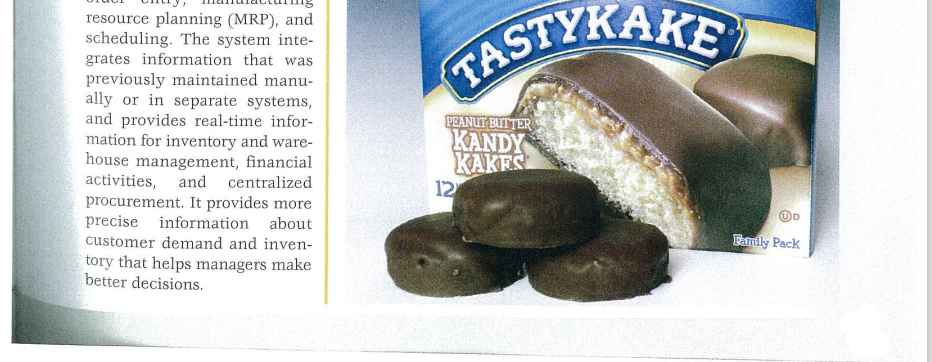
TASTY BAKING COMPANY: AN ENTERPRISE SYSTEM TRANSFORMS AN OLD FAVORITE T asty Baking Company's name says it all. It is known for its Tastykake single-portion cupcakes, snack pies, cookies, and donuts, which are pre-wrapped fresh at its bakery and sold through approximately 15,500 convenience stores and supermarkets in the eastern United States. The Philadelphia-based company, which sold $28 in cakes its first day of business in 1914, rang up nearly $170 million in sales in 2007. Although Tasty Baking Company made customers smile, management and stockholders were frowning, Tasty is a fairly small enterprise in a maturing business, and saw its market share and sales dropping in the mid-1990s. In 2002, profitability levels were at an all-time low, with a -4.9 percent operating margin. To turn the company around, Tasty's new president and CEO Charles Pizzi introduced a new management team and strategic transformation plan. The strategy required new manufacturing methods and new information systems. Tasty's existing systems were technically challenged, inflexible, and posed serious compliance and other business risks. Many key processes were traditional and heavily manual, and the company did not have timely information for tracking manufacturing outputs and warehouse shipments. Tasty had to physically count all the items in its warehouses every day. Even so, inventory information was still inaccurate and out of date. Shipments were missed, and excess inventory had to be sold at a discount at bakery thrift stores. Tasty's market share and sales dropped while operating costs rose. Much of Tasty's information about sales and products comes from its network of sales distributors. Tasty needed to create better connections with its sales operation to receive this information as soon as it was available. Tasty's new management team decided to implement a new enterprise system using software from SAP designed specifically for the food and beverage industry. Consultants from SAP and Deloitte helped the company identify its business processes and figure out how to make them work with the SAP software. By limiting changes to the software and enforcing rigorous project management standards, the company was able to implement the new enterprise system on time and on budget in nine months. Tasty's SAP enterprise system uses a Microsoft SQL Server database and Windows operating system running on an Intel server. Tasty was willing to make many changes in its business processes to take maximum advan- tage of the enterprise software's capabilities. It adopted Deloitte's template of best practices for the food and beverage indus- try. Tasty implemented the SAP modules for financials, order entry, manufacturing resource planning (MRP), and OTYKAKO FASTYKAKE resource planning (MRP), and scheduling. The system inte- grates information that was previously maintained manu- ally or in separate systems, and provides real-time infor- mation for inventory and ware- house management, financial activities, and centralized procurement. It provides more precise information about customer demand and inven- tory that helps managers make better decisions. PEANUT BUTTER KANDY KAKES 12 DD Family Pack Since implementing SAP's enterprise system, Tasty's financial condition has become much healthier. The company has reduced inventory write-downs by 60 percent and price markdowns by 40 percent. Customer satisfaction has increased, as reflected in lower return rates and higher order fill rates. Tasty increased sales 11 percent without having to hire more staff. Sources: "Tasty Baking Company," and "Tasty Baking," www.mysap.com, accessed July 5, 2007 and Tasty Baking Company 10-K Annual Report filed March 12, 2008. asty Banking Company's problems with its inventory and work processes were too high because it did not have accurate and timely information to manage its inventory. Tasty also lost sales from missed shipments. The chapter-opening diagram calls attention to important points raised by this case and this chapter. Tasty's fresh-baked products have a fairly short shelf life. Key business processes were manual, preventing the company from knowing exactly what items had shipped and what items were in inventory. Management couldn't access the data rapidly enough for daily decision making and planning. Management could have chosen to add more employees or automate its existing business processes with newer technology. Instead, it decided to change many of its business processes to conform to industry-wide best practices and to implement an enterprise system. The enterprise system integrated financial, order entry, scheduling, and manufacturing information and made it more widely available throughout the company. Data on manufac- turing output and warehouse shipments are captured as soon as they are created. Instant availability of more timely and accurate information helps employees work more efficiently and helps managers make better decisionsStep by Step Solution
There are 3 Steps involved in it
1 Expert Approved Answer
Step: 1 Unlock

Question Has Been Solved by an Expert!
Get step-by-step solutions from verified subject matter experts
Step: 2 Unlock
Step: 3 Unlock
 Study Help