



Question: The answer to this problem is included in the image below; however, I am looking for a more detailed explanation of how the Time_unaffected and
The answer to this problem is included in the image below; however, I am looking for a more detailed explanation of how the Time_unaffected and Time_affected are calculated. Please be very clear in your explanation. Thank you!
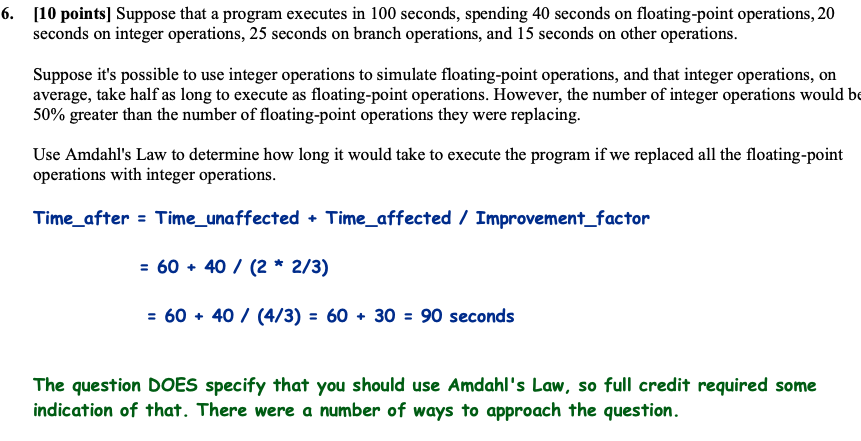
[10 points] Suppose that a program executes in 100 seconds, spending 40 seconds on floating-point operations, 20 seconds on integer operations, 25 seconds on branch operations, and 15 seconds on other operations.
Suppose it's possible to use integer operations to simulate floating-point operations, and that integer operations, on average, take half as long to execute as floating-point operations. However, the number of integer operations would be 50% greater than the number of floating-point operations they were replacing.
Use Amdahl's Law to determine how long it would take to execute the program if we replaced all the floating-point operations with integer operations.
Time_after = Time_unaffected + Time_affected / Improvement_factor = 60 + 40 / (2 * 2/3)
= 60 + 40 / (4/3) = 60 + 30 = 90 seconds
The question DOES specify that you should use Amdahl's Law, so full credit required some indication of that. There were a number of ways to approach the question.
6. [10 points] Suppose that a program executes in 100 seconds, spending 40 seconds on floating-point operations, 20 seconds on integer operations, 25 seconds on branch operations, and 15 seconds on other operations. Suppose it's possible to use integer operations to simulate floating-point operations, and that integer operations, on average, take half as long to execute as floating-point operations. However, the number of integer operations would be 50% greater than the number of floating-point operations they were replacing. Use Amdahl's Law to determine how long it would take to execute the program if we replaced all the floating-point operations with integer operations. Time_after = Time_unaffected + Time_affected / Improvement_factor = 60 + 40 / (2 * 2/3) = 60 + 40 / (4/3) = 60 + 30 = 90 seconds The question DOES specify that you should use Amdahl's Law, so full credit required some indication of that. There were a number of ways to approach the question. 6. [10 points] Suppose that a program executes in 100 seconds, spending 40 seconds on floating-point operations, 20 seconds on integer operations, 25 seconds on branch operations, and 15 seconds on other operations. Suppose it's possible to use integer operations to simulate floating-point operations, and that integer operations, on average, take half as long to execute as floating-point operations. However, the number of integer operations would be 50% greater than the number of floating-point operations they were replacing. Use Amdahl's Law to determine how long it would take to execute the program if we replaced all the floating-point operations with integer operations. Time_after = Time_unaffected + Time_affected / Improvement_factor = 60 + 40 / (2 * 2/3) = 60 + 40 / (4/3) = 60 + 30 = 90 seconds The question DOES specify that you should use Amdahl's Law, so full credit required some indication of that. There were a number of ways to approach the
Step by Step Solution
There are 3 Steps involved in it

Get step-by-step solutions from verified subject matter experts