







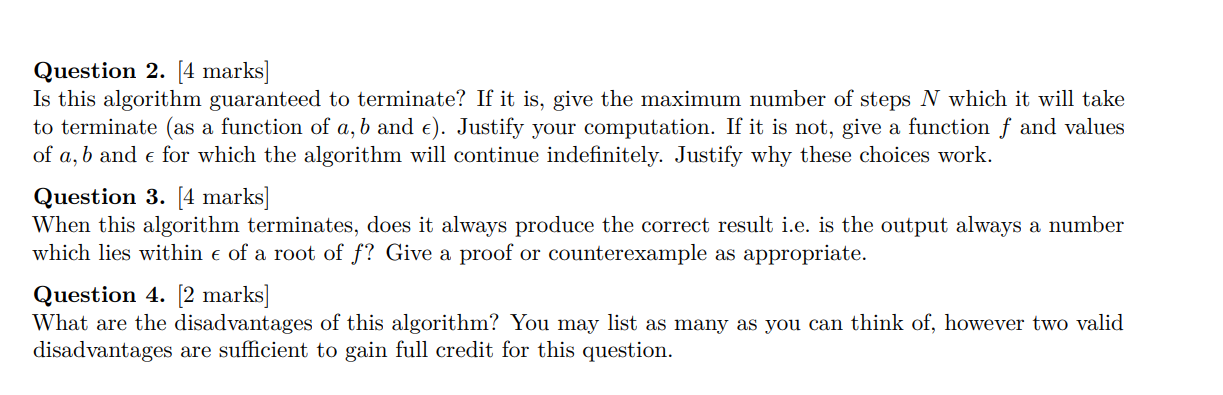
Question: The bisection method is an algorithm for solving the equation f(1) = 0, where f: R+R is a continuous function. Suppose that there exist two
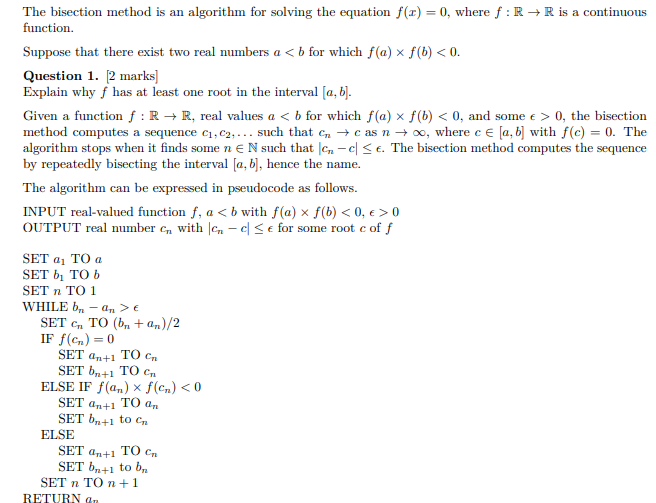
The bisection method is an algorithm for solving the equation f(1) = 0, where f: R+R is a continuous function. Suppose that there exist two real numbers a 0, the bisection method computes a sequence C1,C2, ... such that + c as n +, where ce [a, b] with f(c) = 0. The algorithm stops when it finds some n e N such that C-cl <. the bisection method computes sequence by repeatedly bisecting interval b hence name. algorithm can be expressed in pseudocode as follows. input real-valued function f a with> 0 OUTPUT real number 4, with an - Se for some root c off SET Q, TO SET b TO 6 SET n TO 1 WHILE bn SET C TO (Or+an)/2 IF f(n) = 0 -an>E SET an+1 TO CR SET bru+1 TOC ELSE IF f(ar) x f(en) 0, the bisection method computes a sequence C1,C2, ... such that + c as n +, where ce [a, b] with f(c) = 0. The algorithm stops when it finds some n e N such that C-cl <. the bisection method computes sequence by repeatedly bisecting interval b hence name. algorithm can be expressed in pseudocode as follows. input real-valued function f a with> 0 OUTPUT real number 4, with an - Se for some root c off SET Q, TO SET b TO 6 SET n TO 1 WHILE bn SET C TO (Or+an)/2 IF f(n) = 0 -an>E SET an+1 TO CR SET bru+1 TOC ELSE IF f(ar) x f(en)
Step by Step Solution
There are 3 Steps involved in it

Get step-by-step solutions from verified subject matter experts
 Study Help