Question: The Changing Job Market Please read the example The Changing Job Market on p. 332. In your initial post, please answer the following questions: 1-
The Changing Job Market
Please read the example "The Changing Job Market" on p. 332. In your initial post, please answer the following questions:
1- What types of skills are necessary for the gig economy?
2- Do you believe the gig economy to be a good thing? Why or why not?
3- Would you prefer to be a contract work or to be an employee? Explain
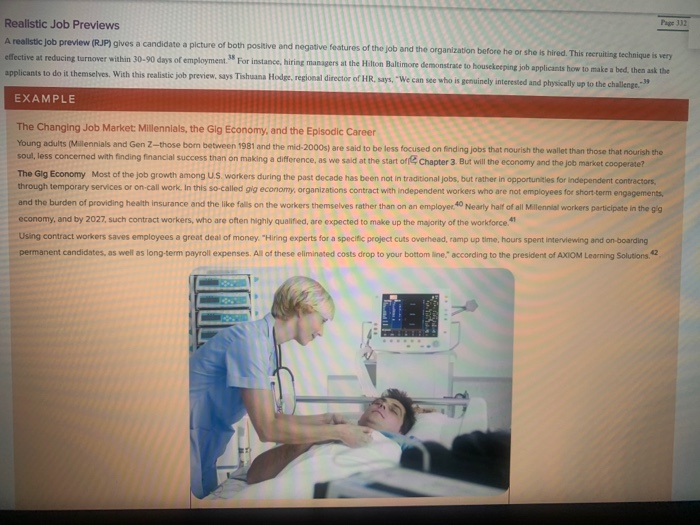
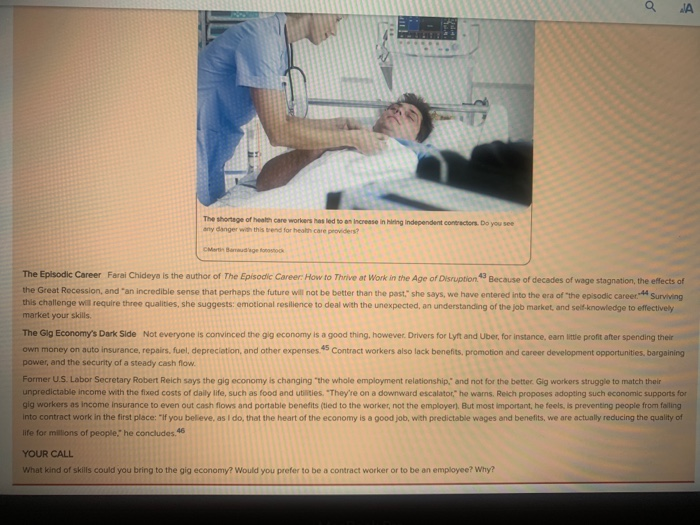
Page 32 Realistic Job Previews A realistic job preview (R.JP) gives a candidate a picture of both positive and negative features of the job and the organization before he or she is hired. This recruiting technique is very effective at reducing turnover within 30-90 days of employment. For instance, hiring managers at the Hilton Baltimore demonstrate to housekeeping job applicants how to make a bed, then ask the applicants to do it themselves. With this realistic job preview, says Tishuana Hodge, regional director of HR, says, "We can see who is genuinely interested and physically up to the challenge." EXAMPLE The Changing Job Market: Millennials, the Gig Economy, and the Episodic Career Young adults (Millennials and Gen 2-those bom between 1981 and the mid-2000s) are said to be less focused on finding jobs that nourish the wallet than those that nourish the soul, less concerned with finding financial success than on making a difference, as we said at the start of Chapter 3. But will the economy and the job market cooperate? The Gig Economy Most of the job growth among US workers during the past decade has been not in traditional jobs, but rather in opportunities for independent contractors, through temporary services or on-call work. In this so-called gig economy, organizations contract with independent workers who are not employees for short-term engagements, and the burden of providing health insurance and the like falls on the workers themselves rather than on an employer. Nearly half of all Millennial workers participate in the glo 40 economy, and by 2027, such contract workers, who are often highly qualified, are expected to make up the majority of the workforce." Using contract workers saves employees a great deal of money. "Hiring experts for a specific project cuts overhead, ramp up time, hours spent interviewing and on-boarding permanent candidates, as well as long-term payroll expenses. All of these eliminated costs drop to your bottom line, according to the president of AXIOM Learning Solutions IA The shortage of health care workers has led to an increase in hining independent contractors. Do you see any danger with this trend for health care providers? CM Badge The Episodic Career Farai Chideya is the author of The Episodic Career: How to Thrive at Work in the Age of Disruption. Because of decades of wage stagnation, the effects of 43 the Great Recession, and an incredible sense that perhaps the future will not be better than the past," she says, we have entered into the era of "the episodic career. 44 Surviving this challenge will require three qualities, she suggests: emotional resilience to deal with the unexpected, an understanding of the job market, and self-knowledge to effectively market your skills The Gig Economy's Dark Side Not everyone is convinced the gig economy is a good thing, however. Drivers for Lyft and Uber, for instance, earn little profit after spending their own money on auto insurance, repairs, fuel, depreciation, and other expenses.45 Contract workers also lack benefits, promotion and career development opportunities, bargaining power, and the security of a steady cash flow. Former U.S. Labor Secretary Robert Reich says the gig economy is changing the whole employment relationship, and not for the better. Gig workers struggle to match their unpredictable income with the fixed costs of daily life, such as food and utilities. They're on a downward escalator" he warns. Reich proposes adopting such economic supports for gig workers as income Insurance to even out cash flows and portable benefits (tied to the worker, not the employer). But most important, he feels, is preventing people from falling Into contract work in the first place: "If you believe, as I do, that the heart of the economy is a good job, with predictable wages and benefits, we are actually reducing the quality of life for millions of people," he concludes. 46 YOUR CALL What kind of skills could you bring to the gig economy? Would you prefer to be a contract worker or to be an employee? Why









 Study Help