







Question: The code below gives the algorithm for Gaussian Elimination with scaled partial pivoting. Below the code, summarize what each block in the code is doing
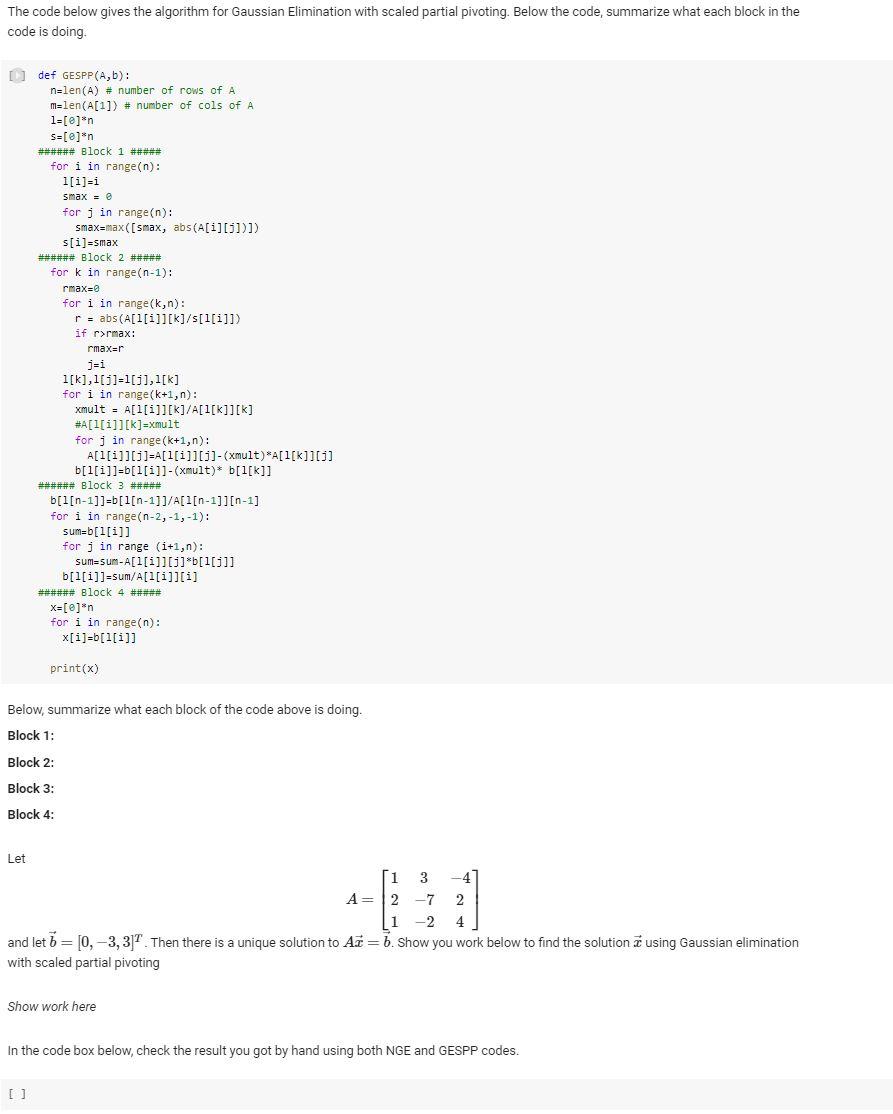
The code below gives the algorithm for Gaussian Elimination with scaled partial pivoting. Below the code, summarize what each block in the code is doing [] def GESPP(A,b): n=len(A) # number of rows of A m=len(A[1]) # number of cols of A 1=[@]*n S=[@]*n ###### Block 1 ##### for i in range(n): 1[i]=i smax = 0 for j in range(n): smax=max(smax, abs (A[i][5])]) s[i]=smax **#### Block 2 ##### for k in range(n-1): rmax=0 for i in range(k,n): r = abs(A[1[1]][k]/5[1[i]]) if r>rmax: rmax=r jui 1[k],[3)-1(31,1[k] for i in range(k+1,n): xmult = A[1[1]][k]/A[1[k]][k] #A[1[i]][k]=xmult for j in range(k+1,n): A[1[i]][j]=A[1[i]][j]-(xmult)*A[1[k]][j] b[1[i]]=b[1[1]]-(mult)* b[1[k]] ###### Block 3 ##### b[1[n-1]]=b[1[n-1]]/A[1 [n-1]] [n 1] for i in range(n-2,-1,-1): sum=b[1[1]] for j in range (i+1,n): Sum=sum-A[1[1]][j]*b[1[1]] b[1[i]]=sum/A[1[1]][i] ###### Block 4 ##### X=[@]*n for i in range(n): x[i]=b[1[1]] print(x) Below, summarize what each block of the code above is doing. Block 1: Block 2: Block 3: Block 4: Let 1 3 -4 A=2 -7 2 (1 -2 4 and let = [0,-3, 3] Then there is a unique solution to Az = b. Show you work below to find the solution 7 using Gaussian elimination with scaled partial pivoting Show work here In the code box below, check the result you got by hand using both NGE and GESPP codes. The code below gives the algorithm for Gaussian Elimination with scaled partial pivoting. Below the code, summarize what each block in the code is doing [] def GESPP(A,b): n=len(A) # number of rows of A m=len(A[1]) # number of cols of A 1=[@]*n S=[@]*n ###### Block 1 ##### for i in range(n): 1[i]=i smax = 0 for j in range(n): smax=max(smax, abs (A[i][5])]) s[i]=smax **#### Block 2 ##### for k in range(n-1): rmax=0 for i in range(k,n): r = abs(A[1[1]][k]/5[1[i]]) if r>rmax: rmax=r jui 1[k],[3)-1(31,1[k] for i in range(k+1,n): xmult = A[1[1]][k]/A[1[k]][k] #A[1[i]][k]=xmult for j in range(k+1,n): A[1[i]][j]=A[1[i]][j]-(xmult)*A[1[k]][j] b[1[i]]=b[1[1]]-(mult)* b[1[k]] ###### Block 3 ##### b[1[n-1]]=b[1[n-1]]/A[1 [n-1]] [n 1] for i in range(n-2,-1,-1): sum=b[1[1]] for j in range (i+1,n): Sum=sum-A[1[1]][j]*b[1[1]] b[1[i]]=sum/A[1[1]][i] ###### Block 4 ##### X=[@]*n for i in range(n): x[i]=b[1[1]] print(x) Below, summarize what each block of the code above is doing. Block 1: Block 2: Block 3: Block 4: Let 1 3 -4 A=2 -7 2 (1 -2 4 and let = [0,-3, 3] Then there is a unique solution to Az = b. Show you work below to find the solution 7 using Gaussian elimination with scaled partial pivoting Show work here In the code box below, check the result you got by hand using both NGE and GESPP codes
Step by Step Solution
There are 3 Steps involved in it

Get step-by-step solutions from verified subject matter experts
 Study Help