







Question: THE CODE TO BE MODIFIED: #include #include #include #include using namespace std; int gravder(double x[], double t, double par[], double deriv[]); int rk4(double q[], double
THE CODE TO BE MODIFIED:
#include
#include
#include
#include
using namespace std;
int gravder(double x[], double t, double par[], double deriv[]);
int rk4(double q[], double t, double dt,
int (*derfunc)(double q[], double t, double par[], double deriv[]),
double par[]);
int gravder(double q[], double t, double par[], double deriv[]){
// deriv = dq/dt -- for the first two elements it is
// the velocity and the second two it's the force.
// par is a 1-d array where par[0] is GM
// t is not really needed but we include it so that
// we can use this with our general rk4 function.
deriv[0] = q[2]; //derivative of x = v_x
deriv[1] = q[3];
// the next two lines are the only different things
// for N2L problems.
deriv[2] = - par[0] * q[0]/pow(sqrt( q[0]* q[0] + q[1]*q[1]),3);
deriv[3] = - par[0] * q[1]/pow(sqrt( q[0]* q[0] + q[1]*q[1]),3);
return 0;
}
int rk4(double q[], double t, double dt,
int (*derfunc)(double q[], double t, double par[], double deriv[]),
double par[]){
double t12;
double qtmp[4];
double k1[4], k2[4], k3[4], k4[4];
int c1,c2,c3,c4;
/* First eval k1 */
c1 = derfunc(q,t,par,k1); // k1 = derfunc(q,t)
t12 = t + dt/2.;
for(int n=0;n
qtmp[n] = q[n] + k1[n]*dt/2.;
}
/* Now k2 */
c2 = derfunc(qtmp,t12,par,k2);
for(int n=0;n
qtmp[n] = q[n] + k2[n]*dt/2.;
}
/* Now k3 */
c3 = derfunc(qtmp,t12,par,k3);
for(int n=0;n
qtmp[n] = q[n] + k3[n]*dt;
}
t12 = t + dt;
/* Now k4 */
// c4 = derfunc(qtmp,t + dt,par,k4);
c4 = derfunc(qtmp,t12,par,k4);
for(int n=0;n
q[n] += (k1[n] + 2.*k2[n] + 2.*k3[n] + k4[n])*dt/6.0;
}
return c1+c2+c3+c4;
}
int main(int argc, char *argv[]){
double q[4]; // defines an array of length 4
// all arrays in C++ start counting at 0
double dt = 0.001, t = 0.0;
double tol = 1e-4;
double pi = acos(-1.0);
double GM = 4. * pi * pi;
double par[1];// array of parameters
int rval;
int nsteps= 30000; /* Should give three orbits*/
double energy;
ofstream fp;
double ell;
//int result = -1;
par[0] = GM;
// for(int i=0;i
// cout
// }
// return -2;
if(argc
cout
cout
cout
return -1;
//also fine if result were declared: return result;
}
else{
// atof(bbb) converts the string bbb to a floating-point number
// atoi(iii) converts the string iii to an integer
q[0] = atof(argv[1]); // 1.0;// x
q[1] = atof(argv[2]); // 0.0;// y
q[2] = atof(argv[3]); // 0.0;// x vel
q[3] = atof(argv[4]); // sqrt(GM);// y vel
}
fp.open("orbit_rk4.dat");
double kinetic = 0.5*(q[2]*q[2] + q[3]*q[3]);
double potential = - GM/sqrt(q[0]*q[0] + q[1]*q[1]);
energy = kinetic + potential;
ell = q[0]*q[3] - q[1]*q[2];
cout
fp
for(int i = 0 ; i
t = i*dt;
rval = rk4(q, t, dt, gravder, par);
kinetic = 0.5*(q[2]*q[2] + q[3]*q[3]);
potential = - GM/sqrt(q[0]*q[0] + q[1]*q[1]);
ell = q[0]*q[3] - q[1]*q[2];
energy = kinetic + potential;
// cout
fp
}
fp.close();
/*Plot orbit*/
FILE *gnuplot = popen("gnuplot", "w");
fprintf(gnuplot,"set out 'orbit_rk4.ps' ");
fprintf(gnuplot, "set term post land ");
fprintf(gnuplot, "plot 'orbit_rk4.dat' u 2:3 w l ");
fprintf(gnuplot, "plot 'orbit_rk4.dat' u 1:7 w l ");
pclose(gnuplot);
/*Plot energy*/
gnuplot = popen("gnuplot", "w");
fprintf(gnuplot,"set out 'orbit_energy_rk4.ps' ");
fprintf(gnuplot, "set term post land ");
fprintf(gnuplot, "plot 'orbit_rk4.dat' u 1:4 w l, 'orbit_rk4.dat' u 1:5 w l, 'orbit_rk4.dat' u 1:6 w l ");
pclose(gnuplot);
system((char *)"ps2pdf orbit_energy_rk4.ps");
system((char *)"ps2pdf orbit_rk4.ps");
return rval; //rval here is always 0.
}
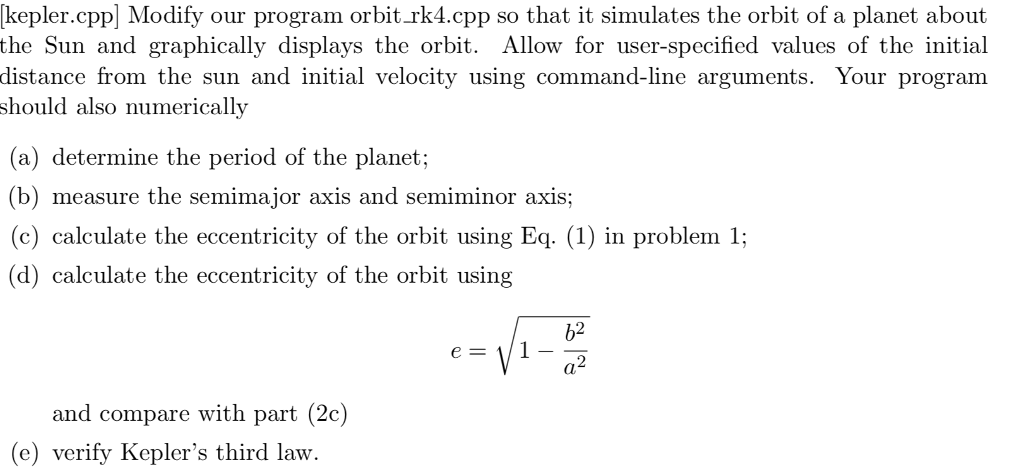
kepler.cppl Modify our program orbit.rk4.cpp so that it simulates the orbit of a planet about the Sun and graphically displays the orbit. Allow for user-specified values of the initial distance from the sun and initial velocity using command-line arguments. Your program should also numerically (a) determine the period of the planet; (b) measure the semimajor axis and semiminor axis; (c) calculate the eccentricity of the orbit using Eq. (1) in problem 1 (d) calculate the eccentricity of the orbit using 62 and compare with part (2c) (e) verify Kepler's third law
Step by Step Solution
There are 3 Steps involved in it

Get step-by-step solutions from verified subject matter experts
 Study Help