



Question: The controller of Keystone Computers & Networks, Inc. (Keystone), a nonissuer, prepared six exhibits relating to Keystones General Account cash position at year 5 year-end.
The controller of Keystone Computers & Networks, Inc. (Keystone), a nonissuer, prepared six exhibits relating to Keystones General Account cash position at year 5 year-end. A new audit assistant with your CPA firm has begun the audit of cash but has questions and comments based on a quick examination of the exhibits, now included in the working papers, and a discussion of some matters with the controller of Keystone.
Your job as senior on the engagement is to review the various points made by the assistant, including a review of the six exhibits.
Required:
A. For each of the eight points made by the audit assistant, indicate the appropriate conclusion from the callout options listed and explain why. The callout options replace the highlighted phrase in each point.
B. For each of the eight points (you may combine points 5-7) made by the audit assistant, indicate what substantive audit procedure was most likely performed and its purpose.
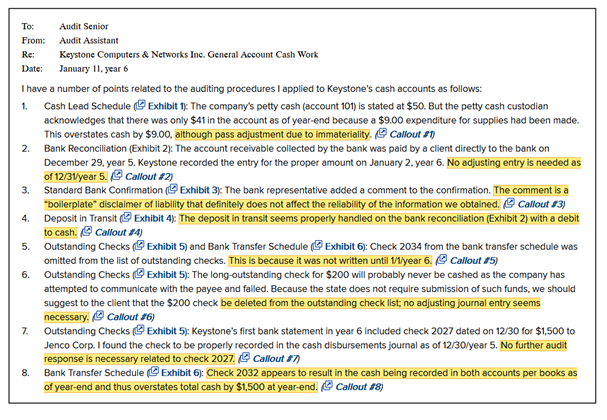
To: From: Re: Date: 3. Audit Senior Audit Assistant Keystone Computers & Networks Inc. General Account Cash Work January 11 year 6 I have a number of points related to the auditing procedures I applied to Keystone's cash accounts as follows: 1. Cash Lead Schedule Exhibit T): The company's petty cash (account 101) is stated at $50. But the petty cash custodian acknowledges that there was only $41 in the account as of year-end because a $9.00 expenditure for supplies had been made. This overstates cash by $9.00, although pass adjustment due to immateriality. Callout 1 2. Bank Reconciliation (Exhibit 2): The account receivable collected by the bank was paid by a client directly to the bank on December 29. year 5. Keystone recorded the entry for the proper amount on January 2. year 6. No adjusting entry is needed as of 12/31year 5. Callout 12) Standard Bank Confirmation Exhibit 3): The bank representative added a comment to the confirmation. The comment is a *boilerplate" disclaimer of liability that definitely does not affect the reliability of the information we obtained. Callout 13) Deposit in Transit Exhibit 4: The deposit in transit seems properly handled on the bank reconciliation (Exhibit 2) with a debit to cash. Callout 14) 5. Outstanding Checks Exhibit 5) and Bank Transfer Schedule Exhibit 6): Check 2034 from the bank transfer schedule was omitted from the list of outstanding checks. This is because it was not written until 11year 6. Callout 45) Outstanding Checks Exhibit 5): The long-outstanding check for $200 will probably never be cashed as the company has attempted to communicate with the payee and failed. Because the state does not require submission of such funds, we should suggest to the client that the $200 check be deleted from the outstanding check list; no adjusting journal entry seems necessary. Callout 16) Outstanding Checks Exhibit 5): Keystone's first bank statement in year 6 included check 2027 dated on 12/30 for $1,500 to Jenco Corp. I found the check to be properly recorded in the cash disbursements journal as of 12/30/year 5. No further audit response is necessary related to check 2027. Callout 57 Bank Transfer Schedule Exhibit 6): Check 2032 appears to result in the cash being recorded in both accounts per books as of year-end and thus overstates total cash by $1.500 at year-end. Callout 48) 4. 6. 7. 8. To: From: Re: Date: 3. Audit Senior Audit Assistant Keystone Computers & Networks Inc. General Account Cash Work January 11 year 6 I have a number of points related to the auditing procedures I applied to Keystone's cash accounts as follows: 1. Cash Lead Schedule Exhibit T): The company's petty cash (account 101) is stated at $50. But the petty cash custodian acknowledges that there was only $41 in the account as of year-end because a $9.00 expenditure for supplies had been made. This overstates cash by $9.00, although pass adjustment due to immateriality. Callout 1 2. Bank Reconciliation (Exhibit 2): The account receivable collected by the bank was paid by a client directly to the bank on December 29. year 5. Keystone recorded the entry for the proper amount on January 2. year 6. No adjusting entry is needed as of 12/31year 5. Callout 12) Standard Bank Confirmation Exhibit 3): The bank representative added a comment to the confirmation. The comment is a *boilerplate" disclaimer of liability that definitely does not affect the reliability of the information we obtained. Callout 13) Deposit in Transit Exhibit 4: The deposit in transit seems properly handled on the bank reconciliation (Exhibit 2) with a debit to cash. Callout 14) 5. Outstanding Checks Exhibit 5) and Bank Transfer Schedule Exhibit 6): Check 2034 from the bank transfer schedule was omitted from the list of outstanding checks. This is because it was not written until 11year 6. Callout 45) Outstanding Checks Exhibit 5): The long-outstanding check for $200 will probably never be cashed as the company has attempted to communicate with the payee and failed. Because the state does not require submission of such funds, we should suggest to the client that the $200 check be deleted from the outstanding check list; no adjusting journal entry seems necessary. Callout 16) Outstanding Checks Exhibit 5): Keystone's first bank statement in year 6 included check 2027 dated on 12/30 for $1,500 to Jenco Corp. I found the check to be properly recorded in the cash disbursements journal as of 12/30/year 5. No further audit response is necessary related to check 2027. Callout 57 Bank Transfer Schedule Exhibit 6): Check 2032 appears to result in the cash being recorded in both accounts per books as of year-end and thus overstates total cash by $1.500 at year-end. Callout 48) 4. 6. 7. 8
Step by Step Solution
There are 3 Steps involved in it

Get step-by-step solutions from verified subject matter experts