







Question: The current Chegg ans is incorrect, so please don't copy that ans to solve this problem. Thanks! :) As a consultant you are asked to
The current Chegg ans is incorrect, so please don't copy that ans to solve this problem. Thanks! :)
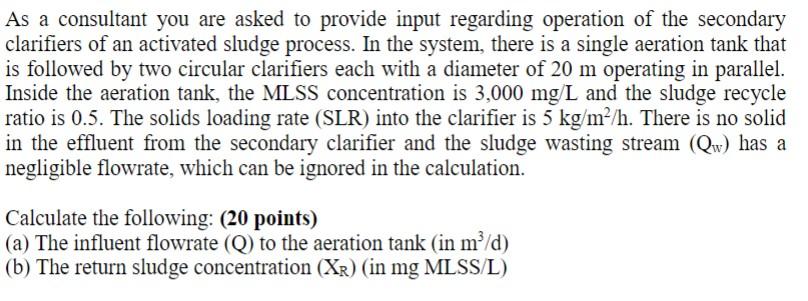
As a consultant you are asked to provide input regarding operation of the secondary clarifiers of an activated sludge process. In the system, there is a single aeration tank that is followed by two circular clarifiers each with a diameter of 20 m operating in parallel. Inside the aeration tank, the MLSS concentration is 3,000 mg/L and the sludge recycle ratio is 0.5. The solids loading rate (SLR) into the clarifier is 5 kg/m/h. There is no solid in the effluent from the secondary clarifier and the sludge wasting stream (Qw) has a negligible flowrate, which can be ignored in the calculation. Calculate the following: (20 points) (a) The influent flowrate (Q) to the aeration tank (in m/d) (b) The return sludge concentration (XR) (in mg MLSS/L) As a consultant you are asked to provide input regarding operation of the secondary clarifiers of an activated sludge process. In the system, there is a single aeration tank that is followed by two circular clarifiers each with a diameter of 20 m operating in parallel. Inside the aeration tank, the MLSS concentration is 3,000 mg/L and the sludge recycle ratio is 0.5. The solids loading rate (SLR) into the clarifier is 5 kg/m/h. There is no solid in the effluent from the secondary clarifier and the sludge wasting stream (Qw) has a negligible flowrate, which can be ignored in the calculation. Calculate the following: (20 points) (a) The influent flowrate (Q) to the aeration tank (in m/d) (b) The return sludge concentration (XR) (in mg MLSS/L)
Step by Step Solution
There are 3 Steps involved in it

Get step-by-step solutions from verified subject matter experts
 Study Help