



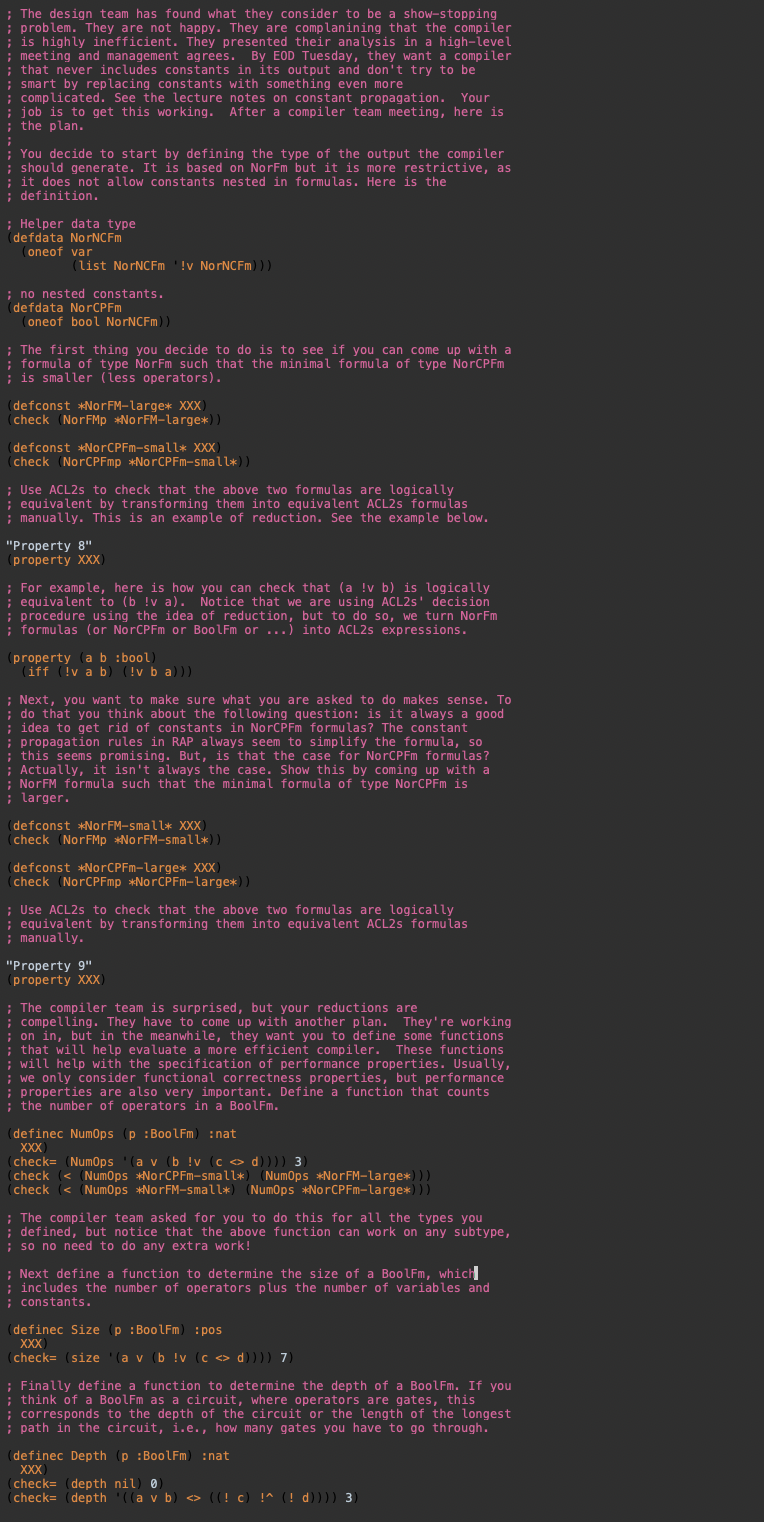
Question: ; The design team has found what they consider to be a show - stopping ; problem. They are not happy. They are complanining that
; The design team has found what they consider to be a showstopping
; problem. They are not happy. They are complanining that the compiler
; is highly inefficient. They presented their analysis in a highlevel
; meeting and management agrees. By EOD Tuesday, they want a compiler
; that never includes constants in its output and don't try to be
; smart by replacing constants with something even more
; complicated. See the lecture notes on constant propagation. Your
; job is to get this working. After a compiler team meeting, here is
; the plan.
;
; You decide to start by defining the type of the output the compiler
; should generate. It is based on NorFm but it is more restrictive, as
; it does not allow constants nested in formulas. Here is the
; definition.
; Helper data type
defdata NorNCFm
oneof var
list NorNCFm v NorNCFm
; no nested constants.
defdata NorCPFm
oneof bool NorNCFm
; The first thing you decide to do is to see if you can come up with a
; formula of type NorFm such that the minimal formula of type NorCPFm
; is smaller less operators
defconst NorFMlarge XXX
check NorFMp NorFMlarge
defconst NorCPFmsmall XXX
check NorCPFmp NorCPFmsmall
; Use ACLs to check that the above two formulas are logically
; equivalent by transforming them into equivalent ACLs formulas
; manually. This is an example of reduction. See the example below.
"Property
property XXX
; For example, here is how you can check that a v b
Step by Step Solution
There are 3 Steps involved in it
1 Expert Approved Answer
Step: 1 Unlock

Question Has Been Solved by an Expert!
Get step-by-step solutions from verified subject matter experts
Step: 2 Unlock
Step: 3 Unlock