



Question: The final task is to optimize the mixture of consulting jobs. Giannis places jobs into four different categories: Pharmaceutical, Transportation, Government, and Community. The below
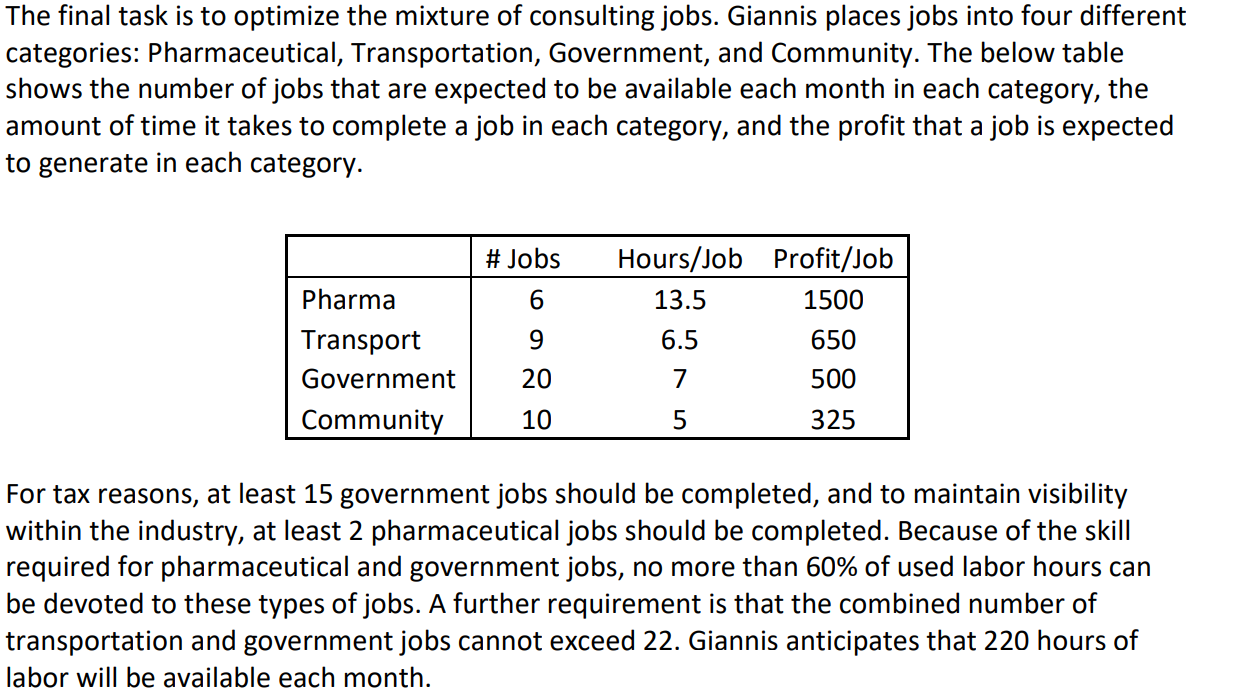
The final task is to optimize the mixture of consulting jobs. Giannis places jobs into four different categories: Pharmaceutical, Transportation, Government, and Community. The below table shows the number of jobs that are expected to be available each month in each category, the amount of time it takes to complete a job in each category, and the profit that a job is expected to generate in each category. For tax reasons, at least 15 government jobs should be completed, and to maintain visibility within the industry, at least 2 pharmaceutical jobs should be completed. Because of the skill required for pharmaceutical and government jobs, no more than 60% of used labor hours can be devoted to these types of jobs. A further requirement is that the combined number of transportation and government jobs cannot exceed 22. Giannis anticipates that 220 hours of labor will be available each month. 4) Develop a linear programming model that will determine how many jobs to complete in each category each month. Non-integer solutions are okay - do not force the optimal variable values to be integers. a) How many jobs should be completed in each category? b) An advisor has suggested that an increase to the amount of available labor would be a good idea. All else being the same, is this suggestion good? Why or why not? c) The advisor also suggested that, since Pharma has the highest profit per job, it would be in our interest to find more Pharma jobs (i.e., to increase the number of available Pharma jobs from 6 to something higher). All else being the same, is this suggestion good? Why or why not
Step by Step Solution
There are 3 Steps involved in it

Get step-by-step solutions from verified subject matter experts