







Question: The following Lineweaver-Burk plot was generated from data regarding the activity of a wild-type (native, non-mutant) enzyme called EPSPS that is involved in plant metabolism.
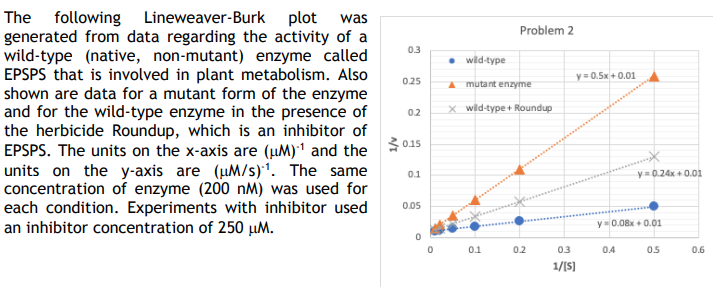
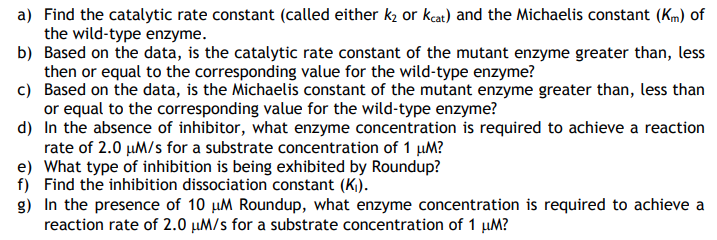
The following Lineweaver-Burk plot was generated from data regarding the activity of a wild-type (native, non-mutant) enzyme called EPSPS that is involved in plant metabolism. Also shown are data for a mutant form of the enzyme and for the wild-type enzyme in the presence of the herbicide Roundup, which is an inhibitor of EPSPS. The units on the x-axis are (M)1 and the units on the y-axis are (M/s)1. The same concentration of enzyme (200nM) was used for each condition. Experiments with inhibitor used an inhibitor concentration of 250M. a) Find the catalytic rate constant (called either k2 or kcat ) and the Michaelis constant (Km) of the wild-type enzyme. b) Based on the data, is the catalytic rate constant of the mutant enzyme greater than, less then or equal to the corresponding value for the wild-type enzyme? c) Based on the data, is the Michaelis constant of the mutant enzyme greater than, less than or equal to the corresponding value for the wild-type enzyme? d) In the absence of inhibitor, what enzyme concentration is required to achieve a reaction rate of 2.0M/s for a substrate concentration of 1M ? e) What type of inhibition is being exhibited by Roundup? f) Find the inhibition dissociation constant (K1). g) In the presence of 10M Roundup, what enzyme concentration is required to achieve a reaction rate of 2.0M/s for a substrate concentration of 1M
Step by Step Solution
There are 3 Steps involved in it

Get step-by-step solutions from verified subject matter experts
 Study Help