







Question: The following problem arises in image processing and compression. You are given a black and white digitized picture P in the form a of n
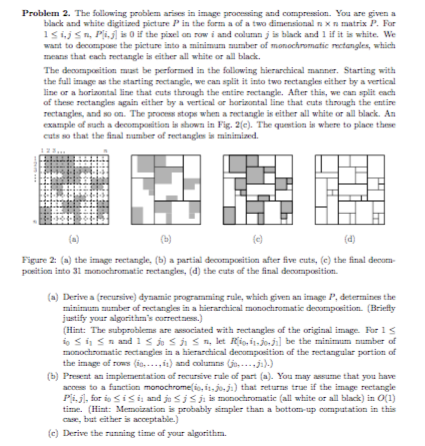
The following problem arises in image processing and compression. You are given a black and white digitized picture P in the form a of n two dimensional n x n matrix P. For 1 lesser than or equal to i, j lesser then or equal to n, p[i, j] in 0 if the pixel on row I and column j in black and 1 if it is white, We want to decompose the picture into a minimum number of monochromatic rectangles, which means that each rectangle is either all white or all black. The decomposition must be performed in the following hierarchical manner. Starting with the full image as the starting rectangle, we can split it into two rectangles either by a vertical line or a horizontal line that cuts through the entire rectangle. After this, we can split each of these rectangle again either by a vertical or horizontal line that cuts through the entire rectangle, and. The process stops when a rectangle is either all white or all black. An example of such decomposition is shown in fig. 2(c). The question is where to place their cuts no that the final number of rectangle is minimized. The following problem arises in image processing and compression. You are given a black and white digitized picture P in the form a of n two dimensional n x n matrix P. For 1 lesser than or equal to i, j lesser then or equal to n, p[i, j] in 0 if the pixel on row I and column j in black and 1 if it is white, We want to decompose the picture into a minimum number of monochromatic rectangles, which means that each rectangle is either all white or all black. The decomposition must be performed in the following hierarchical manner. Starting with the full image as the starting rectangle, we can split it into two rectangles either by a vertical line or a horizontal line that cuts through the entire rectangle. After this, we can split each of these rectangle again either by a vertical or horizontal line that cuts through the entire rectangle, and. The process stops when a rectangle is either all white or all black. An example of such decomposition is shown in fig. 2(c). The question is where to place their cuts no that the final number of rectangle is minimized
Step by Step Solution
There are 3 Steps involved in it

Get step-by-step solutions from verified subject matter experts
 Study Help